
Library
-
admin
- July 26, 2026
- 1
Library

 admin
admin
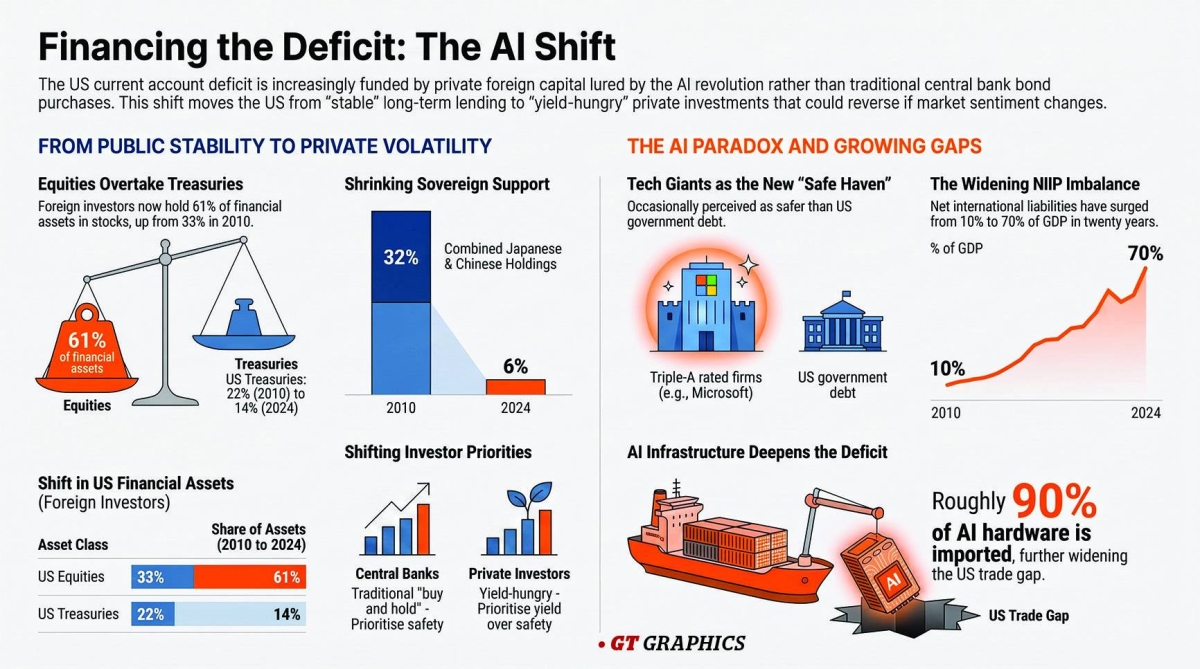
Foreign capital is flooding into Wall Street courtesy of the AI revolution. Paradoxically, however, this is intensifying the spotlight on America’s chronic external deficit. How long can this massive imbalance last? Investors around the world have poured trillions into the US stock market in recent years, lured by the juicy returns promised by the artificial intelligence boom, which has spurred the biggest capex spending spree in history. This flow of overseas money into US equities is now the key funding source for the US current account deficit, which has widened beyond pre-pandemic levels. America’s current account deficit represents the difference between the value of all the goods, services, interest, dividends, and income the US imports and what it exports. The US has been in deficit for decades. To fill that gap, foreigners must “lend” money to Uncle Sam by purchasing US assets. The Trump administration is striving to reduce that gap, especially the goods and services trade deficit, through a range of policies around immigration, domestic investment, and, of course, tariffs. It remains to be seen how successful those efforts will be. The trade gap has been hovering around 3% of GDP for the last few years, and the current account deficit is closer to 4% of GDP. These are big shortfalls in a $31 trillion economy. Attracting foreign capital to fill them is necessary to prevent the dollar from tumbling or bond yields from spiking. In theory, it doesn’t matter how the gaps are covered, just as long as they are. But some sources of capital may be preferable to others. Over the past 20 years, the composition of this funding mix has shifted - from the yield-insensitive “official” sector to return-hungry private investors - and that has arguably made America’s massive foreign liabilities look a lot more worrisome. In February 2005, then-Fed Chair Alan Greenspan noted a “conundrum”: US bond yields remained low despite a series of interest rate hikes. What could explain this? A month later, then-Fed Governor Ben Bernanke offered a potential answer. In a now famous speech, “The Global Savings Glut and the US Current Account Deficit,” Bernanke noted that emerging economies had, in a turnaround from previous decades, become a source of capital lending rather than borrowing. It was this flood of capital coming into the US, especially into the government bond market, that was suppressing interest rates. He had a point. In the decade leading up to the Global Financial Crisis, the US current account deficit was large, hitting a record 6% of GDP in 2006. This yawning deficit was financed by various sources of foreign wealth, whether from oil (“petrodollar” Gulf countries), trade surpluses (China, and much of Asia) or high levels of national savings (Japan). What all of these funding sources had in common was a thirst for US government debt, or Treasuries. Central banks were hoovering up Treasuries to keep their exchange rates competitive and build their foreign exchange buffers. Bernanke argued that this foreign demand for US debt delayed the reckoning that the widening global imbalances - the large US deficits and corresponding surpluses elsewhere - portended. While the day of reckoning may have appeared to come in 2007-08 in the form of the US subprime housing crisis, global credit crunch and Global Financial Crisis, these global imbalances are back. Now, though, the nature of US deficit financing has changed dramatically. The increasing integration of global financial markets in recent decades and loosening of capital controls in many emerging and developing economies have helped boost capital accumulation in the private sectors of these countries. These funds, in turn, have often found their way back into US financial assets as overseas investors have sought large, liquid markets and the prospect of high returns. As a result, private foreign capital has gradually replaced central bank capital as the primary funding source for the US current account deficit. Consider that in 2004, Japan’s official holdings of US Treasuries accounted for 18% of all outstanding US debt held by the public, and in 2010, China’s equivalent share represented 14%. These holdings have evaporated to less than 4% and just 2% today, respectively. Of course, overseas investors continue to buy Treasuries. Their total holdings stand at a record $9.4tn, more than half of which is now held by the private sector. But overall, foreigners now hold only 30% of all outstanding, publicly held US federal debt, compared to 50% in 2012. Foreign governments have gradually reduced exposure to US bonds for various reasons, including geopolitical, financial, and domestic economic considerations. Equities now hold more allure. In 2010, foreign investors held a third of their US financial assets in equities, and 22% in Treasuries. In the first quarter of this year, those shares stood at 61% and 14%, respectively. Foreign ownership of US stocks now stands at a record 18%, nearly double what it was in the mid-2000s. This shift could be a cause for concern. “Central banks tend to be ‘buy and hold’ investors to a large extent. Central banks typically care about safety, liquidity, then yield. In that order,” says Eswar Prasad, professor of economics at Cornell University. “For private investors, to some extent the order is flipped for them - they care about yield, liquidity and a little less about safety.” This isn’t an issue when Wall Street is booming. But it’s not difficult to imagine that dynamic suddenly turning, if Wall Street hits the skids or other markets suddenly look more attractive. Private capital flows could then slow, or worse, reverse, making America’s current account financing much more perilous. On the other hand, foreign investors may simply be onto something. It sounds counterintuitive, but by some measures, today’s US tech behemoths are just as “safe” an investment as Treasuries. Apple and Microsoft have a triple-A credit rating, unlike the US government, and the two-year yield on some corporate debt, like Microsoft bonds, is sometimes lower than the two-year Treasury yield. Moreover, some of the Big Tech firms are now so important to the US government from an economic, strategic and national security standpoint that it’s almost unthinkable that they would be allowed to fail. It’s not just private overseas sector capital that has been lured into Wall Street in recent years. Many central banks and sovereign wealth funds have increased exposures to trillion-dollar US megacaps like Apple, Microsoft and Nvidia. In essence, they’ve swapped the safety and liquidity of Treasuries for what many now consider the safety, if not the liquidity, of Big Tech. According to analysts at Deutsche Bank, the gap between increasing net flows into US stocks and slowing flows into US debt has never been wider. “The US fiscal position is weakening, while US corporate profitability is going from strength to strength,” they write, adding: “AI could accelerate these dynamics as companies get richer and the redistributive pressures on governments grow.” In fact, one unwelcome byproduct of the AI buildout may be a wider US current account deficit. A Fed paper this month found that investment-specific technology shocks are associated with a “persistent current account deterioration of roughly 10% relative to its historical average.” That is usually because imports surge as tech investment booms. This phenomenon threatens to be even more pronounced in the current AI investment frenzy because around 90% of the relevant equipment is imported from East Asia, the authors note. Fears about the US current account are nothing new, of course. If a crisis does eventually materialize, it won’t be out of the blue. It will come slowly over the horizon. It’s also good to remember that despite decades of warnings from deficit hawks about the imminent collapse of the US under its debt burdens, America is still the place to be for investors, and the dollar is still the undisputed global reserve currency. But the size of the imbalance is getting hard to ignore. Another way to look at the flood of capital coming into America is the country’s net international investment position (NIIP). This is essentially all US assets held by foreigners less all foreign assets held by Americans. This figure currently stands around $21tn, according to the Bureau of Economic Analysis, or around 70% of US GDP. Twenty years ago, that was closer to 10% of US GDP. Big numbers, big flows, and maybe one day, a big problem.
 admin
admin
There was a time, not so long ago, when a straightforward errand in Doha was measured not in minutes but in mornings. An attestation, a bank transfer, a specialist referral — each carried its own tax in patience, paid standing up. That this has changed so thoroughly, and with so little fanfare, is itself worth pausing over. The numbers tell a story of steady, unglamorous improvement. Hamad Medical Corporation, redesigning patient pathways across six clinics at Hamad General Hospital, cut average waiting times from 29 days to seven. MRI waits fell from around 75 days to roughly a fortnight. A fast-track system trimmed another service area by a third. At the Communicable Disease Centre, outpatient waits compressed from about seven weeks to two or three. The 2025 annual report records 75% of Qatari patients under one initiative seen within a fortnight, with an average wait of 15 days. None of these figures were achieved by a single grand announcement. They are the residue of process work — scheduling reviewed, capacity reallocated, referrals rerouted — the sort of endeavour that rarely makes a headline and almost never makes a ribbon-cutting. Scale makes the achievement more striking. The Primary Health Care Corporation recorded 5,169,998 visits in 2024, averaging more than 430,000 a month. Under that volume, 76% of patients were seen within 30 minutes. Virtual consultations accounted for 8% of the total. For a Doha resident such as Adele R, who told this newspaper her doctor now reviews test results and prescribes over the phone, leaving only a pharmacy collection, the gain is not abstract. It is a morning restored. Government services show the same pattern. Entities operating through Qatar’s integrated service centres completed 46,786 transactions in June alone, the Ministry of Foreign Affairs accounting for the largest share at 18,385, followed by the Ministry of Justice and the Ministry of Labour. The centres themselves embody the underlying principle: bring the counters to the citizen rather than sending the citizen from counter to counter. Document attestation, once the archetype of bureaucratic endurance, has been rebuilt around it. Applications submitted through Tawtheeq are reviewed within one working day; approval, payment, collection and delivery can be handled without an office visit. The ministry extended electronic attestation to police clearance certificates and government-school educational documents in October 2024, and in December opened the process to users abroad. Anyone who has assembled a file of certificates from another country will recognise how much friction that single change removes. Banking has followed. QNB’s queue-management function lets customers check waiting times, book an appointment or draw a ticket before leaving home — a modest feature that quietly transfers control from the institution to the customer. Its digital account-opening and remote transaction services do the rest. What connects these examples is not technology, which is available to everyone, but co-ordination — the willingness of separate institutions to share infrastructure and design around the person waiting rather than the desk serving. That is the harder part, and it is where Qatar’s digital-government strategy has earned its results. Candour is due on the remainder. Queues have not been abolished, nor should they be. Medical examinations, specialised consultations, biometrics, original-document verification and cases that genuinely need a human being across the desk will continue to require presence. The measure of success is not the elimination of the counter but the reservation of it for work that warrants it. That is the standard by which the next decade should be judged: not how many services move online, but whether the ones that stay physical are worth the journey. On present evidence, Qatar is asking the right question.
 admin
admin
There is a particular silence in a library that exists nowhere else. Not the silence of an empty room — that is only absence — but the populated hush of hundreds listening to something no one else can hear. Qatar National Library recorded 1.25mn visits last year, its highest since opening. A million and a quarter arrivals, hardly a sound. The numbers deserve their due: a database of nearly 70,000 Qatar-focused research records, more than 25,000 openly accessible; a repository past 10,000 items; 1,423 open-access articles funded for 809 authors; 3.1mn digital checkouts. They describe something real — the steady removal of cost, distance and permission from the path between a person and what they want to know. But no-one has ever loved a library for its throughput. What the figures cannot capture is the thing they exist to enable: one reader, one book, one afternoon that does not go as planned. Consider the smallest statistic. Children in the Family Reading Programme took home an average of 16 books each last year. Sixteen. Not a database — a stack carried out of a building by a child who chose them, wobbling slightly under the weight, already deciding which to open first. A reading habit formed at six is a companion for eighty years. This is what the shelves are for. A million titles is not a boast about warehousing; it is a promise that the improbable book is there. The novel nobody has borrowed since 2019. The volume you did not know existed until you saw its spine while looking for something else — which is, as every reader knows, how the important books arrive. Serendipity cannot be searched for. It must be walked past. The digital offer extends this rather than replacing it: the point was never paper, but access — and access has learned new manners. Institutions are measured by what they produce. Libraries should be measured by what they permit — the unsupervised hour, the unassigned book, the reader who came in for one thing and left carrying another. Somewhere in that 1.25mn is you, and the book you have not read yet.
 admin
admin
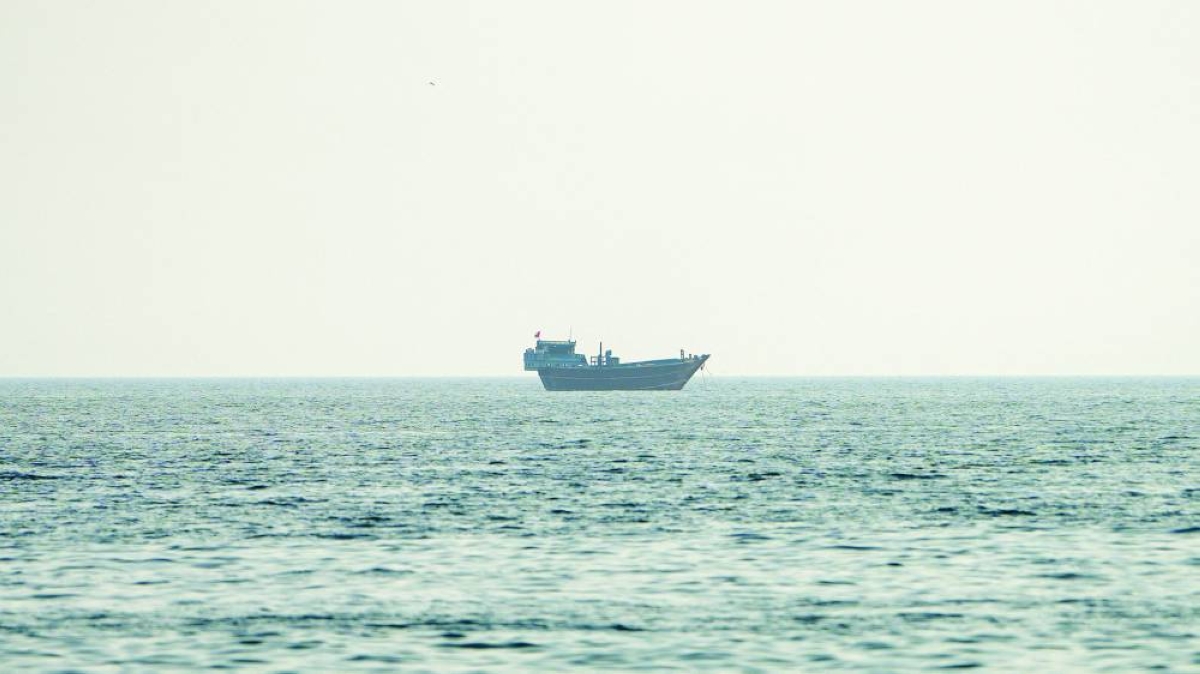
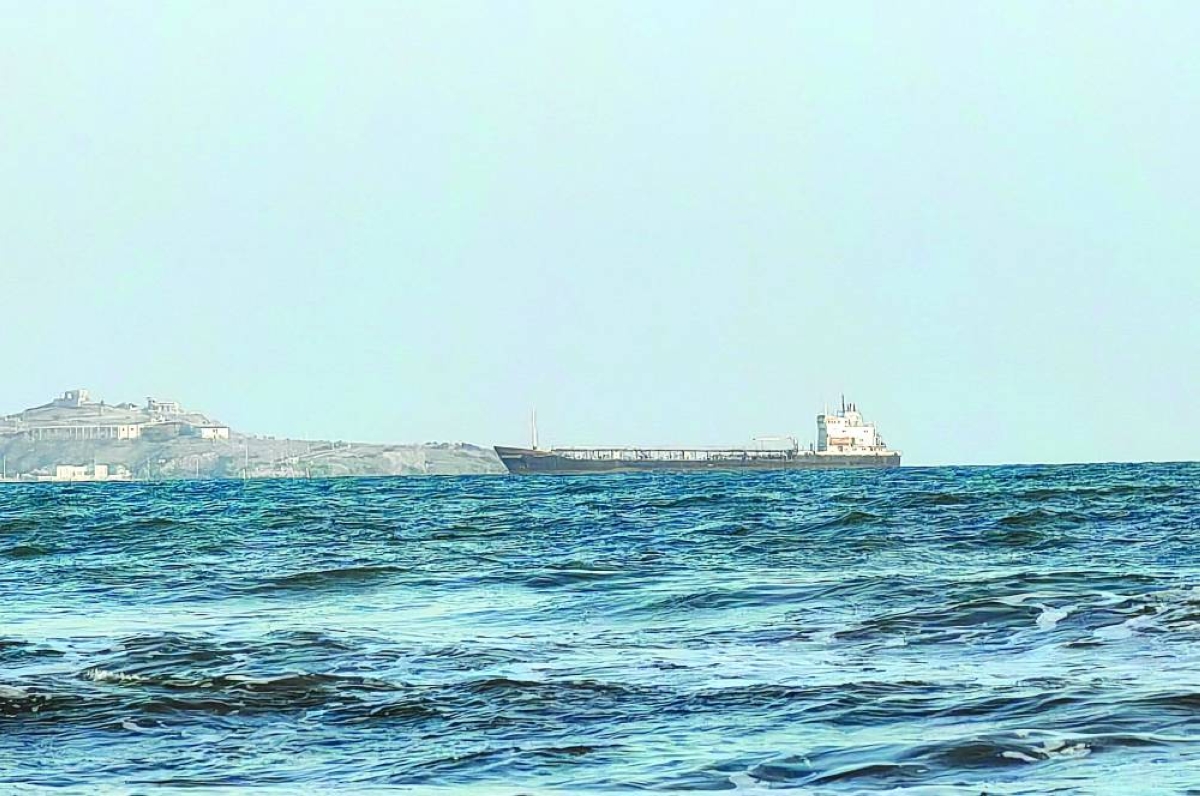
A vessel at the Strait of Hormuz, as seen from Musandam, Oman, on Thursday. (Reuters) Neither Washington nor Tehran wants the next world war. Both are making sure the world doesn’t notice that. Since the ceasefire that followed the February 28 war effectively collapsed, the United States and Iran have settled into something more calculated than chaos. Call it controlled escalation. Each side hits harder. Neither side wants to be blamed for starting round two. Look at the American side first. The strikes have widened well beyond military targets. Roads, bridges, power stations, industrial sites — all have been hit in the latest waves. There are unconfirmed reports of damage to desalination infrastructure too, a detail that deserves independent verification before anyone repeats it as fact. What Washington has conspicuously avoided is the Bushehr nuclear plant. That restraint is not sentimental. A leak into Gulf waters would poison the region for generations, and everyone in the Pentagon knows it. President Trump’s public posture has hardened with each American casualty. After Iranian strikes killed US service members in Jordan, he wrote on Truth Social that Iran would “pay for that killing many times over.” He said he had given that as a direct order to “every Leader in the Military.” The number of American dead since February has climbed past a dozen, with the latest round alone claiming several service members in Jordan. This is the American president’s most dangerous threshold. Not battlefield maps — coffins draped in flags arriving at Dover. Iran, for its part, has widened its own geography of retaliation to include Bahrain, Kuwait, and Jordan. The head of the Gulf Cooperation Council did not mince words, calling the strikes on civilian infrastructure in Kuwait and Jordan a “war crime” and a “highly dangerous escalation.” Notably, neither side appears interested in stepping back from that description. Iran’s calculus is different from Washington’s, but it points toward the same conclusion: keep the fire burning, don’t let it become an inferno. Tehran cannot sustain a full war lasting months. Its oil exports are already strangled. Its economy is bleeding. And yet a controlled, chaotic middle ground — enough disorder to raise the cost of the war for Washington’s regional partners, not enough to invite the kind of retaliation that could finish the regime — may be the best hand Iran has left to play. That is precisely why Foreign Minister Abbas Araghchi has staked out the Strait of Hormuz as non-negotiable Iranian ground. “The Strait of Hormuz is NOT international waters,” he declared, insisting the waterway is shared only with Oman and governed by Iranian consent. Tehran has signaled it intends to charge for passage, dressed up as navigation assistance or cleaning fees, rather than call them tolls outright. Control of the strait is not a bargaining chip for Iran. It is leverage they intend to keep exercising with or without Washington’s blessing. Then there is the Israeli variable, the one that could turn controlled escalation into an uncontrollable one. Fragments from an Iranian strike aimed at Aqaba, Jordan — a stone’s throw from Eilat — have already landed on Israeli soil. For now, Israel is holding back, and the reason is instructive. Prime Minister Netanyahu has told his own cabinet that Israel might eventually have to “deal with the Iranians alone, without US backing.” Trump has been just as blunt in private, reportedly warning Netanyahu: “You better be careful, or you will be on your own very soon.” Israel wants America standing beside it before it strikes Iran directly. Without that guarantee, Jerusalem knows it cannot absorb the retaliation alone. Iran, meanwhile, has made its own warning explicit: if Israel attacks, the response will not be measured. So what tips this from managed conflict into open war? Two triggers stand out. The first is American casualties climbing high enough and fast enough that a president already stung by falling approval ratings and rising oil prices decides restraint has become politically unaffordable. The second is Iran deciding that full-blown regional chaos, rather than a slow bleed, is now the more useful strategy — since controlled escalation is already costing Tehran its oil revenue without buying it anything in return. Qatar and Pakistan continue shuttling between the parties, trying to drag both back to the negotiating table. Nobody knows how long that will take. What is clear is that Araghchi and his negotiating counterparts have shown no appetite for compromise on Hormuz, and Washington has shown no appetite for absorbing more flag-draped coffins in silence. Controlled escalation, by definition, is a wager that both sides can keep their fires exactly as large as they want them. Wars have a way of proving that wager wrong. The writer is a prominent news anchor, programme presenter and media instructor.
 admin
admin
British Prime Minister Andy Burnham holds a National Economic Council meeting at No 10 North at Heron House in Manchester, north-west England on Friday. Burnham opened his newly created northern office as he bids to
 admin
admin
A Houthi threat to impose a naval blockade against Saudi Arabia in the Red Sea could significantly widen the Iran war and strain a US military already focused on stopping Tehran’s attacks across the region, current and former US officials said. Yemen’s Iran-aligned Houthis said on Monday that they would not allow ships to load or unload at Saudi ports, potentially blocking Saudi oil exports and choking off an additional 7% of global oil supply. Saudi Arabia, which hosts US forces, has not yet requested military assistance from Washington. However, Trump suggested on Tuesday that a move by the group to obstruct shipping in the Red Sea – a vital corridor for global trade – could draw the United States in. “If something like that happens, we’ll take care of it. We’ve done that with the Houthis before,” Trump told reporters on Tuesday. For the US military, it may not be so simple. The Houthis have earned a reputation as hardened, nimble fighters who have successfully resisted earlier Saudi and US bombing campaigns. Taking them on would mean stretching American resources already focused on fighting Iran and maintaining the United States’ own blockade of Iranian ports in the Gulf. “You’re bifurcating your admittedly fairly robust resources in the region between two active fronts,” said Jason Campbell, a former senior Pentagon official. Campbell, now with the Middle East Institute, added that addressing the Red Sea threat could mean shifting US warships from the Gulf closer to Yemen to allow the military to carry out operations against the militants and defend against Houthi missiles. The possible entry of the Houthis into the conflict is another example of how the war – first pitched by Trump as a focused bombing campaign that would triggerIran’s capitulation – continues to evolve, worsening a political headache for the US president. And if US Navy vessels and aircraft have to start shooting down Houthi drones and missiles, it could also worsen what experts have warned are diminished stockpiles of US munitions and air defense interceptors. The Pentagon said the US military has everything it needs to “execute at the time and place of the president’s choosing”. “We have executed multiple successful operations across combatant commands while ensuring the US military possesses a deep arsenal of capabilities to protect our people and our interests,” Pentagon spokesman Sean Parnell said. The Houthis have been remarkably resilient through years of bombing by a Saudi-led Arab coalition, which tried unsuccessfully to crush the mountain fighters who are the de facto authority over much of Yemen, and more recent intense US bombing campaigns. “The Houthis have proven many times in the past that they have the ability and willingness to obstruct maritime traffic in the Red Sea and the Bab el-Mandeb strait,” said Michael Mulroy, a former deputy assistant secretary of defence for the Middle East during Trump’s first term. Under Joe Biden’s administration, the United States conducted air strikes against Houthi targets in an effort to keep open the crucial Red Sea trading route. Trump intensified that effort last year, bombing the Houthis who had been firing at US warships and commercial vessels off Yemen’s coast. Experts believe neither campaign ended the group’s ability to threaten shipping. However, last year’s two-month action did demand significant US firepower, including two aircraft carriers, other warships, fighter jets and strategic aircraft such as the B-2 bombers. While the US military is the best funded in the world, it still faces resource constraints, officials say, with many of the systems likely needed for Yemen currently being used in the war in Iran. “We’re pretty busy already,” one official said, noting that some warships had spent longer than usual at sea because of the high tempo of operations, first in the Caribbean and now in the Middle East. Longer than expected deployments wear on service members. Ships eventually need to return to port for maintenance. More than 20 US Navy warships and hundreds of US military aircraft are now operating in the Middle East. Additional forces are headed to the region to help with the Iran conflict, a second US official said. That could limit what is available for a conflict near Yemen, which officials say would require significant naval and aerial resources, and would divert US intelligence resources, given the need to pinpoint Houthi capabilities that may have changed since last year. Mark Cancian, a retired US Marine officer at the Centre for Strategic and International Studies, agreed that a second front in the Red Sea would stretch US naval forces. However, he added, the Houthis would face their own challenges getting resupplied, given the ongoing blockade of Iran, which has been the group’s main supporter. “The US blockade is not 100% effective but it is highly effective. As a result, the Houthis may be hard pressed to continue a campaign for long,” Cancian said.
 admin
admin
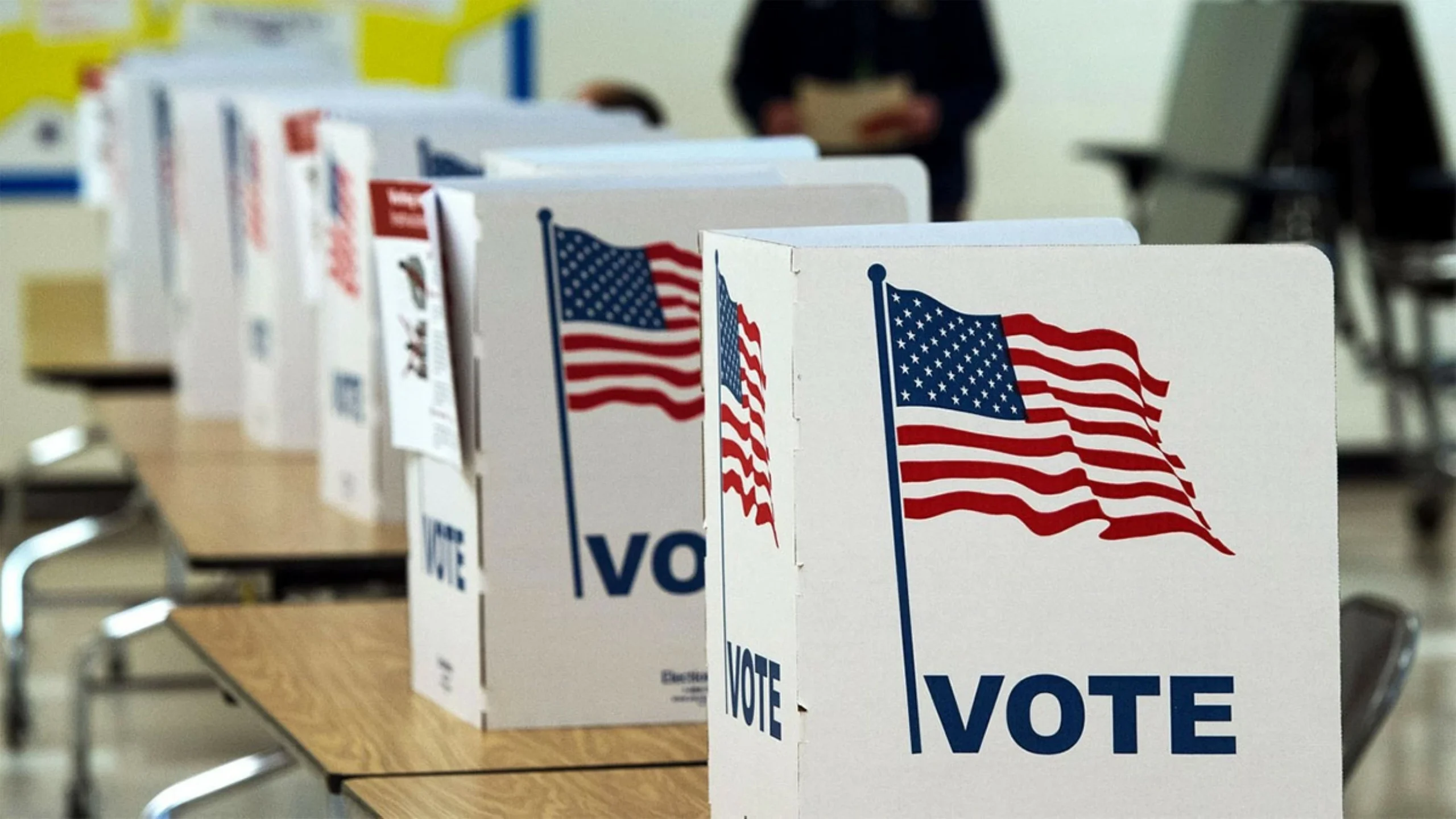
The United States — like all democracies — is centered around the basic premise that a representative system of governance reflects public preferences. This is not and has never been true, however, according to the
 admin
admin
In a small room in a museum downtown, a medium-size leather suitcase sits on the floor. It’s empty now, but nearly 50 years ago — as it crossed the Pacific Ocean from the Philippines to