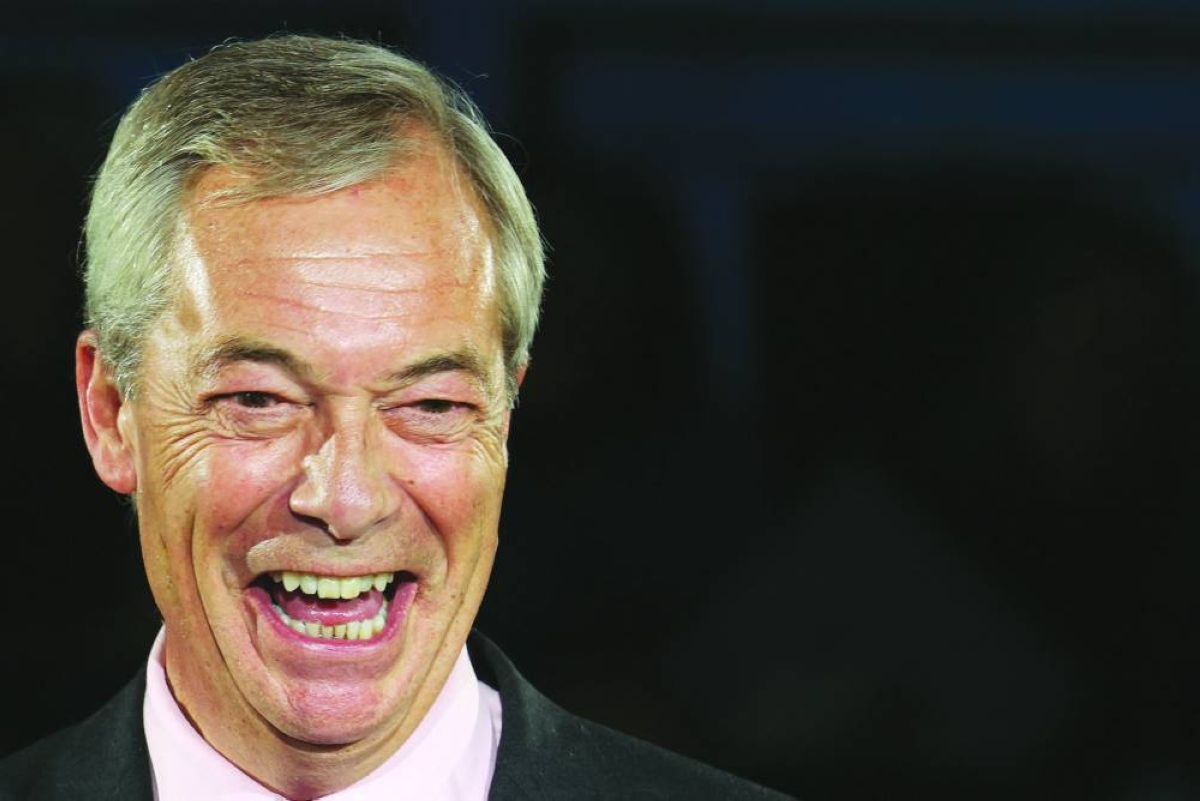
The old world is over. This is Nigel Farage’s time. That’s the message pressed by the Reform UK leader and his allies who are betting that the powerful brand of populism that drove his successful Brexit campaign a decade ago can carry him all the way to 10 Downing Street. “The world is changing,” Farage told Reuters as Reform starts fleshing out its party’s proposed policies, which include carrying out mass deportations, ditching international human rights treaties and slashing overseas aid. He contrasted the comparatively warm welcome he’d received at the annual gathering of political and business leaders in Davos this year with the hostility he recalled in the past. “I would say a third of the delegates I met there were genuinely interested in who I was, what I was, what I was trying to do,” he added. “And next year it will be 50%.” Reform is riding high in UK opinion polls, with a significant lead over Prime Minister Keir Starmer’s governing Labour. The support has bolstered Farage’s case that the party, which has existed in its current form for five years, could win power at the next election, due by 2029. Farage said Reform’s plans would rip up what he sees as the orthodoxy of a liberal establishment responsible for “a progressive, woke ideology” that has left Britons ashamed of their country. He compared himself to his friend Donald Trump, as well as Hungarian leader Viktor Orban and Argentina’s Javier Milei, as figures bringing “very, very big changes” to the world. Traditional politicians are being left in the dust, Farage said in an interview at the launch of Reform’s manifesto for Wales in the city of Newport on March 5. “Keir Starmer is stuck in a mindset that is 15 years out of date,” the 61-year-old added. While Farage is a highly divisive figure in Britain, his campaigning and political acumen have seen him forge, from the crucible of the 2016 Brexit referendum, one of the most potent of the patriotic populist movements sweeping the globe. He and Reform nonetheless face a stiff challenge to convince voters they are ready to lead the country, having little prior experience of government and counting only eight lawmakers in Britain’s 650-seat parliament. Inflammatory rhetoric, such as talk of an “invasion” of illegal migrants, as well as allegations of racism that have led to several members being ejected, have turned off some voters who fear a Reform government would stoke division. A former leader of Reform in Wales was also jailed in November for taking bribes to make pro-Russian speeches, offences condemned by the party as “reprehensible, treasonous and unforgivable”. “Reform’s biggest strength is also its biggest weakness - namely, Nigel Farage,” said Tim Bale, professor of politics at London’s Queen Mary university. “He’s adored by those who are absolutely determined to vote Reform but hated by those determined to vote against it - and disliked and distrusted by far too many who might otherwise be tempted to move in its direction.” Reform’s growing policy list, compiled here by Reuters from public statements and conversations with Farage and 10 current and former advisers, also includes plans to scrap diversity initiatives and net-zero targets, maximise oil and gas production, take the axe to Britain’s civil service and transform the country into a crypto hub. Critics have described the agenda, which Reform says should be a fully developed policy platform by the end of the year, as little more than an echo of the programme pursued by the US Trump administration - a characterisation that Farage rejects. Reform’s policies are underpinned by “simple values”, Farage said, focused on “family, community, country”. Labour has long accused the party of flip-flopping on issues including Britain’s public health service. “Reform don’t have a proper policy platform. Their ideas don’t make sense,” a Labour official said. FARAGE ‘HAS INSTINCTS NOT IDEOLOGY’Like their boss, Farage’s advisers often speak in epochal terms about the sweeping away of liberal elites clinging onto the “rules-based international order”. “You need to be asking: What is your new destination?” said Alan Mendoza, Reform’s chief adviser on global affairs. “Because the old, the old world, has gone. It’s over.” The party’s new head of policy, James Orr — a philosophy professor at the University of Cambridge and friend of US Vice-President JD Vance - spoke of Farage’s ability to connect with voters. “I’m hesitant to use the word philosophy about Nigel,” the 47-year-old told Reuters at a private members’ club in London’s wealthy Mayfair area. “He has instincts, not ideology.” Orr’s dismissal of elites stems from bruising experiences around the Brexit referendum, which saw Britons vote to leave the European Union by 52% to 48%. When doing post-doctorate research at the University of Oxford in 2016, he describes being the “only out-of-the-closet Brexiteer” among academics at his college. By contrast, his stance was backed by “the porters, the butlers, the maintenance department and the gardeners and the groundsmen”. Farage has indeed branded himself a man of the people leading a people’s revolution. Despite his euroscepticism, it was in Brussels that he met two of his biggest political influences — Beppe Grillo, the comic who co-founded Italy’s anti-establishment 5-Star Movement, and his social media guru Roberto Casaleggio. “Grillo weaponised social media and Nigel gets it,” said a former adviser who has been close to Farage since the beginning of his political career and requested anonymity to speak freely. “For a man who has never really turned on a computer in his life, he really gets it.” The main opposition Conservative Party, like traditional rival Labour, dismisses the idea of Reform coming up with coherent policymaking. The Conservatives have been outflanked by Farage on the right, losing many voters to Reform and seeing some of their most high-profile figures defect. “Reform are not serious people and they are not going to solve any of your problems,” Conservative leader Kemi Badenoch told a party forum on March 7. “Reform have absolutely no idea what they want Britain to look like in the 2030s.” FARAGE ON TRUMP AND MAGAReform figures also stress their close relations with American decision-makers could prove an asset in government. “With this administration, I happen to know most of the members of cabinet on a personal basis and have for many, many years,” Farage told Reuters. He said he agreed with Trump on big issues, such as global security, recognising “Iran is the bad actor in the Middle East” and understanding “China wants to take over and dominate our lives”. On controlling borders and producing energy at home, he added, the pair are aligned. Farage bridles, though, when asked whether he is copying Trump’s MAGA movement. “To some extent they copy what we were doing back in the run-up to the referendum,” he said. “I have always gone for bells and whistles and fireworks and fun, and whilst we believe in what we’re doing, we have a good time as well.” Orr, Reform’s policy chief, said Vance “hates what the technocrats and the elites have unleashed on Europe and Britain” and the US simply wants Europe to stand on its own two feet on security. One source with knowledge of Reform’s operations said officials close to Farage often visit Washington to try to raise money and drum up business support for the party. The officials are targeting those British businesses and business owners that oppose the UK tax regime and have largely quit the nation, the source told Reuters on condition of anonymity to speak freely. They hold dinners and events to draw people in and attend conferences to target “high earners” who have moved abroad. That strategy helped Reform raise 5.5mn pounds ($7.3mn) in the fourth quarter of last year, taking the party’s total take of cash donations to 18mn pounds in 2025, according to Electoral Commission data. At least two-thirds of that money, which dwarfed Labour’s 8.1mn pounds, came from donors who live abroad, the data shows. Mendoza, Reform’s global affairs adviser, said Britain must prove its utility to Washington, investing “serious money into defence” and showing “you’re willing to play a larger role”, if it wishes to maintain a serious security relationship. That would combat what he said was a belief in the Trump administration that Britain was “a weak and feeble country”.


admin