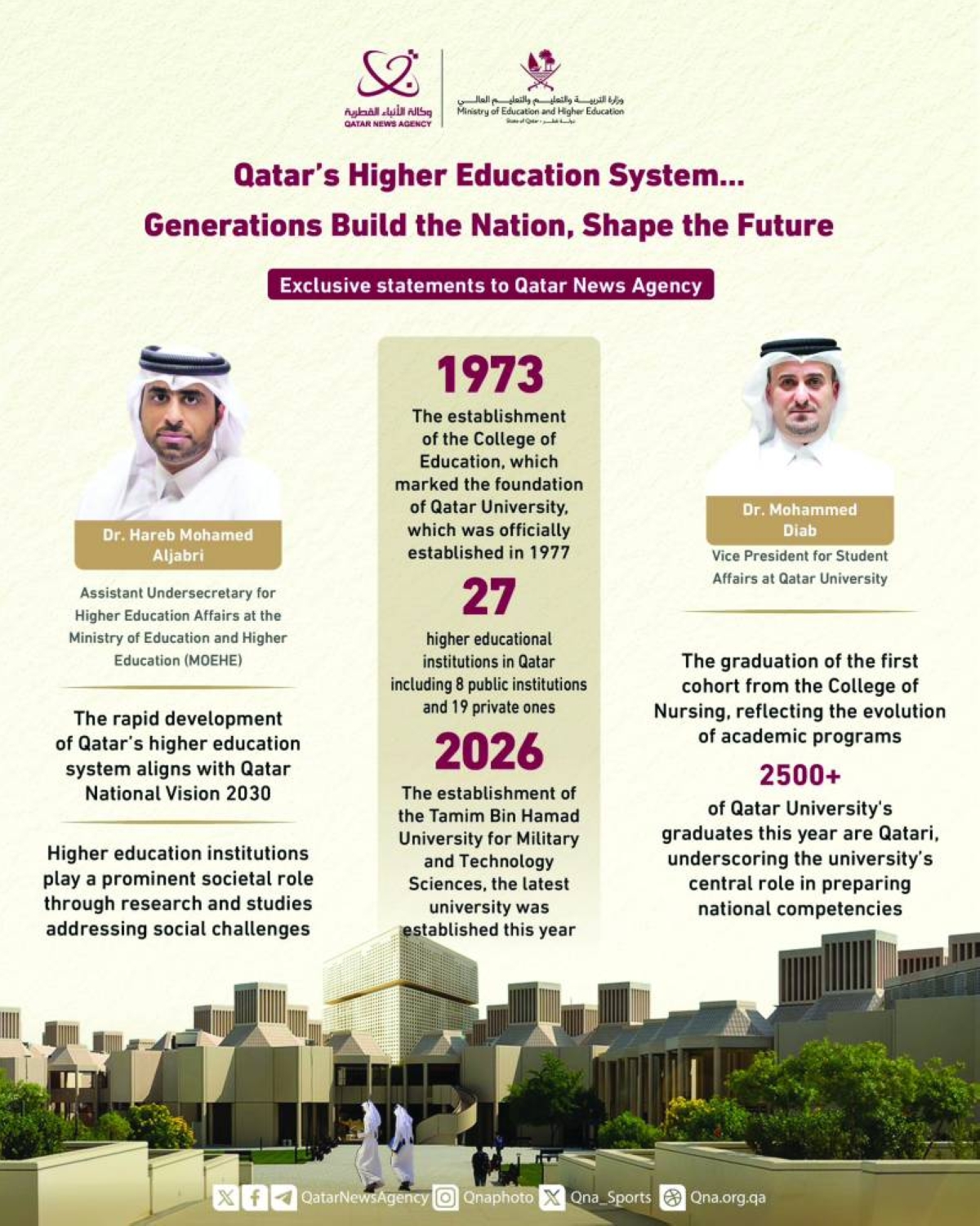
Higher education in Qatar is a cornerstone of human development and the knowledge-based economy, as it aims to prepare national cadres with the required skills, promote scientific research, and meet labour market needs.It also fosters cultural diversity and international exchange through scholarships and by attracting international universities and students, thereby providing a global educational experience.Qatar and its leadership’s growing attention to higher education and the continuous development of its quality reflect the country’s strong commitment to human development.By recognising education as a key driver of economic and social progress, Qatar has established numerous universities, colleges, research and training centres, while attracting international schools and universities, fostering successful global partnerships, and encouraging private educational institutions through continuous support.The establishment of the College of Education for male and female teachers in 1973, in co-operation with the United Nations Educational, Scientific and Cultural Organisation (Unesco), marked the foundation of the country’s first national university, Qatar University (QU), which was officially established in 1977.Today, the country’s higher education landscape includes a diverse range of universities, colleges, and institutes totaling around 27 entities, including eight public institutions and 19 private ones.The latest university was established this year.The Tamim Bin Hamad University for Military and Technology Sciences serves as an advanced academic umbrella integrating the expertise of military colleges while combining field professionalism with advanced technological knowledge.In the same context, His Highness the Amir Sheikh Tamim bin Hamad al-Thani issued Amiri Decision No. 51 of 2022 establishing and regularising the Police Academy.The academy aims to train security personnel according to international standards, consolidate training and academic units under one umbrella, and integrate the Police College into its structure to advance legal and police training.The expansion of higher education institutions in Qatar coincides with the continued increase of academic programmes, reaching nearly 350 accredited programmes covering diploma, bachelor’s, master’s, and doctoral degrees.According to data from the Higher Education Affairs Sector at the Ministry of Education and Higher Education (MoEHE), Qatar’s higher education institutions currently accommodate 52,564 students, including 47,326 undergraduate students and 5,238 postgraduate students.In remarks to the Qatar News Agency (QNA), Assistant Undersecretary for Higher Education Affairs at the MoEHE Dr Hareb Mohamed al-Jabri said that the rapid development of Qatar’s higher education system aligns with Qatar National Vision 2030, supporting the pillars of a comprehensive national development.He stressed that higher education contributes directly to human development, community development, environmental sustainability, and economic diversification, in addition to transforming scientific research outputs into startups and projects incubated within Qatar’s entrepreneurial ecosystem, thereby supporting the national economy.Dr al-Jabri added that higher education forms the foundation for preparing qualified national cadres capable of meeting labour market demands in terms of both specialisations and skills.Meanwhile, graduation ceremonies are currently being held throughout May, marking the end of the academic year, celebrating student achievements, and preparing graduates for a new chapter, the beginning of their professional careers.In this context, Qatar University celebrated the graduation of its 49th cohort, comprising 4,024 students, including 3,122 female students and 902 male students.In similar remarks to the QNA, QU Vice-President for Student Affairs Dr Mohammed Diab said this year’s graduation ceremony carried a significant milestone with the graduation of the first cohort from the College of Nursing, reflecting the evolution of academic programmes and their responsiveness to national priorities, particularly in the healthcare sector.He added that the large number of graduates this year reflects the scale of the QU’s impact on society, noting that more than 2,500 graduates are Qatari nationals, underscoring the university’s central role in preparing national competencies, alongside nearly 1,500 non-Qatari graduates, which further enhances academic and cultural diversity within the university.In a related context, the eight partner and local universities of Education City celebrated the graduation of the Class of 2026, the largest in its history, with 1,100 graduates from the various universities that make up the institution’s system, including 444 Qatari graduates representing 40% of the total number of graduates, and 660 graduates from 78 countries.Education City was officially inaugurated on October 13, 2003, under the supervision and initiative of the Qatar Foundation for Education, Science and Community Development (QF), which was established in 1995, to become a global centre for higher education.It now includes eight prestigious international partner and local universities, including the HBKU.All of these universities offer diverse and specialised academic programmes in various fields of knowledge, which has provided ample opportunities for Qatari students and other resident and international students to pursue their higher education in universities that are among the best of their kind in the world.The president of Higher Education and education adviser at the QF, Francisco Marmolejo, explained in a statement to the QNA the role that QF plays in supporting graduates after graduation, noting that each university within the system, along with the QF, works through specialised teams to follow up with them and support them in their career path.Marmolejo noted that a survey conducted during the Education City Job Fair 2026 showed that about 70% of graduates feel highly confident in their readiness to enter the labour market in Qatar, while employer surveys indicated that QF graduates have a high level of competence, particularly in communication skills, professional conduct and leadership.Regarding the sectors that attract the most graduates in Education City universities, he explained that artificial intelligence (AI) fields are witnessing increasing demand at the present time, as the QF is working in co-operation with its various universities to provide diverse educational opportunities in this field and others.He pointed out that Carnegie Mellon University in Qatar will offer an advanced AI programme ranked among the best in the world during the next academic year, and Virginia Commonwealth University in Qatar will offer a new programme in motion photography, while the Media and AI major at Northwestern University in Qatar is one of the most popular majors among students.Amid the momentum that Qatar is witnessing these days with the graduation of new batches of graduates, University of Doha for Science and Technology (UDST), which replaced what was known as the College of the North Atlantic in 2022, to be the first national university specialising in applied and technical education in the State of Qatar, will celebrate on the graduation of more than 1,200 students on May 19 in various technical and professional disciplines.In a similar statement to the QNA, UDST President Dr Salem bin Nasser al-Nuaimi pointed out that the university currently has more than 9,000 students in various programmes belonging to more than 86 nationalities, which reflects a diverse international educational environment.He noted that Qatari students constitute 25% of the total university student body, a figure that is an essential part of the student community, in support of national talent.Dr al-Nuaimi pointed out that this cultural diversity reflects the richness of the educational experience and enhances the exchange of experiences among students.Lusail University, the first private national university in Qatar, will also celebrate the graduation of its third batch of students on May 18-19.All who gave statements to the QNA emphasised the successful and well-thought-out expansion of higher education institutions in Qatar, and the flexibility, opportunities, and academic and professional options it has provided for students, enhancing their motivation to learn.This results in continuous growth in qualified national cadres, in line with the state’s strategy aimed at supplying the labour market with specialised competencies.Considering the development of Qatar’s higher education system and its remarkable local and international scientific achievements, the nation occupies advanced positions in the Education Quality Index issued by the World Economic Forum (WEF) in Davos, as well as in other competitive indicators and prestigious Arab and international rankings.In this regard, the QU has maintained its position as one of the best universities in the region and the world, according to the 2026 QS World University Rankings, rising to 112th globally and second in the Arab world.This ranking brings Qatar University much closer to joining the ranks of the top 100 universities in the world, especially considering its jump of 61 places compared to the 2024 ranking, in which it held the 173rd position globally.According to this ranking, some universities within Education City, such as the Hamad Bin Khalifa University and Weill Cornell Medicine-Qatar, were also among the top institutions.Furthermore, scholarships play a pivotal and strategic role in strengthening the higher education system in Qatar.They are key tools for developing national talent and building a knowledge-based economy, in line with Qatar National Vision 2030 and national development strategies, while also meeting the needs of the Qatari labour market.In this context, the MoEHE announced on April 21 the government scholarship plan for the 2026-27 academic year.This plan is based on four overarching strategic objectives: economic growth, equal opportunities, diversity and inclusion, and talent development, in alignment with the country’s national vision and the Third National Development Strategy.The plan marks a significant shift in the country’s strategy for building national competencies, introducing new features, most notably the Disability Track, which guarantees the right to higher education globally for this group through scholarships to universities that provide accessible environments and specialised programmes that support their independence and academic excellence.


admin