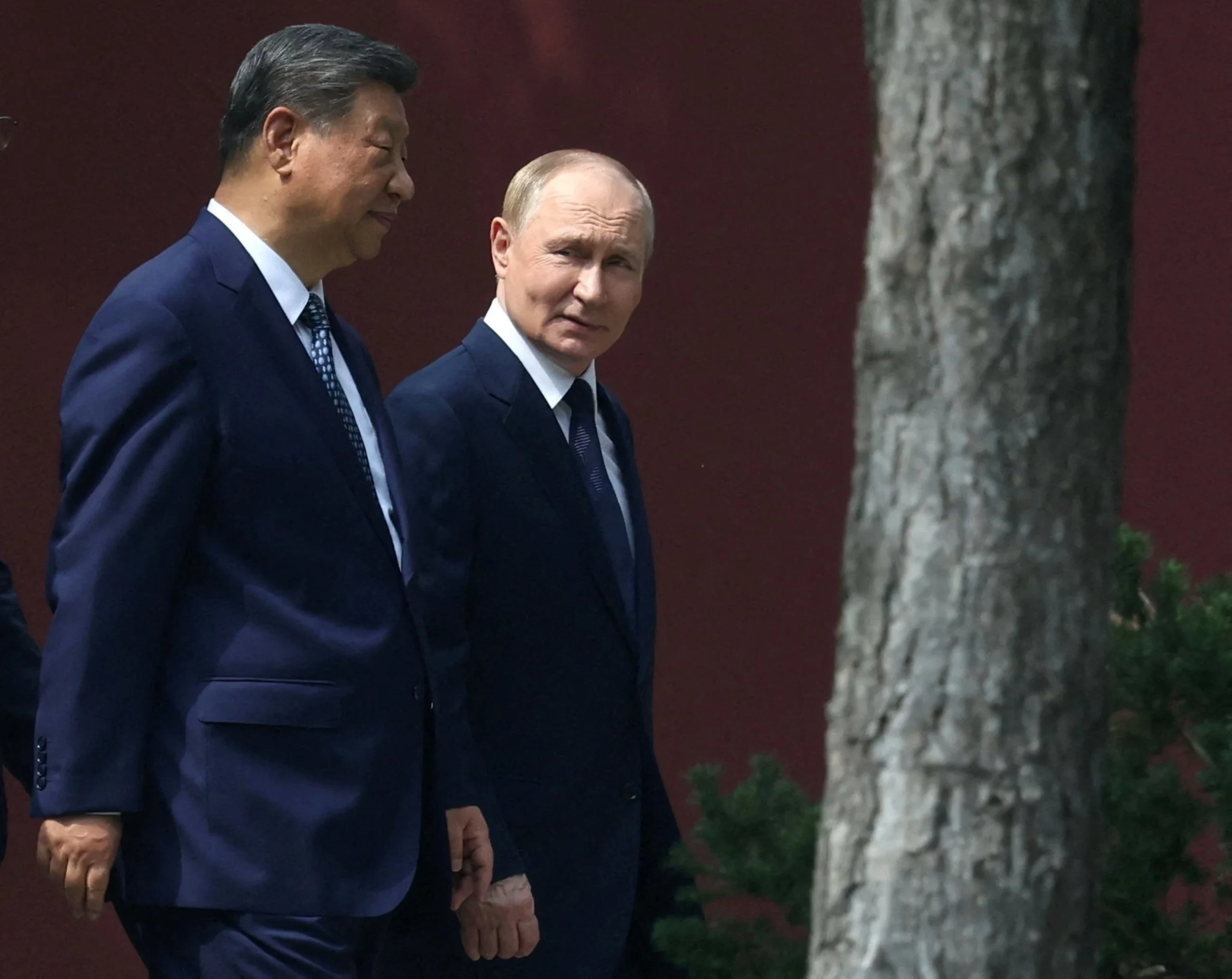
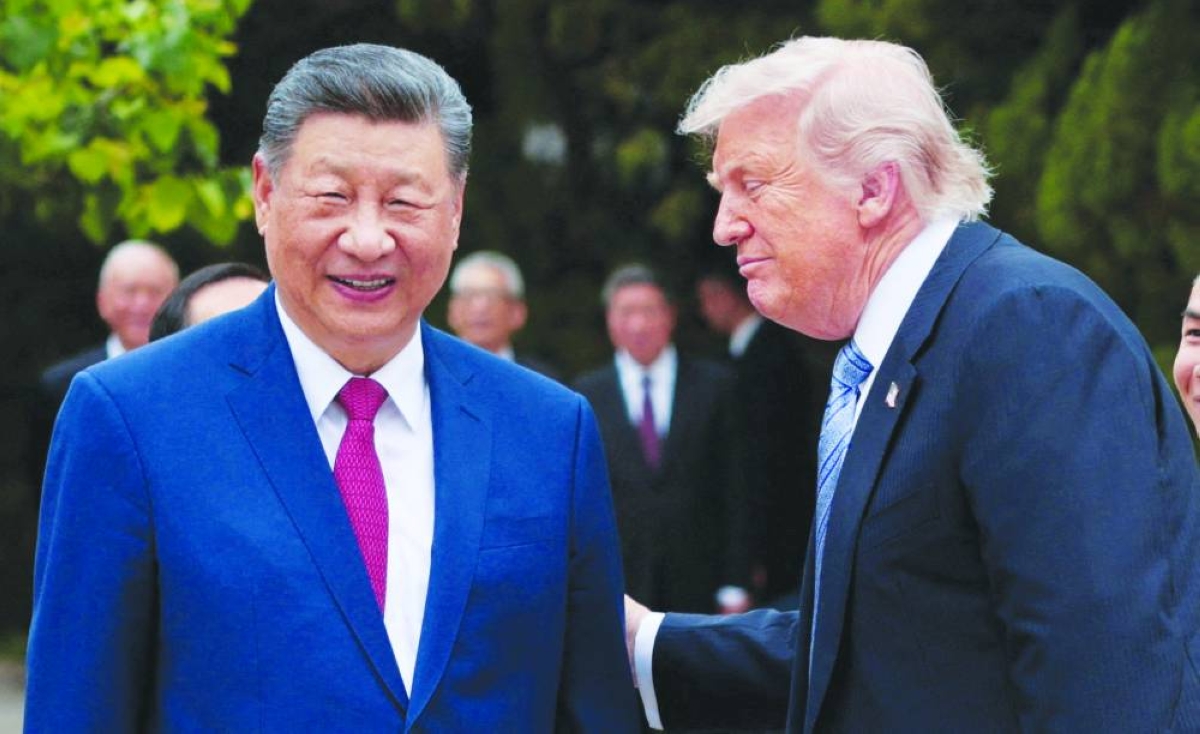
“It was the rise of Athens and the fear that this instilled in Sparta that made war inevitable.” Two thousand five hundred years on, the trap is being set again — and this time the stakes are nuclear. When Xi Jinping stood on Chinese soil and asked Donald Trump whether America and China could “transcend the Thucydides Trap,” he was not extending an olive branch. He was issuing a veiled warning, the kind that comes not in thunder, but in the low, measured tremor of a man who believes the fault line has already shifted beneath his rival’s feet. “The supreme art of war is to subdue the enemy without fighting.” — Sun Tzu, The Art of War. In 2014, Xi invoked the Thucydides Trap, but this time, context is everything. This time, he delivered the message on home ground, before cameras, after what observers interpret as a period of deliberate strategic positioning. To paraphrase British historian Arnold Toynbee: “civilisations do not die from assault. They succumb when they lose the will to respond to challenge.” Xi’s gambit was to whisper, with exquisite courtesy, that the will may already be faltering in Washington. Imagine Sparta, 431 BCE. The campfires burn low. Two generals crouch over a map of the Aegean. Outside, the roar of a navy being built can almost be heard across the water. Archidamus, King of Sparta“What are we to do with this ambitious Athenian? Their ships multiply. Their young men study philosophy and strategy. Do we wait and watch how things transpire — or do we strike now, before it is too late? Sthenelaidas, Spartan Ephor“Athens grows toward us. She builds alliances where we slept. She made Corinth afraid. The Corinthians weep to us for action. If we do not move, our allies will find another protector, and then we shall find ourselves alone and surrounded.” The Athenian statesman Pericles, across the water, understood the psychology of the trapped hegemon with cold clarity. “What I fear more than the enemy’s strategy,” he told the Athenian assembly, “is our own mistakes.” He urged restraint, patience, and the wearing down of a stronger but slower opponent. Harvard’s Graham Allison has documented with clinical precision Athens’ incredible rise. Sparta was the ruling hegemon. In Allison’s landmark study of sixteen such confrontations over five centuries, twelve ended in War, a staggering 75% probability of catastrophe. Washington, our own century. Different rooms; the same dread. Pentagon War Room — National Security Council, circa now“How do we halt China’s rise? Do we keep selling them our debt and hope gratitude follows? We’ve already banned advanced NVIDIA chips and throttled their AI supply chain. We’ve sanctioned their semiconductor ambitions. But they have CATL batteries, Huawei 5G, BYD electric vehicles, undercutting Detroit. Every restriction we impose, they build around. We are Sparta demanding Athens stop building ships, while Athens is already building shipyards.” A senior national security advisorOur long-range munitions stockpiles are not infinite. The Tomahawks that matter most in any Taiwan scenario are already committed elsewhere. Replenishment takes years. Beijing’s intelligence services know our inventory better than some members of this committee.” Napoleon Bonaparte, who understood the arithmetic of strategic timing better than any commander since Caesar, observed: “Never interrupt your enemy when he is making a mistake.” Xi Jinping has read his Napoleon and Allison’s masterpiece, Destined for War, and internalised the Thucydides Trap. China’s strategy is architectural. For two decades, Beijing has been laying the foundations for an alternative financial order: the Belt and Road, the BRICS currency discussions, the internationalisation of the renminbi, and cross-border payment systems that bypass the SWIFT network. René Descartes wrote that one must doubt everything to discover what cannot be doubted. China has applied the Cartesian method to the dollar system: doubting each dependency, then systematically removing it. What they are constructing is an exit ramp from the world America built, so that if the confrontation comes, the economic shock of sanctions can be absorbed rather than endured. “China is not a problem to be managed. It is a civilisation to be reckoned with — and civilizations do not yield to pressure alone.” — Allison, Destined for War George C Marshall, the architect of European reconstruction after 1945, warned that “the measure of a great power was not its capacity to destroy, but its capacity to build and to understand when the building of another was not a threat, but a fact.” America built the post-war order. China intends to renovate it. And fear is precisely what Thucydides identified as the engine of catastrophe. Not aggression. Not ambition. Fear. Sparta did not hate Athens. Sparta feared what Athens was becoming; it feared the restless vitality of a society that could not stop growing. That fear is what made War inevitable. Today, Xi stands in the role of Pericles: confident, patient, reading his rival’s inner anxiety with a strategist’s calm. America’s generals and presidents are scrambling with the torment of the Spartan King Archidamus: they sense the moment is slipping, the correlation of forces shifting, and the window for decisive action is narrowing with each passing fiscal quarter. Julius Caesar, crossing the Rubicon, is said to have murmured: alea iacta est — the die is cast. No side has yet cast the die, and yet both sides, China and the US, can hear it rolling. Allison does not counsel despair. Of his sixteen historical cases, four ended without war, including the Cold War, in which two nuclear-armed superpowers circled each other for 40 years and repeatedly chose to step back from the brink. The mechanism was what strategists called Mutually Assured Destruction (MAD), and the institutional scaffolding of hotlines, treaties, and summits that kept misreading to a minimum. Today’s scaffolding is thinner, and miscalculation can spread at lightning speed. The question Xi posed to Trump was not rhetorical. It was a sharp challenge: Do we have the wisdom that Sparta and Athens lacked? Or will the bell toll for us too? American writer Ernest Hemingway posed the perplexing question, “For whom the bell tolls?” In the summer of 431 BCE, it tolled for Greece, and Greece never recovered. Twenty-five centuries later, the bell hangs in Beijing, and China is waiting to see whether Washington answers with wisdom, with panic, or with the kind of silence that, in the grammar of great powers, means everything. “Appear weak when you are strong, and strong when you are weak.” — Sun Tzu.The wheel of history does not ask permission. It asks only whether those in its path have the imagination to step aside — or the courage to redirect it. • The writer is a news anchor, programme presenter and media instructor.

admin