1. Home
  2. Opinion

Category: Opinion

Opinion
Investors brace for a bigger backlash from ME conflict

Investors brace for a bigger backlash from ME conflict

From being just a fringe risk, conflict in the Middle East has become a top worry for investors unsettled by the prospect of a power ‌struggle in Iran and a protracted regional war, with ramifications for everything from global trade to inflation. US-Israel strikes killed ​Iranian Supreme Leader Ayatollah Ali Khamenei, sowing chaos as Iran struck back at Gulf cities, airlines halted flights and tankers carrying oil and ‌other products suspended transit through the key Strait of Hormuz. The first ‌risk for markets is the uncertainty over what happens ‌next in Iran, given the complexities of the Islamic Republic’s ruling system, the ideological nature of its support base, and the power of its Revolutionary Guards. That then complicates the outlook for oil prices which have been rising for weeks, but are now hostage to what oil-producing countries do and how passage of tankers through the Middle East is affected, with big implications for inflation worldwide and even the safety of bonds hitherto deemed havens. “Middle East tail risks have increased. Markets will reprice from geopolitical shock to regime risk shock, prolonged conflict, not just retaliation, unless Iran says it wants to negotiate,” said Rong Ren Goh, a portfolio manager in the fixed income team at Eastspring Investments in Singapore. A bigger risk, analysts said, is complacency in markets ​that have assumed the fallout would be limited, like it was during last June’s “12-Day War” in Iran or during Russia’s numerous attacks on Ukraine, and dismissive of any comparisons to Iran’s 1979 regime change. Brent crude jumped around 8% on Monday for a gain of nearly 30% so far this ‌year, and investors have already purchased US Treasuries and gold as hedges for ​a variety of risks, including Middle East tensions and President Donald Trump’s erratic policies. Gold had a record run ​last year and is up 24% so far in 2026. The main US stock index is up just 0.5%. “History argues strongly in favour of selling geopolitical risk premium when hostilities start,” Barclays analysts said in a note on Saturday. “What worries us is that investors have now learned this pattern and might be underpricing a scenario where containment fails.” Barclays analysts point to other factors that could exacerbate a selloff should the conflict escalate, such as existing concerns around the artificial intelligence boom and private credit markets. “We would recommend not buying any immediate dip — risk-reward doesn’t seem compelling. If equities pull back enough, say over 10% in the S&P 500, there is likely to come a time to buy. But not yet,” they wrote. Early on Monday, as oil gained, safe assets rose — with the dollar broadly higher, gold up about 1.6% and a bid for Treasuries. ‌Benchmark Brent crude futures were up about 8.5% at $79.05 ‌a barrel and S&P 500 futures fell 1%. “The markets are prepared for a limited surgical strike. What is not priced in is a major strike to decapitate the regime,” said Charles Myers, chairman and founder of Signum Global Advisors, a geopolitical investment consulting firm. He was speaking before the weekend US-Israel strikes. William Jackson, chief emerging markets economist at Capital Economics, expects a prolonged conflict affecting supply could cause oil prices to jump to around $100, potentially adding 0.6-0.7 percentage points to global inflation. “In my view, the market has already been overestimating inflationary forces, so I don’t think this will change much. There will be more impact on Europe than US given the closer proximity of Hormuz oil and gas post-Russia,” said Tariq Dennison, a wealth adviser at Zurich-based GFM Asset Management. “Maybe a ​slight short term uptick on gold, but gold has already priced in maximum geopolitical uncertainty.” Eastspring’s Goh pointed to the steady drop in US yields, which has brought 10-year yields to below 4%. “I’m not sure if buying US Treasuries here is a good trade, especially if oil prices spike and induce inflation, if this thing drags,” he said. On the other hand, some analysts expect Iran will not be able to disrupt trade in the Gulf region and the impact on oil prices will be contained.    

Opinion
‘AI scare trade’ grips markets amid spending, disruption concerns

‘AI scare trade’ grips markets amid spending, disruption concerns

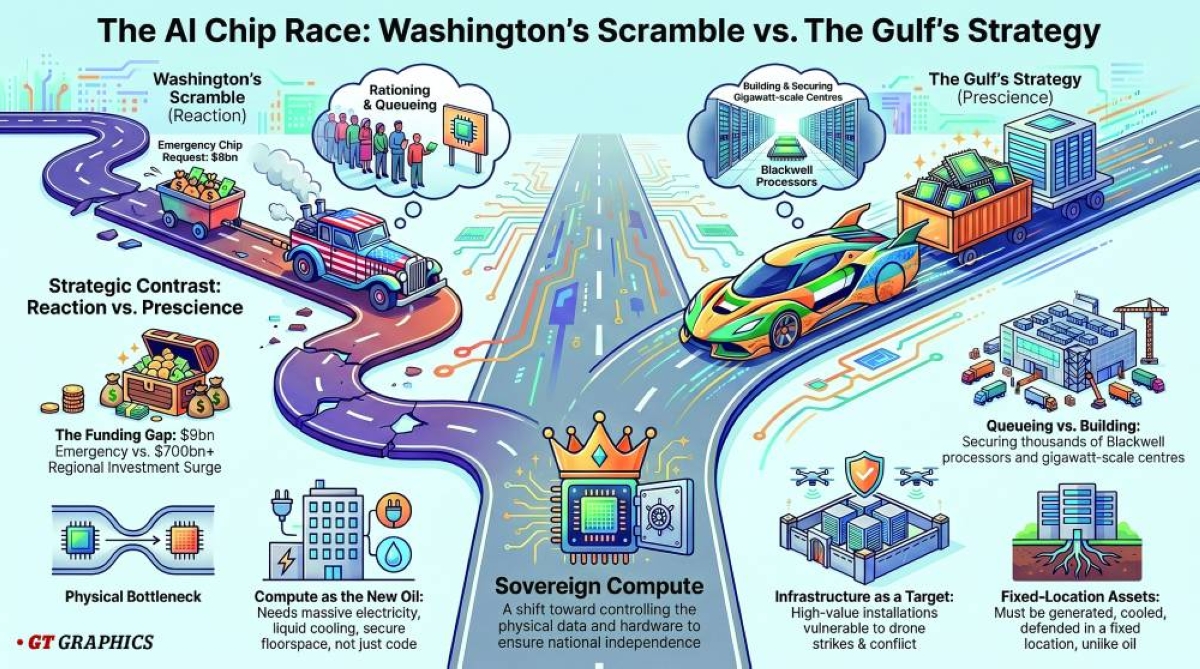
When ChatGPT was launched in November 2022, any stocks linked to the AI theme surged – from chipmakers and software firms to raw-materials suppliers and even companies most exposed to AI disruption. Over the past three years, investors have sought exposure to all things about artificial intelligence, including high-flying tech stocks behind some of the leading AI technology. But over the past year or so, Wall Street has gone through waves of AI-related selloffs, sparked by fears about everything from more cost-efficient competition in China to the likelihood of a looming AI bubble. Recently, though, the market’s focus has shifted, as predictions that AI will be so successful that it might supplant the need for many types of businesses and workers has driven some stocks down sharply. Wall Street is calling it the “AI scare trade.” The moniker first popped up among market participants unnerved by rolling selloffs in industries such as trucking that previously hadn’t been considered related to AI. For the first time since the stocks rally started in 2023, investors’ views on AI have shifted: Long viewed as a potential productivity booster, some now see the technology as a threat to entire industries. The change in perspective threatens to shift the direction of the market after three straight years of gains. Wall Street traders have been so spooked by the disruptive potential of AI that all it took to spark a drop in the S&P 500 Index at the end of February was a gloomy research memo. The scare trade in AI is essentially two fears wrapped up into one action — sell all things AI-linked — in a market that until recently had been trading at bubble-like valuations. The first fear is that firms like Microsoft and Amazon.com, whose stock prices dropped after reporting earlier this year, are spending too much money on data centres and building out AI infrastructure. The second is that AI will severely disrupt entire industries because AI agents will be able to replace white collar workers, shrinking the workforce and, by extension, consumer spending.  That fear has rolled from one industry group to another in recent weeks, sparking massive selloffs in sectors such as software development, even as the overall stock market has remained flat so far this year. At the end of last year, 83% of companies in the S&P 500 listed AI as a “material risk” to their business, up from 72% in the third quarter of 2025 and just 12% in 2023, according to data compiled by the Conference Board and shared with Bloomberg. To some extent, the current uncertainty on Wall Street reflects the mixed messages coming from Silicon Valley and the wider business community. For years, tech leaders have signalled AI is progressing rapidly and framed it as a transformational technology that will reshape large portions of the global economy. Mind-boggling global AI spending spree is projected to cross $2.5tn in 2026, a 44% increase year-over-year. But as of now, the global AI trade is starting to fracture as soaring capex, rising debt loads and doubts over who will profit from the technology force investors to draw sharper lines. In the near term, however, AI’s impact is murkier. Multiple studies last year found employees were using AI to produce “workslop,” undercutting productivity rather than boosting it. Leading AI labs are also still working to help businesses understand how best to use their tools. What’s certain is that AI is here to stay, and the companies that stand to benefit are those providing the foundation of the infrastructure — utilities, chipmakers, and manufacturers of grids and pipelines.  

Opinion
European capitals push back as Ukraine seeks fast-track EU membership

European capitals push back as Ukraine seeks fast-track EU membership

Ukraine’s push for a fast track into the European ‌Union as part of any peace deal has hit stiff resistance from EU governments, who do not want ​to open the Pandora’s box of problems that ‌they fear a quick accession would unleash. Ukrainian President Volodymyr Zelenskiy wants a 2027 date to join the EU ‌as part of a settlement to end Russia’s war, hoping this ‌would anchor his country in Europe’s main political ‌club and offer a path to greater prosperity, security and stability. A clear route into the EU could be vital for Zelenskiy in selling any peace settlement to Ukrainians, particularly if - as is widely expected - Ukraine does not regain control of all of its territory or join the Nato military alliance, analysts say. But EU governments -- including heavyweights France and Germany -- have privately voiced scepticism about a mooted reform of the accession process that would shorten Ukraine’s path to membership, diplomats say. Reuters spoke with eight European diplomats and officials, and many pointed to unease among EU capitals about the idea. Among their concerns is that Ukraine and others would not press on with reforms, such as cracking down on corruption, if it has already been granted EU membership. Ukrainian Deputy Prime Minister ​and lead EU negotiator Taras Kachka told Reuters that Kyiv was ready to address EU members’ concerns. He proposed safeguards such as a monitoring system to check Kyiv was sticking to democratic standards and a transition period before it received EU farm subsidies. But he said a political commitment to ‌a membership date would be important. “This is necessary for the peace process, for the ​establishing of long-lasting and just peace in Europe,” he said. CURRENT MEMBERSHIP PROCESS IS LONG AND COMPLEXThe current process ​for joining the bloc is usually long and bureaucratic, even in straightforward cases, involving years of detailed negotiations and legal reforms to meet EU democratic and economic standards. Every step of the accession process, which is divided into chapters and clusters of policy issues, also requires approval from all EU members. Hungary has blocked Ukraine’s path early in the process. European Commission President Ursula von der Leyen, head of the bloc’s executive, has floated a revamp of the process behind closed doors, diplomats say. Instead of carrying out all the required reforms first, a country could join the EU after meeting some minimum requirements - but with limited access to EU funds and decision-making until they meet all the membership benchmarks. That could make it easier for Ukraine and others such as Moldova, Montenegro and Albania to join quickly - although Zelenskiy’s target of January 1, 2027, would still be unrealistic, not least as ‌all 27 current EU members have to ratify any ‌accession. EU GOVERNMENTS UNCONVINCED BY COMMISSION OVERTURESKachka suggested Ukraine could at least sign an accession treaty with the EU next year, even if ratification and other steps might take longer to implement. But analysts and diplomats see little appetite for such bold moves, including von der Leyen’s mooted revamp, known as “reverse enlargement” as it turns the process on its head by letting a country join before it has met all the current criteria. “The growing support for populist and anti-enlargement parties in several capitals makes governments cautious about being seen to accelerate a process they have not yet built public consent for,” said Anastasia Pociumban, a research fellow at the German Council on Foreign Relations. “The concept of reverse enlargement is dead,” said one EU diplomat. “There is also no support for giving a concrete accession date.” A Western ​European official said: “Ukraine is just not ready and has rampant corruption.” Von der Leyen tried to temper expectations in Ukraine last week. She told Zelenskiy publicly that “dates by themselves are not possible” even as she praised the country’s reforms in the midst of war. COMMISSION EXPECTED TO CONTINUE PUSHING FOR KYIVNevertheless, the Commission is expected to continue to push for ways to get Kyiv into the EU in the next few years, arguing that membership would strengthen the bloc militarily amid fears Moscow may attack an EU member next. Some say a model of gradual integration, whereby aspiring members take part in more and more EU programmes and meetings before joining the club, may be more feasible. “I think a full accession within the next few years remains unlikely,” Corina Stratulat, associate director at the European Policy ‌Centre, said of Ukraine’s prospects. “What seems ​more likely to happen instead is accelerated integration - single market access, energy, digital, transport - phased participation in EU programmes and policies.”   

Opinion
Teaching children about AI is so important

Teaching children about AI is so important

As part of a good education in our changing world, children should learn how to apply their own developing intelligence to the artificial intelligence that’s served up to then in ever larger quantities on the

Opinion
Redistricting war threatens Congress’s last moderates

Redistricting war threatens Congress’s last moderates

Ronald Brownstein, Tribune News ServiceThe mid-decade congressional redistricting war that President Donald Trump triggered is likely to end without any clear partisan benefit for either party. But the cost to the country will be substantial.

Opinion
Harry and Meghan accused of copying Wills and Kate

Harry and Meghan accused of copying Wills and Kate

Charlotte Cripps, The IndependentThis week, the Duke and Duchess of Sussex have been on a quasi-royal dash around the Middle East — sorry, a two-day humanitarian visit to Jordan at the behest of the World

Opinion
Polanski and Mamdani have put the ‘rizz’ back into politics

Polanski and Mamdani have put the ‘rizz’ back into politics

Kat Brown, The IndependentI wasn’t on the finest form on Thursday. The return of the Never-Ending British Grey after Wednesday’s briefest dip into spring had sent me into a porridgy slump. But even I was

Opinion
Antonia Romeo has been given an impossible job

Antonia Romeo has been given an impossible job

Helen MacNamara, The IndependentIn normal times, the appointment of a new head of the civil service would have stirred little interest beyond Whitehall. Aside from the shattering of another glass ceiling, what with the first

Opinion
World needs peace

World needs peace

I tremble at watching the news with what is going on latest and staying indoors makes me reminisce about the time when the world was hit by Covid. The world today watches in grave concern

Opinion
War zone

War zone

War zone