1. Home
  2. World

Category: World

World
Irish ministers to hold emergency meet over fuel cost protests

Irish ministers to hold emergency meet over fuel cost protests

Vehicles block Dublin's O'Connell Street, as part of a protest over the high cost of fuel that clogged up busy thoroughfares and motorways across Ireland for a second successive day, in Dublin. (Reuters/File Photo) The Irish government was Sunday due to hold an emergency cabinet meeting to sign off on measures aimed at ending fuel cost protests that have endangered the functioning of the country's emergency services.Hauliers and agricultural contractors began a series of protests on Tuesday over spiralling petrol and diesel prices amid the Middle East war.Since then the protests have grown from slow-moving convoys on motorways and restricted access to Dublin's busiest streets, to a part blockade of Ireland's only oil refinery and restricted access to at least two other fuel depots.Finance Minister Simon Harris said later on Saturday ministers had held meetings with transport and agriculture sector representatives ahead of Sunday's meeting.The government was in the process of "finalising a significant support package to address the ongoing crisis", a government statement added.Some protests rolled into a sixth day Sunday.The government has urged the public not to panic buy as pumps at many fuel stations have run dry.Police on Saturday with the support of the armed forces deployed public order units to clear the blockade at Whitegate Refinery in southern Ireland.Irish police chief Justin Kelly said the action was taken as a last resort.The blockading of "critical national infrastructure" had "resulted in fuel shortages that are directly impacting on emergency services such as hospitals, the ambulance service, and the fire service", he said.Elsewhere, police dismantled a makeshift barrier erected by protesters blockading western Galway docks.A late-night operation also targeted the blockade of the capital Dublin's main thoroughfare O'Connell Street after multiple vehicles including tractors and lorries were removed.Justice Minister Jim O'Callaghan said earlier the continuation of the protests despite the increasingly difficult situation had been "unacceptable"."While we all acknowledge the impact of higher fuel prices, and seek to minimise that impact, no groups are entitled in our republic to hold our people to ransom in such a manner," he said.In March, Dublin announced a 250 million-euro package to reduce fuel costs, notably including a diesel rebate for road haulier.There were now the "bones of an agreement" with the government, the president Ger Hyland of the Irish Road Haulage Association said on Saturday."It is a substantial package and we hope to have this over the line either late tonight or tomorrow," he added. 

World
‘A perfect mission’: Artemis II astronauts return to Earth

‘A perfect mission’: Artemis II astronauts return to Earth

From left: Nasa astronauts Reid Wiseman, commander, Christina Koch, mission specialist, Canadian Space Agency astronaut Jeremy Hansen, mission specialist, and Nasa astronaut Victor Glover, Artemis II pilot, posing for a group photo after viewing the

World
Arab Parliament mobilises world against Israel’s execution law

Arab Parliament mobilises world against Israel’s execution law

The Arab Parliament announced Sunday that it launched a broad international campaign across parliamentary, human rights, and international levels to confront the so-called execution law for Palestinian prisoners approved by Israel’s Knesset.In a statement, the Arab Parliament stressed that the discriminatory legislation represents one of the most dangerous forms of legitimising systematic political killing against the Palestinian people, describing it as a fully-fledged legislative crime that undermines international law and threatens the global justice system.Arab Parliament Speaker Mohammed bin Ahmed al-Yamahi sent a series of urgent official letters to UN Secretary-General, UN High Commissioner for Human Rights, President of the Inter-Parliamentary Union, President of the International Committee of the Red Cross, as well as heads of regional and international parliaments, calling for immediate and decisive action to halt the implementation of the law and hold those responsible accountable before international justice.Al-Yamahi stressed in his letters that the adoption of this law constitutes an unprecedented escalation in Israeli occupation policies, effectively institutionalising a new phase of systematic executions of Palestinian prisoners under a false legislative cover.He described it as a blatant violation of Geneva Conventions, international humanitarian law, and all relevant international human rights instruments, warning that any international silence or inaction regarding this law would be considered direct complicity in a fully-fledged crime, would grant the occupying entity political cover to continue its crimes, and would open the door to a serious collapse in the international legitimacy system and entrench a policy of impunity.He called on the international community to assume its legal and moral responsibilities and take urgent measures, including activating international accountability mechanisms, referring the crime to competent judicial bodies, ensuring immediate international protection for Palestinian prisoners, and forming independent fact-finding committees to investigate serious violations committed against them in Israeli occupation prisons.He also renewed calls to suspend and freeze the membership of Israeli Knesset in the Inter-Parliamentary Union and other international parliamentary forums, affirming that the Arab Parliament It will continue its political, diplomatic, and parliamentary efforts until the discriminatory law is repealed and the occupying authorities are held accountable for their escalating crimes against Palestinian prisoners.   Related Story

World
Stalemate over Hormuz control – Gulf Times

Stalemate over Hormuz control – Gulf Times

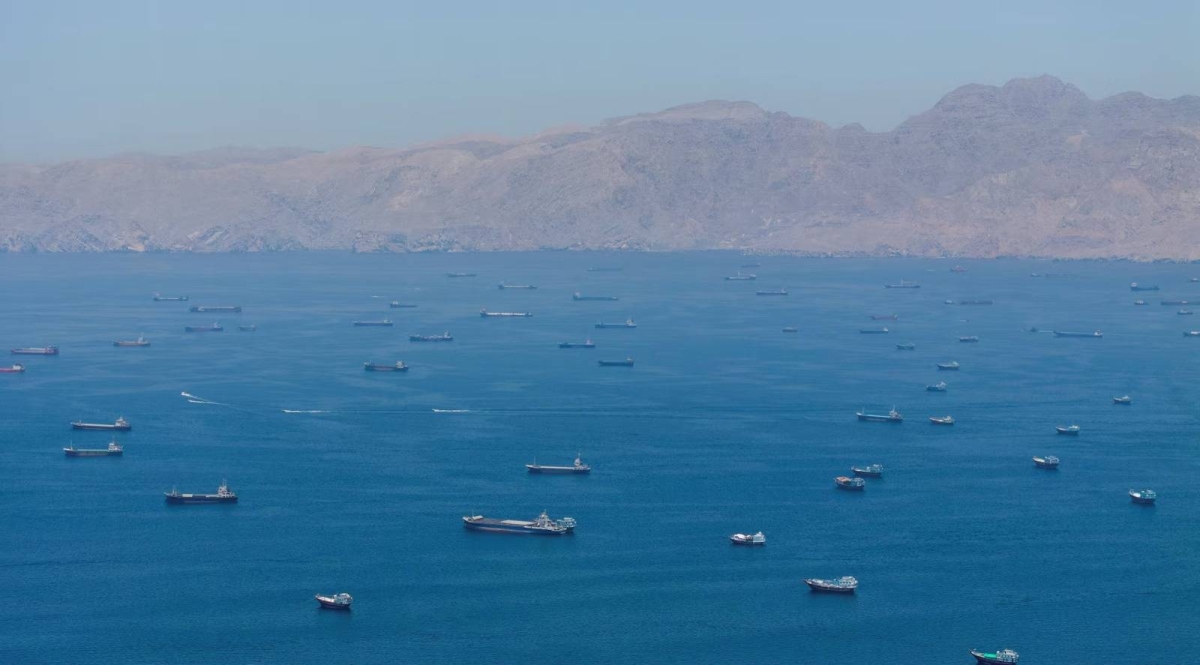
US Vice President JD Vance with Pakistan's Prime Minister Shehbaz Sharif before the talks in Islamabad Saturday. Right, Iran's parliamentary speaker Mohammad Bagher Ghalibaf confers with his colleagues during the talks. (Reuters, AFP) In a city that has rarely been short of drama, the Serena Hotel is hosting something that would have seemed unthinkable just months ago — American and Iranian officials sitting across from each other, exchanging written texts, dining, and trying to find a way out of a war that has shaken the Middle East to its foundations and sent tremors through the global economy. Yet for all the symbolism of the moment, the substance remains stubbornly elusive. After two rounds of talks and well into a third, the negotiations have run into the one obstacle that was always going to be the hardest to clear: who controls the Strait of Hormuz. The White House said the United States, Pakistan, and Iran held face-to-face trilateral talks. Its senior official said the three sides were meeting directly in person, marking a shift from recent negotiations where Washington and Tehran communicated through intermediaries while seated in separate rooms.  Two people briefed on the discussions told the Financial Times that the waterway remains the central sticking point. Iran is insisting on retaining full sovereign control of the strait and the right to levy tolls on vessels passing through it — a position that amounts, in Washington's eyes, to Tehran holding the world's energy supply to permanent ransom. Iranian negotiators have flatly rejected any notion of joint control, even after reportedly a face-to-face meeting between US Vice-President JD Vance and Iran's wartime parliamentary speaker Mohammad Bagher Ghalibaf. The word being used by those close to the talks is stark: stalemate. 

World
India legend Asha Bhosle is no more

India legend Asha Bhosle is no more

(FILES) Bollywood playback singer Asha Bhosle attends an event celebrating 'Marathi Bhasha Gaurav Diwas,' also known as Marathi Language Day, in Mumbai on February 27, 2025. Bhosle, one of India's most iconic playback singers and

World
A ringside view of historic talks

A ringside view of historic talks

Members of the media work as a screen displays news with an image of Pakistan's Prime Minister Shehbaz Sharif meeting with US Vice President JD Vance, at a media centre set up for the coverage

World
Trump orders US Navy to block Hormuz Strait after Iran talks fail

Trump orders US Navy to block Hormuz Strait after Iran talks fail

President Donald Trump ordered the US Navy on Sunday to block the crucial Strait of Hormuz shipping lane, furious with Iran's refusal to surrender its nuclear ambitions after peace talks in Pakistan broke down without an agreement.In response to Trump's announcement, Iran's Revolutionary Guards warned they had traffic in the strategic waterway under their full control and would trap any enemy who tried to challenge it 'in a deadly vortex'.In a lengthy declaration on his social media platform, Trump said his eventual goal was to clear the strait of mines and reopen it to all shipping, but that in the meantime Iran must not be allowed to profit from its control of the waterway.'Effective immediately, the United States Navy, the Finest in the World, will begin the process of BLOCKADING any and all Ships trying to enter, or leave, the Strait of Hormuz,' Trump said. 'Any Iranian who fires at us, or at peaceful vessels, will be BLOWN TO HELL!'Iran has itself been restricting traffic through the strait -- a key route for global shipments of oil, gas and fertiliser -- while allowing vessels deemed to be working for friendly countries, such as China, to pass. There have been unconfirmed reports that Tehran plans to charge tolls.'THIS IS WORLD EXTORTION,' Trump said. 'I have also instructed our Navy to seek and interdict every vessel in International Waters that has paid a toll to Iran. No one who pays an illegal toll will have safe passage on the high seas. We will also begin destroying the mines the Iranians laid in the Straits.'The US military had said Saturday that two Navy warships transited through the strait to begin clearing it of mines and ensure it was a 'safe pathway' for tankers, a claim denied by Tehran.Iran's Fars news agency reported on Sunday that two Pakistani-flagged oil tankers heading for the strait had turned around.Fears of renewed fighting rattled an already tense region after the US-Iran talks collapsed.'I am worried about the continuation of the situation and the return of attacks again,' said Imam, an Egyptian housewife living in UAE capital Abu Dhabi.'I was making a great effort not to pass my tension on to the children.''Act of extortion' Trump later in a Fox News interview again threatened Iran's energy infrastructure, before warning he would impose a 50 percent tariff on Chinese imports if Beijing tried to help the Iranian military.'I could take out Iran in one day. I could have their entire energy everything, every one of their plants, their electric generating plants, which is a big deal,' he said.The president's latest ultimatum appeared to have been triggered by the failure of talks to secure a deal to end the six-week-old war, which began when the US and Israel launched strikes on Tehran and killed Iran's supreme leader, Ali Khamenei.Iran's refusal to give up its right to a nuclear programme frustrated the US delegation, led by Vice President JD Vance, White House envoy Steve Witkoff and Trump's son-in-law Jared Kushner.'I have always said, right from the beginning, and many years ago, IRAN WILL NEVER HAVE A NUCLEAR WEAPON!' Trump said.'The Blockade will begin shortly. Other Countries will be involved with this Blockade,' he added, without specifying.Experts said blocking the crucial waterway in the middle of a two-week ceasefire, after the Islamabad negotiations, would further erode America's global credibility.'Imposing a blockade on the Strait of Hormuz right now -- even if it's implementable, which remains an open question -- is bewildering and seems self-defeating,' said Shibley Telhami, a professor of peace and development at the University of Maryland.Vance left Pakistan after the talks -- the highest-level meeting between the two sides since the 1979 Islamic revolution -- and warned that Washington had made Tehran its 'final and best offer' for a deal, adding: 'We'll see if the Iranians accept it.'Iran's parliamentary speaker Mohammad Bagher Ghalibaf, the head of his country's negotiating team, said he had 'put forward constructive initiatives' but the US team did not win Iran's trust.Ceasefire efforts The failure of the talks will raise concerns that a return to fighting could drive world energy prices higher and further damage shipping and oil and gas facilities.Pakistan, which hosted the talks, urged both countries to continue respecting the temporary truce.UK Prime Minister Keir Starmer called the Sultan of Oman, Haitham bin Tariq, and both leaders agreed it 'was vital there was a continuation of the ceasefire, and that all parties avoided any further escalation'.An EU spokesman said diplomacy would be 'essential' to securing peace and hailed Pakistan's mediation efforts, while Russia's President Vladimir Putin called Iranian President Masoud Pezeshkian to offer his services to the diplomatic effort.'Vladimir Putin emphasised his readiness to further facilitate the search for a political and diplomatic settlement to the conflict, and to mediate efforts to achieve a just and lasting peace in the Middle East,' the Kremlin said, in its readout of the call. 

World
Taiwan spotted Chinese warplanes as Xi met opposition leader in Beijing

Taiwan spotted Chinese warplanes as Xi met opposition leader in Beijing

Taiwan’s defence ministry said yesterday that it spotted 16 Chinese warplanes operating near the island the previous day, around the same ‌time China’s president was meeting the Taiwanese opposition ​leader. Late on Friday ‌morning, Chinese President Xi Jinping met Cheng Li-wun, ‌chairwoman of Taiwan’s ‌largest opposition party the Kuomintang (KMT) in ‌Beijing, where Xi said he “absolutely would not tolerate” independence for Taiwan, which China views as its own territory. Cheng has portrayed her visit as a reconciliation mission to lessen tensions, and told Xi she looked forward to the KMT and Communist Party advancing the “institutionalisation” of peace across the Taiwan Strait.Taiwan’s defence ministry, in its ​daily report on Chinese military activity in the previous 24 hours, said that 16 Chinese warplanes flew near the island from ‌mid-morning to mid-afternoon on Friday. Xi and ​Cheng met at 11am (0300GMT). Shen Yu-chung, a ​deputy minister at Taiwan’s China-policy-making Mainland Affairs Council, told reporters in Taipei on Saturday that using military coercion against Taiwan as a means of applying pressure for political negotiations has always been China’s “go-to tactic”. “So on one hand we see them sending out messages of peace, while on the other hand they continue to use military force to pressure Taiwan without ‌letup,” he added.China’s ‌Taiwan Affairs Office did not respond to a request for comment. In Beijing, KMT Vice-Chairman Chang Jung-kung said that the key to promoting peace lies in offering Taiwan’s people a choice between peace and reconciliation, or war. Engaging with China and promoting cross-strait peace yields “peace with dignity,” not the bowing of one’s head to “shake hands” ​like Taiwan President Lai Ching-te has said, Chang added, according to a KMT statement. Lai’s office said on Friday night that what the Xi-Cheng meeting sought to highlight was that “Taiwan is part of the People’s Republic of China” and to advance “the annexation of Taiwan”. “Taiwan’s future can only be decided by the Taiwanese people themselves,” Lai’s spokesperson ‌Karen Kuo said ​in a statement. 

World
Indian airlines face revenue loss due to Dubai’s flight curbs

Indian airlines face revenue loss due to Dubai’s flight curbs

Passengers sit next to a logo of Dubai Airport, at the departure hall of terminal one, Dubai, United Arab Emirates. (Reuters/File Photo) Dubai has restricted foreign airlines to just one daily ‌flight to its airports until May 31 due to the Iran crisis, igniting revenue ​loss fears among Indian carriers that had ‌planned more flights than airlines from any other country, letters show. The Federation of Indian ‌Airlines (FIA), which represents top carriers IndiGo, Air India ‌and SpiceJet, has asked India to push Dubai ‌authorities to lift the curbs and, failing that, to consider reciprocal measures on Dubai carriers including Emirates and flydubai, according to a letter it sent to the Indian government on March 31. Indian carriers are already under financial pressure from higher fuel prices and longer routings to Western destinations because they have been banned from using Pakistani airspace since last year following military tensions between the two neighbours. In a private e-mail to airlines on March 27, seen by Reuters, Dubai Airports said carriers would be allowed one round trip per day to Dubai International Airport (DXB), normally the world’s busiest international travel hub, and the ​smaller Al Maktoum International Airport (DWC) during the summer season between April 20 and May 31, extending restrictions implemented after the war began. “Carriers continue to be limited to one rotation per day, until capacity allows more to be facilitated... Additional slots will ‌be allocated if capacity is available,” it said.The FIA ​told the Indian government the curbs were not being applied to Dubai’s airlines such as ​Emirates and flydubai, creating an uneven playing field that could lead to “substantial” revenue losses. Dubai Airports and Dubai’s media office did not respond to repeated requests for comment. Flydubai said its flight schedules were approved by the relevant authorities. Emirates did not respond to a request for comment. The measures come after Emirates and other Gulf airlines have long complained about India’s bilateral air service agreements that cap the number of seats that can be deployed between countries. Indian authorities have said such pacts protect Indian airlines in the cutthroat market. India was the largest source of passengers for DXB in 2025, with 11.9mn travellers passing through the hub.The Dubai caps will ‌hit Indian airlines the hardest, according to ‌April and May schedules data from Cirium. Air India and its budget carrier Air India Express have scheduled more than 750 flights into DXB in that period. IndiGo has 481, followed by Saudia and Gulf Air, which planned for 480 and 404, respectively. India’s SpiceJet had planned 61. The one-flight-per-day cap would mean 30 or 31 per month for each foreign airline, versus the hundreds of daily flights being flown by Emirates and flydubai according to Flightradar24 data. IndiGo told Reuters in a statement that the Middle East crisis and the new Dubai extended restrictions “significantly constrained” its operations as it had an approved summer schedule of 15 daily ​flights from India to Dubai. “As a result, a significant portion of IndiGo’s capacity and aircraft time is currently underutilised,” IndiGo said in its first comments on the crisis.Air India, SpiceJet and Indian authorities did not respond to requests for comment. Air India Express told Reuters the restrictions had “significantly curtailed” its planned services despite relatively high demand on India-UAE routes, limiting options for travellers, particularly from smaller cities, and underscored the need for a “fair and reciprocal operating framework.” Other major airlines such as Lufthansa, Singapore Airlines, and British Airways had far fewer flights to Dubai than Indian carriers before the crisis began and have cancelled all flights to the ‌city until at least ​May 31. They are instead adding more non-stop Asia-Europe flights to take advantage of strong passenger demand that has pushed up prices.Federation of Indian ‌Airlines has asked India to push Dubai ‌authorities to lift the curbs and, failing that, to consider reciprocal measures 

World
Mideast war takes a bite out of Filipino street food vendors

Mideast war takes a bite out of Filipino street food vendors

People buy food at a curbside canteen in Manila last week.(AFP) Filipinos like their "pares", a traditional beef stew, served hot — but the soaring cost of liquefied petroleum gas (LPG) has made that prospect increasingly difficult since war erupted in the Middle East.To save a few pesos 20-year-old Eric Garcia delicately turned a knob to adjust the flame under his warming trays to the lowest setting as he grapples with fuel costs that have nearly doubled in price.While sticker shock at petrol stations has garnered the biggest headlines since the war forced the partial closure of the Strait of Hormuz, the rising price of LPG has hit the import-dependent archipelago's humble street food vendors.A day before speaking to AFP, Garcia said he had been forced to raise the price of a bowl of pares to 65 pesos ($1.08) after fuel costs reduced his daily earnings by a quarter."I'm only earning 1,500 pesos (per day), because the rest is spent on LPG," he said.Garcia, who begins cooking at 3am every morning before hauling his stew to a middle-class neighbourhood on a converted motorbike, said an 11 kilo tank of fuel, which typically lasts four days, that once cost 870 pesos (about $14.50) now costs 1,600 pesos."It's the highest price of LPG that I've ever seen since I started here," said Carlo Manalad, a supervisor at a store selling tanks of the gas, 90% of which is imported."If (our suppliers') prices are high, we also raise our prices. Our profit is still the same," the 64-year-old told AFP.Many of the capital's streetside food sellers, however, have no such luxury."If we raise our prices, our customers will buy from other stalls," said Ronilo Titom, who has run a curbside canteen that caters call centre workers and jeepney drivers, for two years.Even while holding the line on prices, Titom said he had noticed his customer base slowly shrinking since the war erupted."Many of them have started to bring packed lunches instead (to save money)," said the 48-year-old who, like Garcia, is using his LPG ever more judiciously."Sometimes we let the soup get cold," he admitted, noting that the cost of ingredients for his dishes had also been on the uptick since the war broke out.The Philippines revealed on Tuesday war-driven inflation figures that showed food prices had increased nearly twice as fast in March as the month before.French fry vendor John Mark Abella, 25, who has also upped his prices by five pesos to compensate for LPG costs, told AFP he believed inflation was putting the squeeze on his mostly student customers."I think we've got fewer customers... because they're limiting their expenses because of the high prices of fuel and food," he said.Sam Natividad, a 25-year-old call centre worker, said that was no illusion."I'm limiting my expenses because... I also have to pay bills at home. I don't have a big budget for my meals here," she told AFP at a roadside canteen, adding it was "understandable" if street vendors had to raise their prices.Near Garcia's pares stall, Allan Palong, a driver for a motorbike ride-hailing app, said he understood the vendor's need to charge five pesos more for a bowl of stew, even if his own earnings were being crippled by fuel price hikes."It's very difficult for us now, all prices have gone up... the five-pesos mean a lot," he said, while calling on the government to slash the excise tax on imported fuel."What they're doing is not enough... we can't feel it."  Related Story