1. Home
  2. World

Category: World

World
China says hopes to boost trade co-operation with US

China says hopes to boost trade co-operation with US

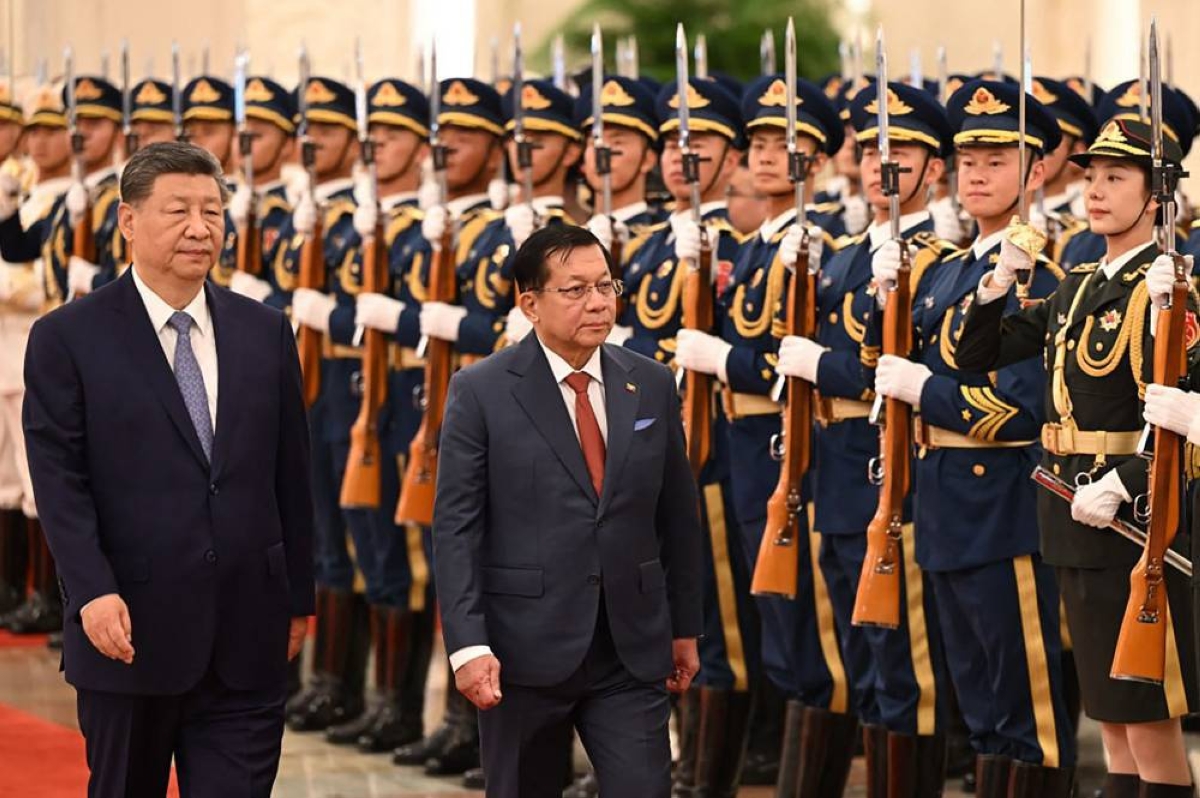
 AFPBeijingChina wishes to strengthen economic co-operation with the United States to avoid "vicious competition", commerce minister Wang Wentao told US Trade Representative Jamieson Greer, according to a readout released yesterday.The two met on Thursday on the sidelines of a World Trade Organisation (WTO) ministerial conference in Cameroon's capital, less than two months ahead of US President Donald Trump's planned visit to Beijing."China is willing to strengthen multilateral and regional economic and trade cooperation with the United States," Wang told Greer, according to a statement by the Beijing's Ministry of Commerce.The two powers must "properly handle the relationship between competition and cooperation" and "avoid vicious competition," he said.The world's two largest economies were locked in a bitter trade battle last year before agreeing to a truce in October.High-level talks in Paris this month between US Treasury Secretary Scott Bessent and Chinese Vice-Premier He Lifeng also helped to ease tensions.Nevertheless, issues including US tariffs, a trade balance in China's favour, and US restrictions on exports of advanced technologies continue to threaten relations.Wang expressed "grave concerns" on Thursday regarding recently announced US trade investigations signalling the possibility of fresh tariffs.Washington's trade investigations target 60 economies, including China, and will look into "failures to take action on forced labour" and whether these burden or restrict US commerce. 

World
Australia defends Middle East efforts after Trump criticism

Australia defends Middle East efforts after Trump criticism

Australia's leader said yesterday it was not consulted over the war with Iran which was having a "massive global economic impact", responding to President Donald Trump's swipe the US ally was not doing enough.Trump has urged nations to dispatch warships to secure crucial oil supply routes through the Strait of Hormuz.Although many have baulked at Trump's proposal, the US president included criticism of Australia as he vented his frustrations over lack of British support."Australia was not great. I was a little surprised by Australia", he said Thursday during a cabinet meeting at the White House.Prime Minister Anthony Albanese said Australia was in close contact with Gulf states under attack from Iran, providing a surveillance aircraft to help defend the United Arab Emirates, where many Australians live."There is no request been made to Australia that has not been agreed to," Albanese told reporters in Canberra yesterday."I make the point as well that Australia wasn't consulted before this action was undertaken. I respect that, that's a matter for the United States," he added.The United States is Australia's main security ally, and a partner with Britain in the trilateral AUKUS pact to build more nuclear submarines to counter China."We do want to see a de-escalation and we do understand that this war is having a massive global economic impact," Albanese said.War has engulfed much of the Middle East since the United States and Israel launched strikes against Iran on February 28.Australia made an early statement of support for the US acting to prevent Iran from obtaining a nuclear weapon.Australia had "abhorrence" for Iran's regime, Albanese said Friday, pointing to its expulsion of Iran's ambassador in August after attributing the fire bombing of a Melbourne synagogue a year earlier to Iran's Revolutionary Guard. 

World
India clears military purchases worth $25 billion to buy aircraft, Russian S-400 missile systems

India clears military purchases worth $25 billion to buy aircraft, Russian S-400 missile systems

 India approved proposals worth $25bn ‌yesterday to buy transport aircraft, Russian S-400 ‌missile systems ⁠and remotely ‌piloted strike aircraft as it pushes ‌its military modernisation and replenishes equipment after its conflict with Pakistan.The ⁠decision comes on the back of another major approval last month worth $40bn to purchase more French Rafale fighter jets for the air force and Boeing P-8I reconnaissance aircraft for the navy.Yesterday's approvals also covered purchases of armoured piercing tank ammunition, gun systems and aerial surveillance systems for the army, ​increasing the life of the Sukhoi-30 fighter jets operated by the air force, and hovercraft for the coastguard, a statement from the defence ministry ‌said.Separately, the ministry also ⁠signed a 4.45 ​billion rupees ($47mn) contract yesterday with Russia's ​JSC Rosoboronexport to acquire Tunguska air defence missile systems for the army.In all, India has approved 55 proposals worth 6.73tn rupees ($71bn) and signed contracts for another 503 proposals amounting to 2.28tn rupees in the fiscal year ending March 31, the statement said, adding that both were the highest in a fiscal year.India is the world’s fifth-largest military spender and the second-largest arms importer ‌after Ukraine, according to latest data ‌from the Stockholm International ⁠Peace Research Institute.It has for decades been modernising its ⁠mostly Soviet-era equipment and ⁠increasingly looking to new sources including France, Israel, the US and Germany. In recent years, it has pushed to manufacture everything from guns and drones to fighter jets and submarines at home, either on its own or in collaboration with foreign partners. Last year, ​India and Pakistan were involved in a fierce four-day military conflict, their worst in decades, after an attack on Hindu tourists in Indian Kashmir. New Delhi said the militant attackers were from Pakistan. Pakistan denied the accusations.India's ties with China have also been testy and they were locked in a military stand-off in the Himalayas for more than four years before they agreed ‌to pull back ​in 2024 and repair relations. 

World
Middle East war exposes UK Navy’s limitations

Middle East war exposes UK Navy’s limitations

HMS Dragon, a Royal Navy Type 45 Daring-class air-defence destroyer warship, is guided by tug boats, as it departs from HM Naval Base Portsmouth, on the south coast of England. (AFP/File Photo) A single destroyer sent to the Mediterranean and Germany stepping in to command a Nato maritime mission: the Iran war is exposing the limits of Britain's navy, seen by observers as an embarrassment for a once proud maritime power.The conflict, launched on February 28 with US-Israeli strikes on Iran, is highlighting the effects of years of under-investment and industrial delays, leaving the Royal Navy virtually absent from the Middle East.Controversy about Britain's naval capabilities first erupted over the slow deployment of HMS Dragon to protect British bases in Cyprus, one of which was hit by an Iranian drone on March 1.The destroyer has only just arrived.In the meantime, France deployed its Charles de Gaulle aircraft carrier, while Italy and Greece sent ships to reassure Cyprus. Right-wing newspaper the Daily Telegraph called the comparisons "embarrassing".This week Germany announced it will assume command in April of a Nato maritime mission in the North Atlantic in place of Britain, which was due to assign HMS Dragon to the role but is not able to deploy another vessel."This is what good allies do," Defence Secretary John Healey said Thursday, while admitting he was "not happy with the situation we have with British warships"."I have to make decisions based on what we've got," he added, noting the UK now has 17 frigates and destroyers, compared with 23 when Labour was last in power in 2010.The vessels include six Type 45 destroyers and 11 Type 23 frigates, but most are currently unavailable, in maintenance or being decommissioned.The next generation of warships — eight Type 26 anti-submarine frigates and five Type 31s — are not due to be ready before 2028-2029 due to delays, prompting some experts to warn of a capability dip in the coming years.The Strategic Defence Review published last year lamented that maintenance costs are being driven up by the ageing fleet — a blow for the Royal Navy, which for centuries extended Britain's empire around the world, once dominating the oceans and turning the island into a global power.It took eight years to complete upgrades on the destroyer HMS Daring.Britain's two aircraft carriers — HMS Prince of Wales and HMS Queen Elizabeth — are also docked. The former is expected to take part in a North Atlantic mission soon.They were labelled "toys" by US President Donald Trump on Thursday, who has criticised London for its limited response to the US-Israel war against Iran.Prime Minister Keir Starmer has said the UK will not be drawn into a broader war, and refused to join the US and Israel's bombing of Iran.But the UK government has allowed US planes to take off from two UK bases to target Iran's missile sites.And Britain has deployed fighter jets and air-defence systems to the Gulf to protect British interests and allies, shooting down numerous drones.Russia's war in Ukraine, the expansion of Nato missions, and the conflict in the Middle East means it is "a particularly challenging period for the Navy", Nick Childs of the International Institute for Strategic Studies told reporters including AFP recently."It is struggling to make capabilities match commitments in particular, but also is struggling to maintain force levels," he said.Mark Sedwill, formerly Britain's most senior civil servant, told the BBC recently that under successive governments "there's been an erosion of the basics, the maintenance, the training, the ordinance supplies and so on that keep an effective force ready to deploy".— 'Russia main threat' —Starmer's Labour government, elected in July 2024 following 14 years of Conservative rule, has pledged to significantly ramp up defence spending, with priority given to Nato commitments.But the publication of its defence investment plan, first expected back in late 2025, continues to be pushed back — to the frustration of industry.Within the Navy, priority is to go to nuclear deterrence and the shift toward a so-called hybrid force combining traditional crewed warships with autonomous maritime drones."For good reason, the UK has decided that the main threat faced by the UK is Russia," Kevin Rowlands of the RUSI think-tank told AFP."And the main theatre of operations where we need to confront Russia will be in Northern Europe, the North Atlantic and the High North."So it's almost inevitable, if something happens in a different part of the world, then we won't necessarily be there." 

World
India cuts excise duties on petrol, diesel as global oil prices surge

India cuts excise duties on petrol, diesel as global oil prices surge

People rush to refuel their vehicles at a fuel station in Amritsar yesterday. (AFP) India has slashed excise duties on petrol ‌and diesel to protect consumers and curb a potential spike in inflation, while imposing windfall taxes ​on aviation fuel and diesel exports, amid ‌volatile global oil markets due to the Iran war.Global oil prices have surged past $100 per barrel ‌after the near closure of ⁠the Strait of Hormuz, ‌which serves as a conduit for 40% of India's ‌crude oil imports, since the US and Israel first struck Iran on February 28.In a government order late Thursday, ⁠India's finance ministry reduced the special excise duty on petrol to 3 rupees ($0.0318) per litre from 13 rupees. It also cut the duty on diesel to zero from 10 rupees per litre.The move comes ahead of elections next month in four Indian states and one federal territory, with voters very sensitive to higher prices.India will lose 70bn rupees ($739mn) a fortnight from the excise cuts, although it will recover part of this — 15bn rupees — through separate export taxes on some fuel products, Vivek Chaturvedi, chairman of Central Board of Indirect Taxes and Customs, ​told a press briefing.The net hit to government finances will be 55bn rupees per fortnight.The yield on 10-year government bonds rose 7 basis points to 6.95%, its highest level in 20 months on concerns that the government may struggle to meet its ‌fiscal deficit target of 4.3% of GDP for ⁠the financial year beginning ​April.The tax cuts also ease the burden for oil marketing companies. While fuel prices in India ​are technically deregulated, state-run oil companies, which control 90% of the retail network, do not always raise prices when crude climbs.As a result, consumers are shielded from volatility, with either the government or the companies absorbing the increases."Government has taken a huge hit on its taxation revenues to ensure very high losses of oil companies, approximately 24 rupees a litre for petrol and 30 rupees a litre for diesel, at this time of sky high international prices, are reduced," Oil Minister Hardeep Singh Puri said in a post on X.The government said that at current crude rates, the combined daily under-recoveries being absorbed by oil firms stand at 24bn rupees.Shares of oil marketing companies such as Bharat Petroleum Corp and HPCL reversed early gains to close slightly higher.The diesel export tax was set ‌at 21.5 rupees a litre, along with a 29.5 ⁠rupees a litre tax on aviation fuel exports, the order said.Between April 2025 and January 2026, India exported 14mn ⁠metric tonnes of gasoline and 23.6mn tonnes ⁠of gasoil. Most refiners have stopped exporting fuels. Reliance Industries is the country's biggest fuel exporter.Finance Minister Nirmala Sitharaman said the government will ensure there is no shortage of petrol, diesel and jet fuel.It will support oil marketing companies so that citizens are spared price hikes and ensure that jet fuel prices do not rise, she told news agency ANI.India, the world's third-biggest oil importer and consumer, relies heavily on overseas supplies.In a letter dated Thursday, the petroleum ministry said it will ​raise the allocation of liquefied petroleum gas to commercial and industrial users by 20%, taking total supply to 70% of pre-crisis levels.The increase builds on an existing 50% allocation, with priority to sectors such as steel, automobiles, textiles and other essential industries. India had cut gas allocation for non-cooking purposes after the start of the Iran war.India consumed 33.15mn tonnes of cooking gas last year, with imports covering about 60% of demand. About 90% of those imports came from the Middle East.Prime Minister Narendra Modi and his government have stressed adequate arrangements are in place, including for fertiliser supplies for the summer sowing season and coal to meet rising electricity demand.The government, in a separate statement, assured the ‌public that retail petrol and diesel ​prices will not change. 

World
Italy’s Meloni faces risky choices after referendum defeat shakes government

Italy’s Meloni faces risky choices after referendum defeat shakes government

 * Meloni weighs risky paths to stay in control* New vote law or even early elections now in play* Weak economy and Iran war add to political pressure Giorgia Meloni's defeat in a justice reform referendum has thrust the Italian leader into the toughest phase of her premiership, with her authority weakened, her reform programme ‌in tatters and no easy way to regain the initiative.The prime minister's right-wing coalition suffered a resounding loss in ​the March 22-23 vote, puncturing the aura ‌of political invincibility she has cultivated since taking office in 2022.As the result came in, Meloni made clear she ‌had no plans to resign, ⁠but none of her options looks ‌attractive, political analysts say.Governing as if nothing has changed risks ‌leaving her a lame-duck prime minister, with the anaemic economy under growing strain and her closeness to US President Donald Trump seen ⁠by pollsters as an increasing liability.Alternatively, she could seek to reshape the electoral law to try to boost her chances of winning the next general election, due in 2027, but would open herself to charges of upending the rules to suit her political interests.A third option could be to gamble on forcing an early ballot this spring before the full impact of the Iran war hits Italy's already fragile economy, hoping to catch the fragmented centre-left opposition unprepared. "It's clear that what's at stake is the end of the legislature. Even the date of the next election is uncertain," said Nicola Lupo, director of the Centre for Parliamentary Studies at Rome's ​Luiss University.OPPOSITION BLOC REMAINS FRAGMENTEDFor all the damage, the referendum did not amount to a blanket rejection of Meloni, with 37% of those who voted "No" telling Youtrend pollsters she should remain in office. "This wasn't an opposition victory so much as a victory for the judiciary," said Massimiliano Panarari, ‌a political analyst at the University of Modena and ⁠Reggio Emilia.The centre-left opposition hailed ​Monday's result as evidence the political cycle was turning its way, but its two main components, the Democratic ​Party and 5-Star Movement, remain deeply divided over key issues, including foreign policy. These splits could tempt Meloni to resign shortly and force a snap election, Luiss' Lupo said, adding that the government had pushed for a swift referendum in March to have the eventual option of holding a pre-summer vote."Meloni knows the next budget won't allow for generous spending, so she might say it would be better to go to elections now and not give the opposition time to organise," he said. While none of her allies are openly suggesting this, some of her partners -- including Maurizio Lupi, head of the small "Us Moderates" party -- are urging a change to the electoral law to introduce a system based solely on proportional representation.Latest polls show the conservative bloc, including Meloni's Brothers of Italy party, the League and Forza Italia, in the lead, but vulnerable to defeat in a future ballot because of ‌the way seats are distributed under the current ‌system. Studies have suggested a pure PR system could give ⁠the ruling coalition a comfortable majority.Although government parties presented a draft bill on this last month, some of Meloni's allies urged caution after ⁠the referendum, saying voters would not approve. "It would be stupid," ⁠Stefano Candiani, a League lawmaker in the lower chamber, told Reuters. "There are so many problems facing Italians, including the Iran war and (high) cost of living, that anyone who wants to tie up parliament with this electoral law is crazy."TRUMP TIES, WEAK ECONOMY DRAG ON MELONIPollsters confirmed an unexpectedly high turnout in the justice referendum was driven by voters motivated by broader political and economic concerns rather than the technical details of the complex judicial reform. "In the last 10 days, the number of people saying they would vote grew by 10 percentage points. We ​had never seen such a surge," said pollster Antonio Noto.The referendum's timing proved challenging for Meloni, with the US-Israeli war on Iran turning a spotlight on her friendship with Trump and costing her votes, analysts said. "Even if she has tried to put a bit of distance between herself and him in recent days, the shift hasn't been very noticeable," said political analyst Panarari.Meloni risks treading water for the next 12 months, with her reform agenda in shreds and little time left to enact meaningful change. "From this day forward, she is a lame duck," said centrist leader Matteo Renzi, who quit as prime minister in 2016 after losing a referendum on his own constitutional reform agenda.He told La7 news channel that opposition parties would draw strength from Monday's result, saying the Meloni-backed "Yes" camp had until recently ‌enjoyed a big lead. "If beating Meloni ​in the referendum wasn't easy, it will be far easier to beat her on issues like inflation, fuel taxes, the cost of living, and public safety in major cities," he said. 

World
G7 allies press Rubio on US Iran plans

G7 allies press Rubio on US Iran plans

Ministers pose for a family photo on the second day of the G7 Foreign Ministers' Meeting in Vaux-de-Cernay Abbey in Cernay-la-Ville near Paris, yesterday. (Reuters) G7 allies were yesterday pressing US Secretary of State Marco Rubio for clarity on American plans for Iran almost one month into the war in the Middle East, with concern also intensifying over the extent of co-operation between Russia and the Islamic republic.Having skipped the first day of the meeting at the historic monastery turned luxury hotel complex outside Paris, Rubio arrived at the Vaux-de-Cernay Abbey for a full day of talks with counterparts from leading industrialised democracies.German Foreign Minister Johann Wadephul said the international community needed to collaborate even more closely now it was dealing with two wars — including the conflict sparked by Moscow's invasion of Ukraine — in which Russia and Iran were co-operating."We need to strengthen our unity. Given that Iran and Russia are working together in the closest way, we must stand even closer together," Wadephul told reporters.He told German radio earlier ahead of the talks that allies needed to know "how the US will proceed" in Iran. Rubio, he said, would "perhaps explain this more precisely".In contrast to usual protocol, and in a sign of the distance between the US and its allies, there is to be no joint communique at the end of the meeting.Instead, the G7 presidency, which France holds this year, will issue a statement, said a diplomatic source who asked not to be named.The UK's foreign minister Yvette Cooper urged a "swift resolution to this conflict that restores regional stability".She echoed concerns over the ongoing de facto blockade by Iran of the key Strait of Hormuz, which has driven up global oil prices and left vessels queueing up to enter the energy bottleneck."Frankly, Iran cannot be able to just hold the global economy hostage as a result of a Strait which is about international shipping routes and the freedom of navigation," she said.It is Rubio's first trip abroad since the US and Israel launched the war with the air strikes on February 28 that killed supreme leader Ali Khamenei.Before leaving for France, Rubio said Thursday that it was in the "interest" of all G7 nations to push for the reopening of the Strait of Hormuz.Defending the war, he said: "The president is not just doing a favour to the US and to our people. This is for the world."With Ukraine's Foreign Minister Andrii Sybiha in attendance, European ministers are keen to emphasise support for Kyiv must not be forgotten over four years after Russia's full-scale invasion."Putin is cynically hoping that the escalation in the Middle East will divert our attention from his crimes in Ukraine," Wadephul said."This calculation must not succeed," he said, warning that any compromising on Ukraine's defence capabilities would "play into Putin's hands".Writing on X, in his first comment on the meeting, Rubio said he had reiterated at the G7 "that President Trump is committed to reaching a ceasefire and negotiated settlement to the Russia-Ukraine war as soon as possible".France is eager to broaden the scope of the elite G7 club — whose origins go back to the first G6 summit held in the nearby Chateau de Rambouillet in 1975 — and which now comprises Canada, Germany, France, Italy, Japan, UK and US.It has invited foreign ministers from key emerging markets Brazil and India, as well as Saudi Arabia and South Korea.The event is leading up to a G7 summit in the French Alpine lakeside resort of Evian in June to be chaired by President Emmanuel Macron.The South African presidency Thursday alleged Washington had urged Paris to disinvite President Cyril Ramaphosa from that summit. But French Foreign Minister Jean-Noel Barrot said Kenya — rather than South Africa — had been invited. "We did not give in to any pressure," he said. 

World
Energy crisis may force Germany to run coal plants longer: Merz

Energy crisis may force Germany to run coal plants longer: Merz

Chancellor Friedrich Merz said yesterday that if the energy crisis sparked by the Middle East war dragged on, Germany might have to keep running coal-fired power plants longer than planned.Germany has committed as part of its climate plans to gradually shutting down plants fired by anthracite and lignite and complete the coal phase-out by 2038 at the latest.'If the energy crisis continues and a shortage actually occurs, we may even have to keep existing coal-fired power plants online for longer,' Merz told a forum in Frankfurt organised by the FAZ newspaper.'We have to supply this country with electricity. I am not prepared to jeopardise the core of our industry just because we have decided on phase-out plans that have become unrealistic.'Europe's biggest economy has for decades pushed an energy transition away from fossil fuels and nuclear energy by building up wind, solar and other clean and renewable energy sources.While the Merz government has pledged to stick to national climate targets, it has prioritised boosting the stagnating economy and scrapped some green energy initiatives.Under Merz, Germany has lobbied for the EU to weaken the phase-out of combustion engine car sales, proposed ending subsidies for rooftop solar panels and reversed a law mandating green heating for buildings.His Economy and Energy Minister, Katherina Reiche, speaking at an oil and gas conference in Houston, Texas this week, called for more 'flexibility' in EU plans to reach carbon neutrality by 2050, sparking protests at home and abroad.Yesterday, Merz said he was committed to the further expansion of renewable energies, but said they must be supplemented by new gas-fired power plants.Under ex-chancellor Angela Merkel, Germany moved to shut down nuclear power in the aftermath of the 2011 Fukushima disaster.Merz said yesterday the decommissioned reactors would have to stay shut for technical reasons.But he also said that he envisions Germany participating in research on small modular nuclear reactors, and, ultimately, building nuclear fusion reactors. 

World
S. Korean budget airlines cut flights on high fuel costs

S. Korean budget airlines cut flights on high fuel costs

South Korea's low-cost carriers (LCCs) are cutting international flights to mitigate the impact of surging fuel costs amid prolonged tensions in the Middle East.Aviation industry sources reported Thursday that some companies plan to suspend 50 flights between April 20 and May 31, citing limited local refueling conditions in Vietnam.The country's three largest LCCs are also considering cutting services on select Southeast Asian routes, according to industry watchers.Jet fuel prices in Asia and Oceania rose 16.6% to $204.95 per barrel in the week of March 13-20, compared with the previous week, and were sharply higher than the prior month's average, according to the International Air Transport Association (IATA).

World
S. Korea to expand fuel tax cuts

S. Korea to expand fuel tax cuts

The Ministry of Finance and Economy of South Korea announced on Thursday that South Korea will significantly expand its temporary fuel tax cut in a bid to ease the financial burden on consumers amid the prolonged conflict in West Asia.Under the latest measures, the tax reduction rate on gasoline will rise from 7 percent to 15 percent, and on diesel from 10 percent to 25 percent, as part of the government's efforts to support living costs.The measure, which had been set to expire in April, will be extended through the end of May, according to the ministry.As a result, fuel taxes per liter, including value-added tax, will fall by KRW 65 (USD 0.04) to KRW 698 for gasoline and by KRW 87 to KRW 436 for diesel.The decision is aimed at easing the burden of rising oil prices and supporting small and midsize businesses, as well as vulnerable households affected by the prolonged conflict.South Korea first introduced the fuel tax cut in November 2021 as a response to rising energy prices. The government has since extended the measure, adjusting the rates in accordance with changes in the global energy market.