1. Home
  2. World

Category: World

World
India gets first Iranian oil in seven years

India gets first Iranian oil in seven years

 Two very large crude carriers loaded with Iranian oil ‌have reached Indian ports, ​ship tracking data ‌from LSEG shows, as ‌local refiners ‌utilise a temporary waiver ‌granted by the US last month to resume purchases from Tehran for the first time in seven years. The current waiver is due to expire on April 19. The Iran-flagged Felicity ​has reached Sikka Port in western India, while the Curacao-flagged Jaya is ‌at the eastern port of Odisha, ​the data shows. A VLCC ​carries 2mn barrels of oil.India, the world’s third-biggest oil importer and consumer, has not received a cargo from Iran since May 2019 after coming under US pressure not to buy the country’s ‌crude. Indian Oil Corp, ‌the country’s top refiner, has bought Iranian oil loaded on the Jaya, a vessel under US sanctions, Reuters reported last week. India has also allowed Reliance Industries Ltd, the operator of the world’s ​biggest refining complex, to buy Iranian oil loaded on the Comoros-flagged aframax Kaviz, Curacao-flagged VLCC Lenore and Iran-flagged VLCCs Felicity and Hedy, all of which are more than 20 years old and are ‌also under US ​sanctions. 

World
US president’s comments are ‘unacceptable’: Meloni

US president’s comments are ‘unacceptable’: Meloni

US President Donald Trump’s attack on Pope Leo was “unacceptable”, Italian Prime Minister Giorgia Meloni said Monday, joining forces with politicians of all colours in springing to the Pontiff’s defence. The statement represented an extremely rare public rebuke of Trump from Meloni, who has cultivated particularly close ties with the US president, underscoring widespread anger in Italy over his broadside on Pope Leo. Trump set off the furore by calling Leo “terrible” in a long tirade on Sunday. He subsequently posted an artificial intelligence (AI) image depicting himself as a Messiah-like figure, sparking further outrage among Christians who saw the image. Meloni issued an initial statement backing Leo as he flew off on an ambitious four-nation visit to Africa, but made no specific mention of Trump’s broadside. Opposition politicians accused her of lacking the courage to directly challenge Trump, prompting her to issue a second statement later in the day to clarify her position. “I thought the meaning of my statement this morning was clear, but I will restate it more explicitly. I find President Trump’s words about the Holy Father unacceptable,” Meloni said. “The Pope is the head of the Catholic Church, and it is right and normal for him to call for peace and to condemn every form of war.” Meloni was the only European leader to attend Trump’s inauguration in 2025 and she had hoped their friendship would boost her standing at home and abroad. However, Trump risks becoming a liability, with 66% of Italians having a negative view of the US leader. Pollsters say that Meloni’s ties to the White House might have been a factor in her defeat last month in a referendum on judicial reform. Deputy Prime Minister Matteo Salvini, who has also in the past associated himself closely with Trump, also distanced himself from the US leader Monday, highlighting how Europe’s far-right is trying to draw back from the MAGA (Make America Great Again) orbit. “Pope Leo is a spiritual leader for billions of Catholics, but beyond that, if there is one person striving for peace, it is Pope Leo, and so attacking him does not seem either wise or helpful,” he said in a statement. The Pope is the bishop of Rome and spiritual leader to millions of Italian Catholics, making politicians of all stripes wary about taking him on. “It has been centuries since such a blatant act of aggression against the Roman pontiff was seen,” said former centre-left prime minister Matteo Renzi, adding that it was vital for Catholics and non-believers alike to defend Leo. “He is, after all, a ‘builder of bridges,’ unlike Trump, a destroyer of relationships and of civilisation. The only advantage is this: Trumps come and go, popes remain,” he said. The comment echoed an Italian saying, “chi mangia papa crepa” which roughly means, “whoever tries to devour the pope dies” – a proverb born of centuries of tension between successive papacies and temporal rulers. “Trump has made the mistake of the century, because ‘chi mangia papa crepa’ has been borne out repeatedly,” said church historian Alberto Melloni, pointing to Italy’s royal family, the House of Savoy, which clashed repeatedly with the Vatican during the 19th century only to be swept away while the papacy lived on. Antonio Spadaro, a Roman Catholic priest and undersecretary of the Vatican’s Dicastery for Culture and Education, said Trump’s attack revealed his own weakness. “If Leo were irrelevant, he would not merit any comment. Instead, he is invoked, named, opposed – a sign that his words matter,” Spadaro wrote on X. “This is where the church’s moral force emerges. Not as a counter-power, but as a space in which power is judged by a standard it does not control.” 

World
China says Hormuz blockade against global interests, urges restraint

China says Hormuz blockade against global interests, urges restraint

 China said a blockade of the Strait of Hormuz would go against the international community’s interests and urged ‌calm and restraint by all sides. The US military ​said it will begin ‌a blockade of all maritime traffic entering and ‌exiting Iranian ports and ‌coastal areas yesterday, after the ‌failure of weekend talks in Islamabad aimed at ending the Iran war. Before the war, most Iranian oil exports were shipped to China, the top global importer of crude. The blockade of the Strait of Hormuz does not serve the common interests of the international community, Chinese Foreign Minister Wang Yi told Khaldoon Khalifa al-Mubarak, special envoy of the UAE ​President for China, in Beijing yesterday, according to a ministry statement. Wang said China understood the legitimate security concerns of the Gulf Arab states, ‌and that the fundamental way to resolve the ​crisis was a comprehensive and lasting ceasefire achieved through ​political and diplomatic means. “China hopes the relevant parties will abide by the temporary ceasefire arrangements, remain committed to resolving disputes through political and diplomatic means, and avoid a resumption of hostilities,” foreign ministry spokesperson Guo Jiakun said at a regular press conference yesterday. China stood ready to “play a positive and constructive role” in resolving the crisis, Guo added, calling the weekend talks in the Pakistani capital a ‌step in a direction conducive ‌to easing tension. After the marathon talks failed, the US Central Command said its forces would begin a blockade of all maritime traffic with Iranian ports from 10am ET (1400 GMT) yesterday. 

World
US-Iran talks still alive after Islamabad round: Sources

US-Iran talks still alive after Islamabad round: Sources

After a sleepless and at times tense night in Islamabad, Iranian and US officials ended their highest-level talks in decades without a breakthrough, but 11 sources familiar with the negotiations said dialogue was still alive.The weekend meeting to resolve the conflict between the US and Iran, held four days after last Tuesday's ceasefire announcement, was the ‌first direct encounter between US and Iranian officials in more than a decade and the most senior engagement since Iran's 1979 Islamic Revolution.Inside Islamabad's luxury Serena Hotel, the talks unfolded across ​two separate wings and one common area - one for the ‌US side, one for the Iranians and one for trilateral meetings involving Pakistani mediators, operational staff told Reuters.Among the slew of issues at stake was the Strait of Hormuz, a ‌major transit point for global energy supplies ⁠that Iran has effectively blocked but the US has vowed ‌to reopen, as well as Iran's nuclear programme and international sanctions on Tehran.Phones were ‌not allowed in the main room, forcing delegates, including US Vice President JD Vance and Iranian Parliamentary Speaker Mohammad Baqer Qalibaf, to step out during breaks to relay messages back home, two of the sources said.'There ⁠was a strong hope in the middle of the talks that there would be a breakthrough and the two sides would reach an agreement. However, things changed within no time,' a Pakistani government source said.Another source involved in the talks said the parties came 'very close' to an agreement and were '80% there', before running into decisions that could not be settled on the spot.Two senior Iranian sources described the atmosphere as heavy and unfriendly, adding that while Pakistan tried to soften the mood, neither side showed any willingness to ease tensions.At one point, atmosphere began to liftNevertheless the two Iranian sources said that by early Sunday morning the atmosphere had shown some improvement, and the possibility of a one-day extension began to take shape.However, differences persisted. A US source said the Iranians did not properly understand that the core US aim was to have a deal that ensured Iran would never obtain a nuclear weapon. Among Iran's concerns was a distrust of US intentions.This account, based on sources who spoke on ​condition of anonymity due to the sensitivity of the matter, offers a first account of the internal dynamics of the meeting, how the mood in the room shifted, how talks ended after signs the meeting might be extended, and how further dialogue remains on the cards.There was no immediate response from the Iranian government to a request for comment on the issues reported in this story.Monday US President Donald Trump said Iran had 'called this morning' and that 'they'd like to ‌work a deal.' Reuters could not immediately verify the assertion.A US official, ⁠referring to Trump's comment, said there was continued ​engagement between the US and Iran and forward motion on trying to get to an agreement.Asked for comment, White House spokeswoman Olivia Wales said the US position had ​never shifted in the Islamabad meeting.'Iran can never have a nuclear weapon, and President Trump’s negotiating team stuck to this red line and many others. Engagement continues toward an agreement,” she said.'Ups and downs'A Middle East-based diplomat said conversations between mediators and the Americans have continued since Vance left Islamabad, while the source involved in the talks said Pakistan was still passing messages between Tehran and Washington.'I want to tell you that a full effort is still on to resolve the issues,' Pakistan's Prime Minister Shehbaz Sharif said Monday.Despite numerous obstacles to peace, both sides appear to have strong reasons to consider de-escalation.The US strikes appear unpopular at home and look unlikely to topple Iran's theocratic ruling system, while Tehran's strangling of energy supplies is hurting the global economy and pushing up inflation months before US midterm elections.Also, war damage to Iran's ailing economy risks leaving the authorities there weaker internally just weeks after protests they were able to put down only with mass killings.In Islamabad, the longtime foes had gathered to try to chart a path to a long-term settlement, after a Pakistan-brokered ceasefire paused six weeks of war that has killed thousands of people and disrupted the world's energy supplies.Central to the dispute is a belief among Western countries and Israel that Iran wants a nuclear bomb. Iran denies seeking nuclear weapons.A White House official said the US wanted Iran to end all uranium enrichment, dismantle all major ‌nuclear enrichment facilities, turn over its highly enriched uranium, accept a broader peace, agree ‌a security framework that includes regional allies, end funding for regional proxies and fully ⁠open Hormuz, charging no tolls.Iran’s demands included a guaranteed permanent ceasefire, assurances of no future strikes on Iran and its allies in the region, lifting of primary and secondary sanctions, unfreezing of all assets, recognition of its right ⁠to enrichment and continued control of Hormuz, Iranian sources have said.Four of the 11 sources said ⁠that at times the dialogue appeared close to producing at least a framework understanding, but unraveled over Iran's nuclear programme, the Hormuz Strait and the amount of frozen assets Tehran wants access to.The Iranian sources said most of the substantive exchanges in Islamabad were between Vance, Qalibaf and Iranian Foreign Minister Abbas Araqchi.'There were ups and downs. There were tense moments. People left the room, and then came back,' the security source said.Pakistani representatives, including Army Chief Asim Munir, and Foreign Minister Ishaq Dar, moved between the sides through the night to keep things on track, five Pakistani sources said.'How can we trust you?'The talks stretched for more than 20 hours with on-duty hotel staff eating, sleeping and working on site after undergoing expedited background checks, they said.When discussions turned to guarantees, both non-aggression assurances and sanctions relief, the tone of the normally mild-mannered Araqchi grew sharper, the two Iranian ​sources said.The sources quoted him as saying: 'How can we trust you when, in the last Geneva meeting, you said the US would not attack while diplomacy was under way?”The US-Israeli attack on Iran began two days after the two sides held a previous round of talks in Geneva.In addition to differences over Hormuz, sanctions and other topics, the two sides also disagreed over the scope of any deal. While Washington focused on the nuclear file and Hormuz, Tehran wanted a broader understanding, according to two of the sources.During one tense moment, raised voices could be heard outside the negotiating room before Munir and Dar called a tea break and moved the two sides back into separate rooms, the government source said. 'Our final and best offer'Toward the final stages of the discussions, which spilled into Sunday morning, the US delegates were moving between the negotiating room and their private floor far more often than the Iranians, the senior Pakistani official said.A US source said the vice president came to the talks with the aim of making a deal and reaching a mutual understanding. The US side has been wary of protracted negotiations with Iran, believing the Iranians are adept at delaying tactics and refusing to make concessions, the source said.Despite the deadlock, when Vance appeared in front of reporters ‌later to announce the talks had ended, his remarks suggested ​more exchanges of some kind might be in prospect.'We leave here with a very simple proposal, a method of understanding that is our final and best offer,' he said. 'We'll see if the Iranians accept it.' 

World
Nato allies refuse to join Trump’s Iranian port blockade

Nato allies refuse to join Trump’s Iranian port blockade

Nato allies said yesterday they would not get involved in US President Donald Trump’s plan ‌to blockade Iranian ports, proposing to intervene only once fighting ends, in a move likely to ​anger Trump and increase strains in the ‌alliance. Trump said the US military would eliminate any Iranian ships that came near the blockade ‌that began yesterday, after weekend talks failed to ‌reach an agreement to end the six-week conflict with ‌Iran. Trump initially said the US would work with other countries to block ships passing through the Strait of Hormuz, but the US military later specified that the blockade would only apply to ships going to or from Iranian ports.Since the war started on February 28, Iran has largely blocked the waterway for all ships but its own. It has been seeking to make its control of the strait permanent and possibly collect levies from ships that use it.“The Blockade will begin shortly. Other Countries will be involved with this Blockade,” Trump said in a post on Truth Social on Sunday. But Nato allies, including Britain and France, said they would not ​be drawn into the conflict by taking part in the blockade, saying instead they were working on an initiative to open the strait, through which a fifth of global oil supplies normally passes. Their refusal to participate is another point of friction with Trump, ‌who has threatened to withdraw from the military alliance and is ​weighing pulling some US troops from Europe after several countries denied US military planes use of ​their airspace for attacks on Iran. “We’re not supporting the blockade,” British Prime Minister Keir Starmer told the BBC. “My decision has been very clearly that whatever the pressure, and there’s been some considerable pressure, we’re not getting dragged into the war,” he said. Nato Secretary-General Mark Rutte told European governments that Trump wants concrete commitments in the near future to help secure the Strait of Hormuz, diplomats told Reuters last week. Nato could play a role in the strait if its 32 members could agree on the formation of a mission, Rutte said on Thursday.Several European countries have said they are willing to help in the strait, but only once there is a durable end to hostilities and an agreement with Iran that their ships ‌will not be attacked.France will organise a conference ‌with Britain and other countries to create a multinational mission to restore navigation in the strait, French President Emmanuel Macron said on X yesterday. “This strictly defensive mission, distinct from the belligerents, will be deployed as soon as the situation allows,” Macron said.The initiative aims to establish rules for safe passage and the co-ordination of military vessels to escort tankers, Starmer said in parliament yesterday. “Let me be very clear, this is about safeguarding shipping and supporting freedom of navigation once the conflict ends. Our shared aim here is a co-ordinated, independent, multi-national plan,” he said. A meeting to draw up plans for the mission involving about 30 countries, including Gulf countries, India, Greece, Spain, Italy, the Netherlands ​and Sweden, could happen as soon as Thursday in Paris or London, a French diplomatic source said. The military ships would provide reassurance without being belligerent, the source said, adding that Iran and the US would be informed of the mission but play no direct part. Another European diplomatic source questioned whether Trump would welcome a mission now that he had ordered the blockade.“Since Trump is now using the strait as his own leverage, does he even want a mission there?” the source said.The Strait of Hormuz should be reopened by diplomacy, Turkish Foreign Minister Hakan Fidan said yesterday, adding that creating an international force to oversee it would be complicated. He called for ‌Nato to reset its ties ​with Trump at a summit in Ankara in July. 

World
Pro-EU Magyar vows ‘new era’ in Hungary

Pro-EU Magyar vows ‘new era’ in Hungary

Peter Magyar, leader of the pro-European conservative TISZA party, delivers a press conference at the HUNGEXPO Congress and Exhibition Center in Budapest, yesterday. (AFP) Hungarian pro-EU prime minister-elect Peter Magyar pledged yesterday to usher in a “new era” after defeating long-time nationalist leader Viktor Orban in elections seen as a blow to hard-right populism.Orban, a self-described “thorn” in the European Union’s side who was backed by US President Donald Trump and maintained close ties to Moscow, was ousted in Sunday’s ballot after 16 years in power. Hungarians fed up with corruption handed conservative former government insider Magyar a decisive victory, with a two-thirds majority in parliament. The vote saw a record turnout.Magyar, 45, said he would do “everything in our power” to ensure the “beginning of a new era”, adding Hungarians “didn’t vote for a mere change of government, but for a complete regime change.” In power since 2010, Orban has transformed the central European country of 9.5mn people into a model of “illiberal democracy”, making wide-ranging reforms that restricted civil rights and the independence of the judiciary, media and academia.In that, he frequently clashed with Brussels, which has frozen billions of euros in funds over rule-of-law concerns. Magyar said he was “willing to take on” reforms, including anti-graft measures, to seek to unlock the funds.He urged President Tamas Sulyok, an Orban ally, to convene parliament “as soon as possible”. The president has 30 days, or until May 12, to do so.Sulyok on Facebook said he had invited the leaders of parliamentary parties to a meeting tomorrow. “Our country has no time to waste. Hungary is in trouble in every respect. It has been plundered, looted, betrayed, indebted and ruined,” Magyar told reporters.Many EU leaders welcomed Magyar’s win, while the Kremlin said Moscow hoped for “pragmatic” relations with Hungary’s new government and China — which Orban also courted — congratulated Magyar.Magyar thanked both Moscow and Beijing for “being open to pragmatic co-operation, just as Hungary is.” Orban, 62, conceded defeat on Sunday, saying the message was “painful but unambiguous”.Magyar was a supporter of Orban for years before emerging as his most serious challenger. He stepped into frontline politics just two years ago, promising to fight corruption and offering better public services.He garnered support against a backdrop of economic stagnation and despite an electoral system skewed in favour of Orban’s Fidesz. Ahead of the vote, US Vice-President JD Vance, one of the most fervent supporters of far-right parties in Europe, visited Hungary last week to attend a rally with Orban.His boss, Trump, had promised to back Hungary with the United States’ “economic might” if Orban’s party won. The election “could mark a real turning point for Donald Trump’s culture war in Europe”, said Pawel Zerka, senior policy fellow at the European Council on Foreign Relations.It gave “confidence (to) pro-European forces across the continent” and meant that association with Trump’s culture war was now becoming “more of a liability than an asset”, he said. Orban, who repeatedly blocked EU moves to help Ukraine fight Russia’s invasion, made Ukraine a central campaign issue, portraying Kyiv as “hostile” to Hungary. Like Orban, Magyar opposes sending EU military aid to Ukraine or offering Ukraine a fast-track route to join the 27-nation bloc. He reiterated that stance yesterday, saying: “We are talking about a country at war. It is completely out of the question for the European Union to admit a country at war.”On election night, jubilant supporters poured into the streets to celebrate in the capital, Budapest.“At long last it feels so good to be Hungarian. It’s like a weight lifted off our shoulders,” Csilla Bekesi, 25, told AFP. 

World
France, UK to host summit on Hormuz this week

France, UK to host summit on Hormuz this week

France and Britain will co-host a summit this week to discuss a “co-ordinated, independent, multinational plan” to safeguard shipping in the Strait of Hormuz, UK Prime Minister Keir Starmer said yesterday.Britain had convened “more than 40 nations who share our aim to restore freedom of navigation” and the summit will discuss ways to protect shipping “when the conflict ends,” Starmer said. Britain and France will work on a “peaceful multinational mission” that would be “separate from the warring parties,” French President Emmanuel Macron said earlier yesterday.US-Israeli strikes on Iran in late February sparked a region-wide war and brought traffic through the Strait of Hormuz to a near standstill, blocking a key route for global oil and gas shipments. Iran and the US last week agreed to a two-week cessation of hostilities, but ceasefire talks between the warring sides in Pakistan on the weekend ended in failure.US President Donald Trump responded by ordering his navy to carry out a blockade of the Strait of Hormuz starting yesterday. Trump also said, on his Truth Social platform, that “Other Countries will be involved with this Blockade” but did not specify which ones.The UK-French initiative, which Macron and Starmer announced on X, appeared to be separate from Trump’s announced blockade. On April 2, a UK-led diplomatic meeting of some 40 countries demanded “the immediate and unconditional reopening” of the vital shipping route.Macron said the conference would involve “countries prepared to contribute alongside us to a peaceful multinational mission aimed at restoring freedom of navigation in the strait”. “This strictly defensive mission, separate from the warring parties to the conflict, is intended to be deployed as soon as circumstances permit,” he said. The US military said the blockade of the Strait ordered by Trump would begin at 1400 GMT, and apply to all ships leaving or seeking to dock at Iranian ports on either side of the key waterway.Starmer said yesterday that Britain will not join the naval blockade announced by Trump. 

World
UK approves German takeover of Telegraph newspaper

UK approves German takeover of Telegraph newspaper

Copies of The Daily Telegraph are displayed on a rack in a supermarket in London. (Reuters/File Photo) The UK government Tuesday gave the green light for German media group Axel Springer to buy British newspaper The Telegraph, ending a drawn-out pursuit of the 170-year-old title.The Labour government's Culture Secretary Lisa Nandy said in a statement that she is "not minded to intervene in this merger" over competition and foreign-ownership concerns.Axel, which owns German newspapers Bild and Welt as well as the Politico news outlet, last month announced it would pay £575mn ($661mn) in cash for The Telegraph's print and online versions.That came after the UK government in February launched an investigation into an agreed sale of The Telegraph to the owner of the Daily Mail, a rival British right-wing publication, citing competition concerns.That probe has been made redundant by the government's approval of the German takeover."After a long period of uncertainty, we can confirm that we will invest significantly in The Telegraph's editorial excellence and international growth," Axel Springer chief executive Mathias Dopfner said in a statement Tuesday."The Telegraph will join a global network committed to independent reporting while retaining its distinct editorial voice and British identity."An international pursuit of The Telegraph stretches back almost three years.RedBird IMI, a joint venture between US investment firm RedBird Capital and Abu Dhabi's International Media Investments, had struck a deal for the title in late 2023.However, the previous UK government triggered a swift resale over freedom-of-speech concerns owing to Abu Dhabi's press censorship record.RedBird then pursued the takeover under a revised structure, but abruptly dropped its bid in late 2025.The Daily Mail then agreed a £500-million deal with US-Emirati consortium RedBird IMI in November for the purchase.Amid the takeover saga, the previous UK Conservative government also amended merger laws to bar foreign states from controlling British newspapers.  Related Story

World
India’s Uttar Pradesh state raises workers’ wages amid protests over pay

India’s Uttar Pradesh state raises workers’ wages amid protests over pay

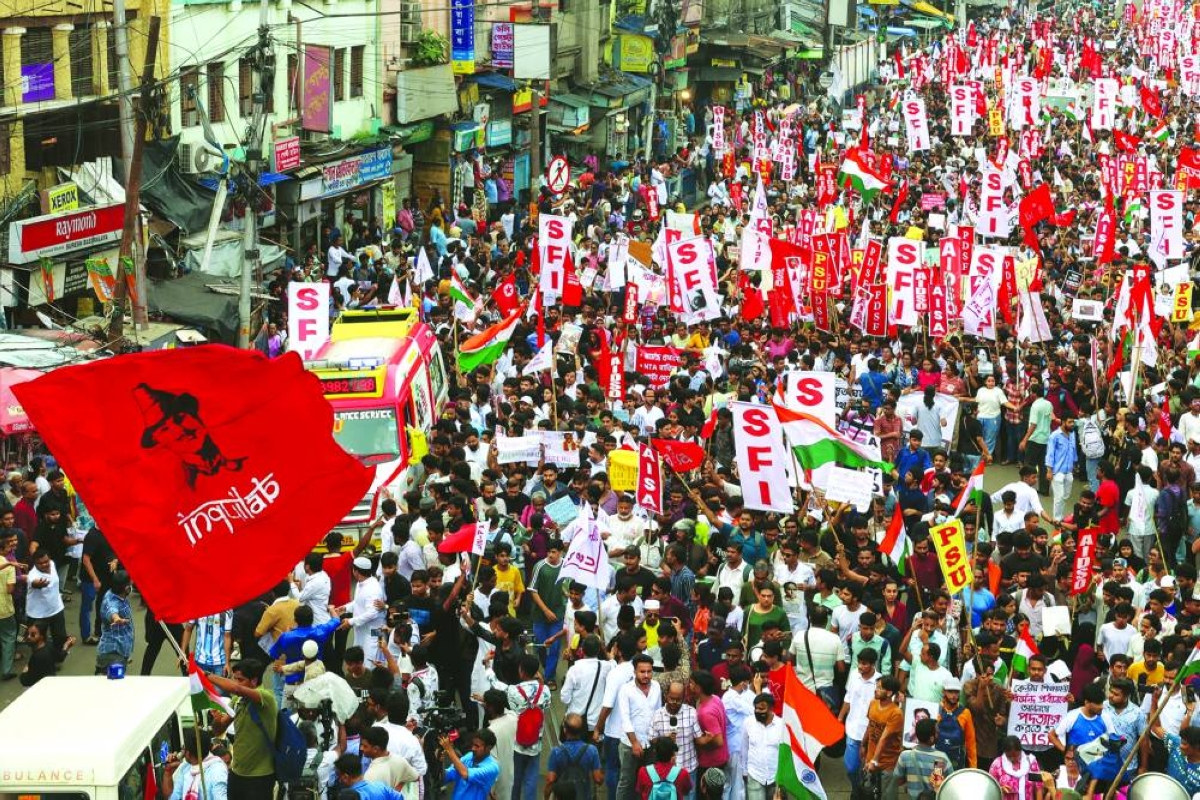
A police officer stands as people queue to get LPG cylinders, after Tuesday's violent protests by factory workers demanding wage hikes amid rising living costs linked to the US-Israeli conflict with Iran, in Noida, Tuesday.

World
South Korea’s Lee warns Iran war to keep oil price high, orders quick aid rollout

South Korea’s Lee warns Iran war to keep oil price high, orders quick aid rollout

South Korean President Lee Jae Myung (Reuters/File photo) South Korean President Lee Jae ​Myung said rising tensions around ‌the Strait of Hormuz made it hard to be optimistic about the ‌fallout from the ⁠Iran war, warning that ‌high oil prices and supply-chain strains were likely ‌to persist for some time.Lee told a cabinet meeting on Tuesday the government should treat ⁠prolonged disruption in global energy and raw materials markets as a given and reinforce its emergency response system."For the time being, difficulties in global energy and raw materials supply chains and high oil prices will continue," Lee said."I ask that we pursue the development of alternative supply chains, medium- to long-term industrial restructuring, and the transition to a post-plastic economy as top-priority national strategic projects." Lee also urged ministries to move quickly to ​deploy a supplementary budget passed in response to the war.At the meeting, ministers outlined steps to contain the economic shock from the conflict, including support for crude imports, controls against hoarding of petrochemical ‌feedstocks and medical supplies, and expanded financial ⁠assistance for affected companies.Industry Minister Kim Jung-kwan said disruptions to shipping through the ​Strait of Hormuz were still affecting supplies and that even if the passage normalises, it could take around 20 days for Middle Eastern cargoes to reach South Korea.The government is prioritising support for the passage of seven South Korea-bound oil tankers stuck in the Gulf area, a document shown during the cabinet meeting said. Foreign Minister Cho Hyun told the meeting that the ministry had sent officials to the Congo, Algeria and Libya in a bid to secure energy supplies, in addition to presidential Chief of Staff Kang Hoon-sik travelling to countries such as Kazakhstan since last week."I also urge ‌the parties to this war to ‌take courageous steps toward the peace ⁠the world so desperately wants, based on the principles of protecting universal human rights and ⁠the lessons of history," Lee said. South Korea's ⁠energy ministry said on Tuesday it would begin rolling out a revised seasonal and time-of-use electricity pricing system to shift power demand away from evening peak hours toward midday, when solar generation is higher. The new rates take effect for large industrial users from April 16 while weekend discounts for electric-vehicle charging will begin on April 18. Meanwhile, Middle Eastern oil producers are in ​contact with South Korea about using the country's petroleum storage facilities as disruptions at the Strait of Hormuz continue, a South Korean industry ministry official said on Tuesday, signalling growing interest in offshore crude storage hubs.Yang Ki-wook, a senior official at the industry ministry, told a briefing that Middle Eastern countries were showing increased interest in storing oil outside the strait because a prolonged disruption in logistics would hit their economies and pre-positioning crude could reduce export risks.Yang said that in addition to Abu Dhabi National Oil Company (Adnoc), which already has a ‌joint stockpiling agreement with South ​Korea, other Middle Eastern producers were also in contact, though he did not identify them.  Related Story