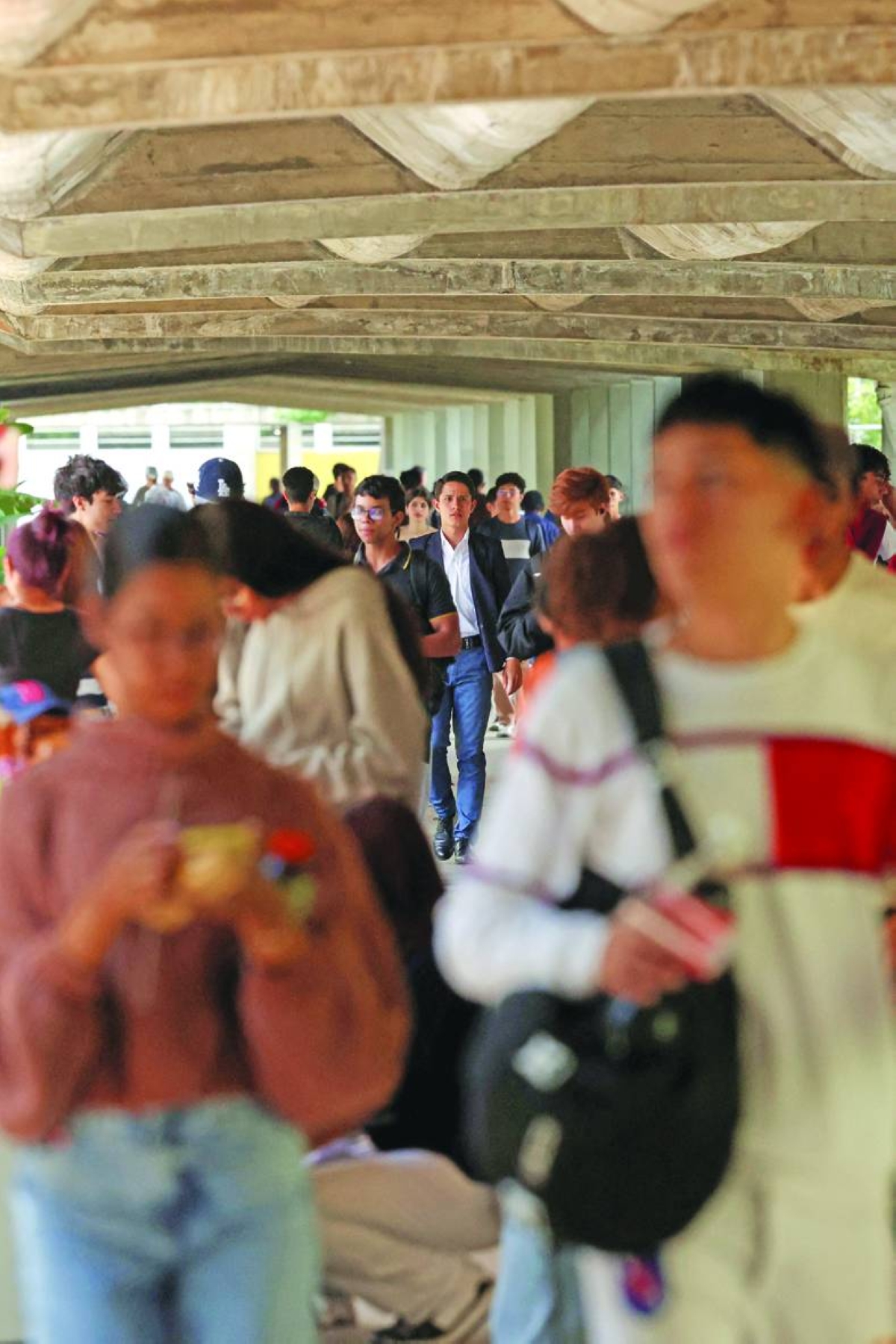
In mid-February, hundreds of students from Venezuela’s most prestigious university did the once unthinkable: their protest left the campus of the Central University of Venezuela in Caracas and spilled out into a nearby street. Before the US military operation that captured Nicolas Maduro on January 3, student activism was a risky proposition in Venezuela. Remaining on campus had historically offered some protection; student protesters who took to the streets risked being beaten, detained, or worse. Bodies like the United Nations have denounced torture against detainees in Venezuela, including electric shocks, asphyxiation and sleep deprivation. So when the students, marching alongside relatives of some of those imprisoned by the Maduro government left campus chanting “free them all,” it was an act of defiance. “I was born in 2003 and all I knew was fear...until today,” Paola Carrillo, 22, a member of the student union told the cheering crowd. “We are fighting for the freedom we want.” Venezuelan university students, waving flags or bloodied from clashes with security forces, were the key protagonists of massive anti-government protests a decade ago. Those demonstrations waned amid a crackdown by security services which included arrests of students and professors and violence by ruling-party-allied motorcycle gangs that killed hundreds. A deep economic crisis forced many out of classrooms and into the workforce. Smaller protests in 2019, 2024 and early 2025 were quickly extinguished. But now a new generation is on the streets. Ten student activists from four universities around the country told Reuters they see real hope after the ouster of Maduro — despite the endurance of the government he headed — and feel safer speaking out now than at any point in recent history. The students, ranging in age from 22 to 27, have only ever known the socialist ‘Chavismo’ government, named for former President Hugo Chavez, in power since 1999. “I hadn’t done anything like this before, and I think now is the moment even though it’s frightening,” said Carrillo, who is in her final year of a law degree and was just becoming a teenager when the last mass student protests took place. Her goal, she said, is to encourage others to join, “to let people who feel like I do know that they have a voice, that there is someone who feels the same and is still here, trying,” she said. Neither Venezuela’s communications ministry, which handles all press requests for the government, nor the attorney general’s office responded to questions for this story. CONFRONTING DELCY RODRIGUEZ IN THE STREETSThe students said their agenda goes far beyond the release of prisoners: they want the repeal of laws against hate speech and terrorism which they say are tools of oppression, free and fair elections, and what they call “reinstitutionalization,” repairing state institutions activists say have been destroyed by the socialist party. The students also want larger budgets for universities and salary increases for professors, who earn just $4 a month. Miguelangel Suarez, 26, president of the student federation at the Central University of Venezuela, even confronted Interim President Delcy Rodriguez after she attended an event on campus in January, an encounter which was shared widely on Venezuelan social media. “I told the group: ‘Look, I’m going to confront Delcy Rodriguez.’ About 20 others stood up and decided, ‘We’re going with you.’ That says a lot about how the paradigm has changed since January 3,” he said. The interaction was a rare unscripted one for Rodriguez, a 56-year-old lawyer and herself a Central University of Venezuela graduate, who rarely gives interviews or takes questions. Her interactions with the public are mostly at pro-government events. “She told us we weren’t letting her speak. On the contrary, we were - and still are - willing to engage in dialogue,” said Suarez, who is set to graduate in December with a degree in political and administrative studies. “As a graduate, and as someone with such important responsibilities, she should come and talk with us about the many problems facing universities.” Though the students are anti-government, many are not involved directly in opposition parties and have yet to turn their attention to eventual elections promised by the US. About 1.3mn students are eligible to vote, according to Carlos Melendez, a sociologist and director of the non-governmental Observatory of Universities, which could make them a crucial voting bloc in the country of 28 million. “We are seeing a group of students who not only want to study, but also to engage in the country’s political agenda,” said Melendez, who has monitored Venezuela’s higher education system since 2018. Their participation is “not due to party indoctrination, but rather a reaction to the government and its policies, as they seek to push for democratic restoration.” ‘NOBODY WANTS THEIR COUNTRY TO BE BOMBED’Students across Venezuela expressed gratitude that Maduro is gone, but are wary of the United States and said they wished his ouster had been achieved through other means. Maikel Carracedo, 27, a law student at the University of Zulia in Maracaibo said he learned of the US operation to remove Maduro when he was woken by a phone call. “They’re invading Caracas!” a friend said. “The first thing I did was make myself a cup of coffee. My first coffee in freedom,” he said. But for all the elation of seeing the potential end of the Chavista era and the hope for reconstruction, Carracedo, like a lot of other students, expressed dismay about how it happened. “We truly hoped that change would come in a much more democratic, peaceful way,” he said. “Nobody wants their country to be bombed or attacked, but that’s what happened. Most people weren’t injured, it was surgical. And I’m genuinely glad because the dictator’s departure was quite significant.” Carrillo, the student leader in Caracas, said that in general, young Venezuelans “would have preferred to reach this point differently.” “Deep down there is frustration that it couldn’t be done by us and that the situation, the circumstances, the regime, led us to this point where someone else had to do it for us,” she said. “Furthermore, there is practically indirect administration by a third country over our country and especially over our resources.” US President Donald Trump has repeatedly praised Rodriguez for stabilizing the country after the removal of Maduro, as well as for her efforts to open the country to oil and mining interests. Maduro always denied accusations he presided over a dictatorship and said he was fairly elected for his third term in 2024, an assertion rejected by the opposition and international observers, who say the candidate for an opposition coalition roundly won. FROM STUDENT TO PRISONER AND BACKFor some students, prisoner releases are personal. Jose Castellanos, a 22-year-old economics student at the Lisandro Alvarado Central Western University in the western state of Lara, was detained in October 2025 and held for nearly four months on charges of terrorism, inciting hate and treason, all of which he denies. Authorities accused Castellanos of hanging a banner reading ‘Freedom... it’s happening’ on a university building. He was arrested alongside his brother, a communications student and reporter, and their mother. Both have also been released. “Being in prison made me mature. It gave me more courage and strength to fight for the country’s freedom, for democracy,” Castellanos told Reuters while taking part in a march in Barquisimeto in February. “We will continue peacefully in the streets, with the truth on our side, demanding our rights as Venezuelans.” At least two Central University of Venezuela students and two professors were also released from detention in February, student leader Suarez said. They include Jesus Armas, a professor, human rights activist and opposition member who was arrested in December 2024 and accused of terrorism, which he denies. “We are basically going through a personal transition - from uncertainty and fear of speaking out to feeling freer,” said Luigi Lombardo, 26, a social sciences education student at the University of Carabobo, in the central state of the same name, adding that Maduro’s capture marked “the end for us of a long and painful era.” “It’s the freedom to say what you feel, to express the circumstances you’re living through today or the needs facing the university, such as lack of transportation funding, increases in student grants and decent salaries for professors,” Lombardo said. “Now there is space to express that discontent...to understand that the country is moving toward reconciliation.”


admin