admin
admin 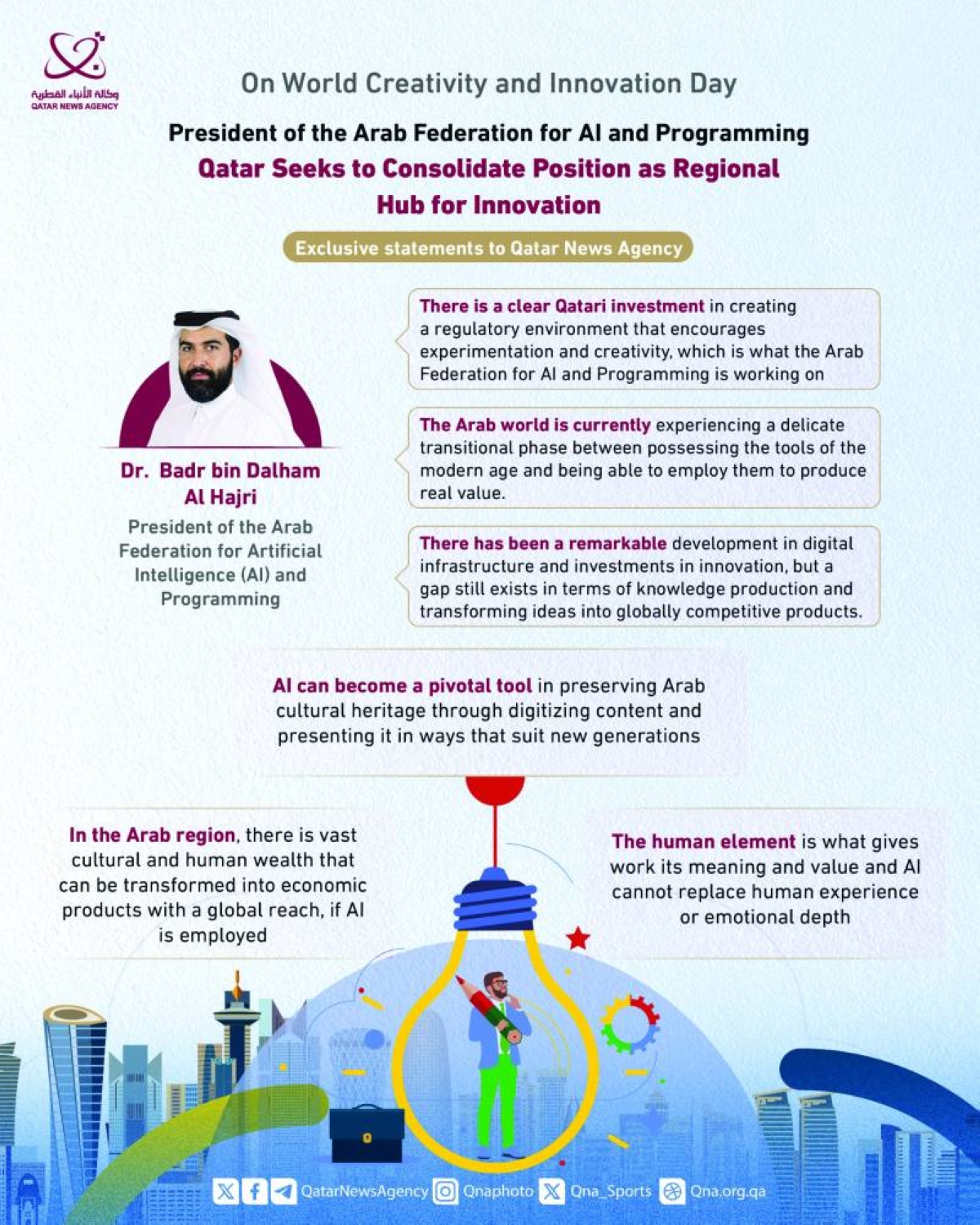
The world celebrated World Creativity and Innovation Day yesterday as the United Nations designated April 21 of each year as a global day to highlight the use of creative thinking and technology towards achieving the Sustainable Development Goals.
On this occasion, President of the Arab Federation for Artificial Intelligence (AI) and Programming Dr Badr bin Dalham al-Hajri confirmed in an exclusive statement to Qatar News Agency (QNA) that the Arab world is currently experiencing a delicate transitional phase between possessing the tools of the modern age and being able to employ them to produce real value. There has been a remarkable development in digital infrastructure and investments related to innovation, he added, noting that a gap still exists in terms of knowledge production and transforming ideas into globally competitive products.
Dr al-Hajri said that Qatar is presenting an advanced model, as it has moved from adoption to the initiative stage, and is now seeking to consolidate its position as a regional centre for innovation, not only through investment in technology, but also through building an integrated system that links education with scientific research and industry, which is what the federation is currently working towards.
Advanced infrastructure
Regarding the role of cultural and creative infrastructure in Qatar in this direction, Dr al-Hajri affirmed that the country possesses an advanced infrastructure at the regional level, whether in terms of cultural institutions or initiatives supporting innovation. There is a clear investment in education and research, along with a regulatory environment that encourages experimentation and creativity. These are very significant efforts that cannot be overlooked, he added.
Regarding the role that AI can play in protecting Arab cultural diversity, he explained that AI can become a pivotal tool in preserving Arab cultural heritage through digitising content, analysing cultural data, and presenting it in ways that suit new generations. It can also support Arabic languages in all their diversity, and provide wider and more interactive access to cultural content.
However, this role requires clear policies that ensure the use of technology in the direction of protection and promotion, he pointed out. Regarding whether AI can redefine the concept of creativity itself, especially in the fields of arts and cultural industries, Dr al-Hajri pointed out that AI does not redefine creativity as much as it expands its boundaries and changes its tools. He added that there is a qualitative shift from individual, talent-based creativity to collaborative creativity that combines human sensibility with the immense computational capabilities of machines. In the arts and cultural industries, it has become possible to produce more diverse and complex works, he added.
He said that the human element is what gives work its meaning and value, and therefore, AI frees the creator from technical constraints, but it cannot replace human experience or emotional depth.
Regarding the relationship between the creative economy and smart technologies, Dr al-Hajri described it as a relationship of strategic integration, where technology represents a tool to increase efficiency and expand markets, while creative content provides added value. He pointed out that in the Arab region, there is vast cultural and human wealth that can be transformed into economic products with a global reach, if AI is employed in fields such as digital production, marketing, and audience behavior analysis.
He said that the challenge lies in building flexible work systems that accommodate integration and sustainable investment, and even achieve economic benefits capable of competing and asserting themselves in global circles, which can be achieved in the future thanks to the Arab efforts currently being made to be part of this path.
Young creators
Regarding the possibility of employing AI in supporting young creators in the Arab world, President of the Arab Federation for Artificial Intelligence (AI) and Programming Dr Badr bin Dalham al-Hajri affirmed to QNA that AI plays a prominent role in empowering young creators by providing low-cost production tools and smart platforms that help them reach a wider audience, and analytical techniques allow for a more accurate understanding of market trends and audience needs, which enhances the chances of success and continuity. It can also contribute to reducing the gap between talent and opportunity, which is one of the most prominent challenges facing young people in the region.
Regarding the policies necessary to integrate AI into the creative economy without harming its human nature, he stressed the importance of the need for a balanced legislative and ethical framework that guarantees the protection of creators’ rights, promotes transparency in the use of AI technologies, as well as investing in education and training to build a generation aware of the dimensions of this technology and capable of employing it responsibly.
He said that preserving the human character of creativity does not mean rejecting technology, but rather directing it in a way that serves cultural and social values, indicating that it cannot be assumed that modern technologies, which have become an urgent necessity in the current era, will come at the expense of humanity, but rather they will only exist with the presence of humanity itself, which leads and directs them.
Regarding whether AI can contribute to reshaping Arab cultural identity, he explained that AI may influence the tools for expressing identity, but it does not have the ability to formulate it in the first place, pointing out that cultural identity is formed through history and societal experience, not through algorithms. The real challenge lies in using this technology to enhance the presence of Arab identity in the digital space, rather than leaving it vulnerable to being absorbed into dominant global cultural models, al-Hajri added.
Regarding how cultural institutions can benefit from AI to achieve the Sustainable Development Goals, he affirmed that these institutions can employ AI in developing cultural education, expanding access to knowledge, and supporting initiatives aimed at empowering women and youth, and it can also be used in analysing the cultural and social impact of projects, which helps improve their efficiency and sustainability, and all of this makes AI a means to promote cultural justice and equal opportunities.
On the other hand, he stressed the importance of the need for an integrated partnership model, in which roles are distributed between humans and machines in a way that enhances the capabilities of both parties, expressing that humans will remain the visionary and imaginative ones, while the machine will take over the tasks of implementation, analysis, and expansion.
He noted that this relationship will not be based on replacement as much as it is based on co-operation, which may open new horizons for creativity that were not possible in the past.
World Creativity and Innovation Day is celebrated on April 21 of each year, pursuant to a resolution of the UN General Assembly issued on April 27, 2017, to contribute to turning ideas into reality and finding solutions to the challenges facing societies around the world. It is an occasion to celebrate new and innovative ideas that promote social, economic and environmental development towards building a sustainable and prosperous future for humanity.
World Creativity and Innovation Day is also an invitation to think outside the box and go beyond the usual boundaries. It encourages taking tangible risks and exploring new opportunities, making them available to everyone, including women and young people. It also helps in finding solutions to important crises and problems such as eliminating poverty and hunger.
The Arab Federation for AI and Programming is affiliated with the Council of Arab Economic Unity in the League of Arab States, and aims to promote Arab co-operation in the fields of AI and programming, and to support digital transformation and sustainable development efforts in the region.