admin
admin Manea Abdullah Bin Huwaireb Al Muhairi, an Emirati resident of Al Ain, has successfully transformed his farm in the desert sands of Al Aamerah, into a fertile ground for cultivating and propagating various non-native fruit trees. This transformation was achieved through sustainable solutions for soil and water management, utilising worm castings as a form of organic fertilizer.
He has also managed to utilise all farm waste, converting it into organic fertiliser, firewood, fencing and other materials, thus contributing to sustainability, food security and environmental conservation.
Al Muhairi, a graduate of business administration from a university in the United States, said he owned the farm since 2007 and began in 2010 implementing unconventional ideas by planting more than 10 non-native trees that were among the finest varieties in their homelands and grafting them onto local varieties that could tolerate the UAE environment, temperature and soil.
The impressive results he achieved at the beginning prompted him to turn the farm into something like an agricultural experimental field, where the cultivation of bananas, pomegranates, grapes, various types of berries, oranges, Egyptian sugarcane among others was successful, he said.
‘BIOLOGICAL WAYS’
This was achieved by grafting the finest non-local varieties that were brought onto local trees, which resulted in fruits that were of high quality, identical to those produced in their original environment, he added.
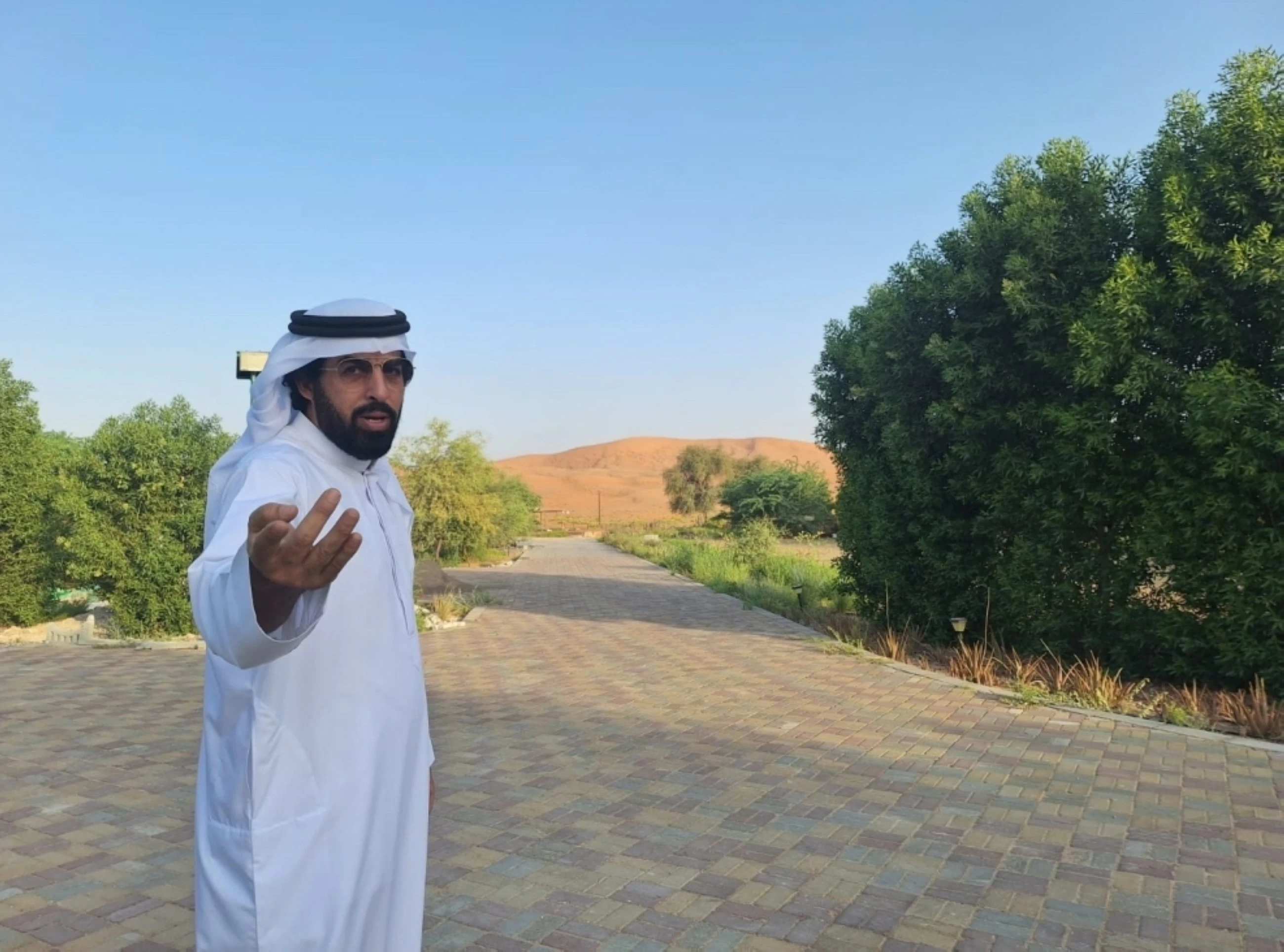
Manea Abdullah Bin Huwaireb Al Muhairi.
The soil was treated in biological ways that relied on organic mixtures that he prepared himself and fertilized with worm waste, he said, noting that he bought about 2,000 earthworms and multiplied them until they were millions.
These earthworms ate tree waste and excreted it as waste that turned into powder organic fertiliser that was put in basins built for this purpose, he added, noting that this powder organic fertiliser, which included enzymes and bacteria increased soil fertility and was considered one of the best types of fertilisers in the world.
After a series of experiments, he used the water produced from earthworm basins, which were usually moistened, and used it to fertilise the soil, he said, adding that these experiments achieved amazing results.
Al Muhairi stated that he allocated part of his farm to cultivating plants with balanced, non-genetically modified seeds and succeeded in propagating a number of varieties including peppers, celery, parsley, onions and coriander.
He also allocated another part of his farm to beekeeping close to 18 carefully selected varieties of Sidr trees with the aim of producing Sidr honey, he said.
“I am keen to achieve the highest levels of sustainability by utilising all farm waste including wood, which is converted into wood shavings used for chicken coop floors and into soil, and tree trunks for manufacturing firewood, fencing and other multiple uses,” he added.