1. Home
  2. Author Blogs

Author: admin

admin

World
Boat carrying stranded whale 'Timmy' reaches Denmark

Boat carrying stranded whale 'Timmy' reaches Denmark

A special barge carrying a humpback whale that was stranded in Germany had entered Danish waters by Wednesday afternoon and is expected to reach the North Sea in two days, local officials said.The whale, dubbed 'Timmy' by German media, was coaxed into the vessel in a last-ditch rescue attempt on Tuesday after a weeks-long struggle for survival on the Baltic Sea coast.The ship Fortuna B, which is towing the barge, was located between the islands of Langeland and Lolland in southeastern Denmark at around 1400 GMT, according to the VesselFinder website.'If everything goes well, he'll be in the North Sea in two days. The very worst is already behind him now,' Till Backhaus, environment minister for the state of Mecklenburg-Western Pomerania, told the Bild daily.Speaking to reporters on the island of Poel, where the whale was most recently stranded, Backhaus said the animal was 'doing well' and had made sounds during the night.Backhaus thanked rescuers for their 'wonderful' effort in 'an exceptional situation that is hardly comparable anywhere in the world in this form'.The whale had been struggling for more than a month around the German coast, getting stuck on sandbanks and then managing to free itself again several times.At the start of April, officials gave up on trying to rescue the animal, saying they believed it could not be saved.But this triggered an outcry and authorities were persuaded to approve a privately financed rescue plan proposed by two wealthy entrepreneurs.The barge idea was hatched after their initial attempt to save the whale with inflatable cushions and pontoons was unsuccessful.The rescue effort was seen as a long shot and criticised by experts who said it would only cause the animal more distress.The whale's ordeal has sparked a media frenzy — with non-stop coverage from TV channels, online outlets and social media influencers — but has also led to angry spats and conspiracy theories. 

World
US Supreme Court leans towards Trump’s move targeting immigrants

US Supreme Court leans towards Trump’s move targeting immigrants

The US Supreme Court appeared sympathetic Wednesday towards moves by President Donald Trump’s administration to strip humanitarian protections from hundreds of thousands of Haitian and Syrian immigrants, part of his signature immigration crackdown. The justices heard arguments in the administration’s appeal of rulings by federal judges in New ‌York and Washington, DC, halting its actions to terminate Temporary Protected Status, or TPS, previously provided by the US government to more than 350,000 people from Haiti and 6,100 ​from Syria. The legal dispute presents a test of Trump’s executive power and the Supreme Court’s traditional deference to presidents ‌on matters of immigration, national security and foreign policy. The court last year let the administration ‌end TPS for hundreds of thousands of Venezuelans. US Solicitor General D John Sauer, ‌arguing for the Trump administration, said the lawsuits challenging the TPS revocation are meritless and barred by federal law. The lawsuits before the Supreme Court “challenge the very kind of foreign policy-laden judgments that are traditionally entrusted to the political branches,” Sauer said. Revoking TPS and other humanitarian protections is part of Trump’s broader rollback of legal and illegal immigration since he returned to office in January 2025. In defending its actions on TPS, the administration has said such protections were always meant to be temporary. The United States first provided these protections to Haitians after a major earthquake in 2010 and to Syrians after their country descended into civil war in 2012. Under US law, TPS is a designation that allows migrants from countries stricken by war, natural disaster or other catastrophes to live and work in the United States while it is unsafe for them to return to their home countries. Ahilan Arulanantham, the lawyer representing the Syrian immigrants, said the administration’s position “contravenes the text, bedrock administrative law and common sense,” adding that “the government reads the statute like a blank check.” The administration has said it followed proper procedures, and has made the broader ​argument that courts cannot second-guess its TPS decisions in the first place, an assertion that if accepted by the court could doom challenges going forward. The law governing TPS “bars judicial review of both the (Department of Homeland Security) secretary’s ultimate decision, whether to designate, extend or terminate and of each antecedent step along the way to that determination,” Sauer told the justices. “That provision means what it says,” Sauer said, adding that “attempts to carve out exceptions ‌to the review bar would eviscerate it.” The Trump administration has drawn parallels between the revocation of TPS and Trump’s travel ban targeting several Muslim-majority countries during his first term, which the Supreme Court declined to block in a 2018 decision known as Trump v. Hawaii. Justice Sonia Sotomayor, one of the three liberal justices, said the administration’s position is at odds with the relevant federal statute and the US Constitution. “Congress could have said any termination of TPS status is unreviewable, but it didn’t,” Sotomayor said. The relevant statute may not allow a challenge to the “substantive conclusions” of whether TPS should be terminated, but it does seem to allow challenges to the procedural steps undertaken to get there, Sotomayor said. “What you are basically saying is Congress wrote a statute for no purpose,” Sotomayor said. Federal law, Sotomayor said, clearly “set forth procedural steps that had to be followed.” TPS recipients, until the termination, “are here lawfully with permission,” Sotomayor added. “They are entitled to due process, and now Congress has given them a process — it may not be a court process, but that’s okay, it’s a process — and you are saying it is ‌unreviewable whether the president has followed that process.” The Supreme Court has granted ‌the Republican president’s requests to immediately implement various hardline immigration policies while legal challenges continue to play out in courts. For instance, it let Trump deport immigrants to countries where they have no ties and let federal agents target people for deportation based in part on their race or language. The legal dispute could have wide implications, affecting 1.3 million immigrants from all 17 countries currently designated for TPS, according to the plaintiffs. Trump’s administration has sought to rescind the protections for 13 of those countries so far. Conservative Justice Brett Kavanaugh asked Sauer why Congress would have wanted to prohibit judicial review of TPS determinations. Sauer responded that revoking a TPS determination is “the sort of foreign policy-freighted decision that lies at the heartland” of the executive branch’s competence. “Those sort of determinations being second-guessed at the district courts - it’s almost like these district court judges (are) appointing themselves junior varsity secretaries of state,” Sauer said. Lower courts ruled against the TPS terminations, finding that administration officials failed to follow mandatory protocols to assess conditions in a country before ​revoking its designation. The Trump administration has argued that courts should not be second-guessing whether government agencies engaged in sufficient consultant with each other before terminating TPS. Conservative Justice Samuel Alito seemed to endorse that argument, saying “it is always going to be possible to raise procedural objections to what’s been done.” When TPS for Syrians was terminated, “there was some consultation,” Alito said. “It was very brief, and maybe it was not what one would hope for, but still.” At issue are actions taken last year by Kristi Noem, Trump’s former Department of Homeland Security secretary, to revoke the TPS designations for Syria and Haiti, stating that providing this status to them was contrary to US national interests.  Related Story

World
QF students reflect on Education City’s resilience, support, continuity

QF students reflect on Education City’s resilience, support, continuity

When regional tensions escalated, students across Qatar Foundation’s (QF) Education City found themselves navigating uncertainty, disruption, and concern. For many students, the greatest difficulty came in the early days, when the future felt unclear and routines suddenly shifted. During this intense period, QF ensured to safeguard its community through clear communication and swift co-ordination, while ensuring academic continuity during a challenging period. Usama Aliyu, a PhD candidate in Genomics and Precision Medicine at QF’s Hamad Bin Khalifa University (HBKU), described the initial moments as “deeply unsettling”. He said: “The biggest challenge was the initial panic and not knowing what might happen next and how it could affect our academic life and safety.” Beyond personal concerns, Aliyu also carried responsibilities as a student leader, acting as a link between students and administrators. “I was supporting others, answering questions, and providing reassurance, often without having complete information myself. Being the bridge between students and management during such a tense period required composure, clarity, and emotional resilience.” With families of students watching events unfold from afar, Aliyu feels that studying abroad during a time of regional tension carries additional emotional responsibility. “My main concern was reassuring my family that we were safe, despite what they were seeing on international news. Balancing their concerns while staying focused on my studies required emotional strength, but the strong support system at QF made that much easier.” For Kareem Fanous, a final-year medical student at Weill Cornell Medicine–Qatar, QF partner university, the uncertainty came at a particularly critical moment. “Being so close to graduation, there was constant concern about how the situation would evolve and impact the remainder of the semester,” he said. Fanous explains that logistical changes compounded these concerns. “Rapid transitions to online learning and multiple evacuations from student housing highlighted how unpredictable the situation was.” Despite these challenges, Fanous emphasised that Qatar Foundation’s response played a significant role in reducing anxiety and maintaining order, describing clear and frequent communication as “a recurring theme across student experiences”. Ameer Shamyl Ahmed, a Pakistani student completing his Master’s degree in Islam and Global Affairs at HBKU’s College of Islamic Studies this year, shared that the support he received went far beyond operational measures. Having lived in Qatar for two years, he noted that Student Housing at Education City demonstrated exceptional flexibility and care throughout the period. He also emphasised the value of community building efforts. “Initiatives such as creating gaming areas and organising small gatherings, including group Suhour and Iftar during Ramadan, offered moments of comfort and normalcy during a challenging time.” A similar sense of disruption was felt by Aya Abdelhamid, an Information Systems student at Carnegie Mellon University in Qatar and a Class of 2026 graduate. Born and raised in Qatar, Abdelhamid had spent most of her life immersed in a vibrant campus and social environment. Abdelhamid echoed QF’s consistent presence throughout the transition. “What I really appreciated was how responsive QF was,” she said. “It never felt like we were left to figure things out on our own.” “Even beyond academics, just knowing there were support systems in place made a big difference during such an uncertain time,” she added.  Related Story

World
Iran war has cost US $25bn so far

Iran war has cost US $25bn so far

 The war against Iran has cost the United States $25bn since it was launched in late February, a senior Pentagon official said yesterday. “We’re spending about $25bn on Operation Epic Fury. Most of that is in munitions,” acting Pentagon comptroller Jules Hurst told lawmakers, using the official name for US operation.   Related Story

Sports
HE Sheikh Joaan declares close of Asian Beach Games, praises Sanya success

HE Sheikh Joaan declares close of Asian Beach Games, praises Sanya success

His Excellency Sheikh Joaan bin Hamad al-Thani, President of the Olympic Council of Asia and the Qatar Olympic Committee, officially declared the conclusion of the 6th Asian Beach Games during the closing ceremony held at Yasha Park in Sanya.In his closing remarks, HE Sheikh Joaan described the Sanya edition as exceptional, emphasizing that Asia’s unity had created a historic moment. “Together, as one Asia, we made history. Through our love of sport and our shared dream, we have showcased the very best of our continent,” he said.HE Sheikh Joaan praised the host city’s success in rising to the occasion and establishing itself on the global stage. He commended the efforts of the organizing committee, the Chinese Olympic Committee, and the government of the People's Republic of China.“I have no doubt this will be the first of many major sporting events that Sanya will host. As this edition concludes, the spirit of Sanya will remain with us - reminding us that when Asia unites, anything is possible,” he added. The ceremony also featured the traditional handover of the Olympic Council of Asia flag. The Mayor of Sanya presented the flag to the President of the Chinese Olympic Committee, who then handed it to Sheikh Joaan. His Excellency subsequently passed it to Abraham Tolentino, symbolizing the transfer to Cebu City, host of the next edition in March 2028.Qatari delegation celebrates national achievementsUnder the patronage of HE Sheikh Joaan, His Excellency Dr. Thani bin Abdulrahman al-Kuwari, Second Vice President of the Qatar Olympic Committee, hosted a banquet honoring the Qatari delegation’s participation and achievements. The event was attended by Ali Ghanem al-Kuwari, President of the Qatar Volleyball Federation, and Mohammed Saad al-Mughaisib, President of the Qatar Basketball Federation, along with administrative staff and national team athletes. During the banquet, the delegation celebrated gold medal victories in beach volleyball, 3x3 basketball, and handball, as well as a silver medal achievement. The evening reflected a strong sense of pride and appreciation for the teams’ outstanding performances throughout the Games.  Related Story

Opinion
Will fuel shortages ruin summer vacations?

Will fuel shortages ruin summer vacations?

Out-of-service fuel nozzle is seen at a gas station in Les Sorinieres, near Nantes, France, April 30, 2026. REUTERS/Stephane Mahe Concerns are growing that shortages of diesel and jet fuel due to supply problems caused by war between Iran and the United States could ruin summer vacations. The chief executive of French energy giant Patrick Pouyanne warned that if the Strait of Hormuz remains closed another two or three months all of the world will face “energy shortages like those certain Asian countries are facing”. Since the start of the war at the end of February travel through the Strait of Hormuz, through which around a fifth of the world’s oil and liquefied natural gas (LNG) supplies normally pass, has been closed by Iran. Some 11mn barrels of oil per day are thus shut out from the market, according to the International Energy Agency. Gulf refineries also produce considerable amounts of diesel and jet fuel. Pouyanne said the world can’t make do without these supplies and not suffer serious consequences. Several nations in Africa and Asia -- which were more dependent upon Middle East supplies -- have already had to ration fuel or electricity. Both the European Commission and member states have sought to reassure consumers about supplies, at least in the short term. Summer is traditionally the peak driving season as families pack their cars to drive to their vacation destinations or hop on a plane. When supplies dwindle competition for them intensifies between the two major importing regions: Asia and Europe. This happened in 2022 following Russia’s invasion of Ukraine, and is shaping up to happen again. “Asia rations, switches to coal and can experience shortages in places” while “Europe pays very high prices to avoid shortages,” said an energy industry insider on condition of anonymity. That means Europe is first and foremost exposed to the risk of a price shock but shortages could emerge if supplies from the Gulf remain choked off. “Multiple cases point towards a shortage of diesel and jet fuel in Europe as the summer evolves, as imports from vital supply lines in the Middle East and Asia have waned with the current disruption,” said Janiv Shah, vice-president of Oil Markets and Downstream Analysis at Rystad Energy. Airlines have raised ticket prices and cut back on their flight schedules to cope with high jet fuel prices, with warnings of shortages in jet fuel just weeks away. “Unfortunately, it’s very likely that many people’s holidays will be affected, either by flight cancellations or very, very expensive tickets,” the EU’s energy commissioner Dan Jorgensen said on Sky News last week. Most nations have strategic oil reserves and those part of the International Energy Agency have already tapped those reserves to help contain surging prices earlier in the war. The could do so again in order to ensure no shortages develop. EU nations are trying to boost refinery production as much as possible, and in some cases boost production of diesel and jet fuel for which the bloc depends on imports. Encouraging working from home and carpooling are also options to reduce consumption in the short term. Over the longer-term, the electrification of transport and home heating aim to reduce reliance on imported fuels. Price also has an impact on consumption.  

World
Italy recovers looted antiquities from US

Italy recovers looted antiquities from US

Artefacts recovered from the US following a repatriation operation are displayed during a presentation at the Carabinieri Command for the Protection of Cultural Heritage, in Rome, Wednesday. (Reuters) The US has handed back 337 antiquities looted from Italy in one of the largest recent ​returns of stolen cultural ‌property, officials said Wednesday, highlighting deepened co-operation between Rome ‌and Washington. The artefacts, ranging from ancient ‌Roman sculptures to Greek, Etruscan and Egyptian ‌pieces, were presented at the headquarters of Italy’s Carabinieri cultural protection unit following an array of investigations, many centred on New York. Italy has spent decades trying to curb a rampant trade in illicitly excavated antiquities, securing the repatriation of thousands of artefacts worth tens of millions of euros. The campaign has gained momentum in recent years, aided by online databases, advances in technology and closer co-operation with US authorities, particularly the Manhattan ​district attorney’s office, which found 221 objects of this latest haul. “There’s no country in the world that has history and culture like Italy, and the US ‌will always do whatever it takes to help bring ​these wonderful artefacts back to your very special country,” the ​US ambassador to Italy Tilman J. Fertitta told reporters. Among the most significant items unveiled Wednesday were a marble head of Alexander the Great dating to the first century AD, which was stolen from a Rome museum in 1960. Also recovered were a bronze sculpture looted from the Roman town of Herculaneum, two Egyptian basalt statues, Roman coins, jewellery, ceramics and architectural fragments spanning from the fifth century BC to the third century AD. Italian authorities said many of the objects were ‌taken from clandestine excavations or ‌stolen from cultural institutions before being funnelled into the international art market. “Protecting cultural heritage means defending memory, strengthening identity and passing on to future generations the value of culture as a universal public good,” said Italian Culture Minister Alessandro Giuli. Italy and the US last year renewed a memorandum of understanding tightening US import restrictions on Italian archaeological material, strengthening customs controls and expanding information-sharing. The US is one of the main markets for ​global antiquities, with an array of auction houses, private collectors and museums interested in acquiring rare artefacts. “Sometimes they do not pay enough attention as to why these antiques are up for sale. That can be a very costly mistake,” said an official from the Culture Ministry, who was not authorised to talk to the press. “We know what is missing and are getting much better at finding it,” she added, predicting more returns in the ‌future. The recovered objects will ​now be studied and, where possible, returned to their places of origin across Italy.  Related Story

Sports
Atletico hit back to hold Arsenal in cagey semi-final

Atletico hit back to hold Arsenal in cagey semi-final

Atletico Madrid’s Marc Pubill (right) and Arsenal’s Piero Hincapie battle for the ball during the Champions League first leg semi-final in Madrid. (Reuters) Julian Alvarez’s penalty secured Atletico Madrid a 1-1 draw against Arsenal in a nervy Champions League semi-final first leg clash. Viktor Gyokeres sent the Premier League leaders ahead from the spot just before the interval after he was fouled, but Alvarez followed suit 10 minutes into the second half after Ben White’s handball. Arsenal were upset at a late penalty decision being overturned following a VAR review when David Hancko made contact with Eberechi Eze in the area. Atletico had the better for long periods but Arsenal’s solid defending helped them leave the Spanish capital in a good position to return to the Champions League final 20 years after their last appearance. “We were the team we have to be, if we play at this level we can win,” said Atletico captain Koke of his team’s second-half display. “From my point of view they didn’t create much danger against us... the team defended well and they just had that penalty.” What the game lacked in the dizzying goal rush of Paris Saint-Germain’s 5-4 win over Bayern Munich in the other semi-final the night before, it replaced with tension and a desperation not to fall behind. Toilet paper rained down from the stands of the Metropolitano stadium minutes before kick-off, in a striking – if wasteful – display, which invited cynical jokes from some quarters about the calibre of the spectacle ahead. In a tussle between arguably the continent’s two biggest teams never to lay a finger on the trophy neither wanted to blink first. Atletico still have an outdated defensive reputation but pinned Mikel Arteta’s miserly Arsenal back in the early stages, with David Raya tipping Alvarez’s shot around the post. The Gunners, a long way from Arteta’s eve-of-the-game demand they dominate proceedings, looked to smash and grab, with Marc Pubill blocking from Martin Odegaard on a quick breakaway. Noni Madueke, starting on Arsenal’s right flank with Bukayo Saka only fit for the bench, hammered just wide from distance as last year’s beaten semi-finalists sporadically emerged from their half. The next time they did, Gyokeres won a penalty. The Swedish striker, who might not have started if Kai Havertz was fit, exchanged passes with Martin Zubimendi and Hancko clumsily shoved him in the back from behind. Diego Simeone and Atletico veteran Antoine Griezmann begged for the decision to be reviewed but VAR saw no reason to intervene. Gyokeres took the spot-kick himself, walloping it past Jan Oblak, who dived the right way but stood no chance of keeping it out. Three-time runners-up Atletico, back in the semi-finals for the first time in nine years, came out guns blazing in the second half. Raya saved Ademola Lookman’s drive with Gabriel blocking Griezmann’s follow-up. The hosts pulled level from the penalty spot after White handled Marcos Llorente’s shot, the ball bouncing up and hitting his arm, which was away from his body. Alvarez took it, and having missed in Atletico’s Copa del Rey final shoot-out defeat earlier in April, this time made no mistake with an unforgiving blast rivalling Gyokeres’s first-half effort. MLS-bound Griezmann looped a shot off the crossbar and then sent the rebound off target as Atletico turned the screw in pursuit of an advantage to take into next Tuesday’s second leg. Nigeria international Lookman twice came close and could end up ruing his missed chances.  Related Story

Sports
Mainoo signs new five-year Man Utd contract

Mainoo signs new five-year Man Utd contract

Kobbie Mainoo has signed a new contract at Manchester United that will keep him at Old Trafford until 2031, bringing an end to months of uncertainty over his future.The 21-year-old, who joined United's academy in 2014, has already made 98 appearances for the club, scoring seven goals, including in the FA Cup final win against Manchester City in 2024.Mainoo fell out of favour under former boss Ruben Amorim and had a request to leave on loan in August rejected.He started just one game all season - the League Cup loss to Grimsby on penalties - under the Portuguese, who was sacked in January.That led to growing speculation that the future of the boyhood United fan could lie away from Old Trafford.But Mainoo has been rejuvenated under Michael Carrick, who was appointed as head coach until the end of the season after Amorim was fired.The midfielder has started all but one game since then, playing a key role as United have climbed to third in the Premier League, all but securing a return to the Champions League.'Manchester United has always been my home - this special club means everything to my family,' said Mainoo.'I have grown up seeing the impact that our club has on our city, and I relish the responsibility that comes with wearing this shirt.'He added: 'We can all feel the momentum building inside the club. I am determined to step up and play my role in helping Manchester United to regularly fight for major trophies in the years ahead.'Jason Wilcox, United's director of football, hailed Mainoo as one of the most 'naturally gifted young footballers in the world'.'His technical ability, dedicated professionalism and humble personality make him the perfect role model for our young players and a true credit to our outstanding academy system,' he said.'We are delighted that Kobbie has extended his stay here and have full confidence that he will develop into one of the best players in the world, ready to play a pivotal role in a Manchester United team challenging for the biggest honours.'Mainoo has also regained his place in the England set-up under Thomas Tuchel, featuring in friendlies in March against Uruguay and Japan. 

World
Uganda kindergarten murderer sentenced to death

Uganda kindergarten murderer sentenced to death

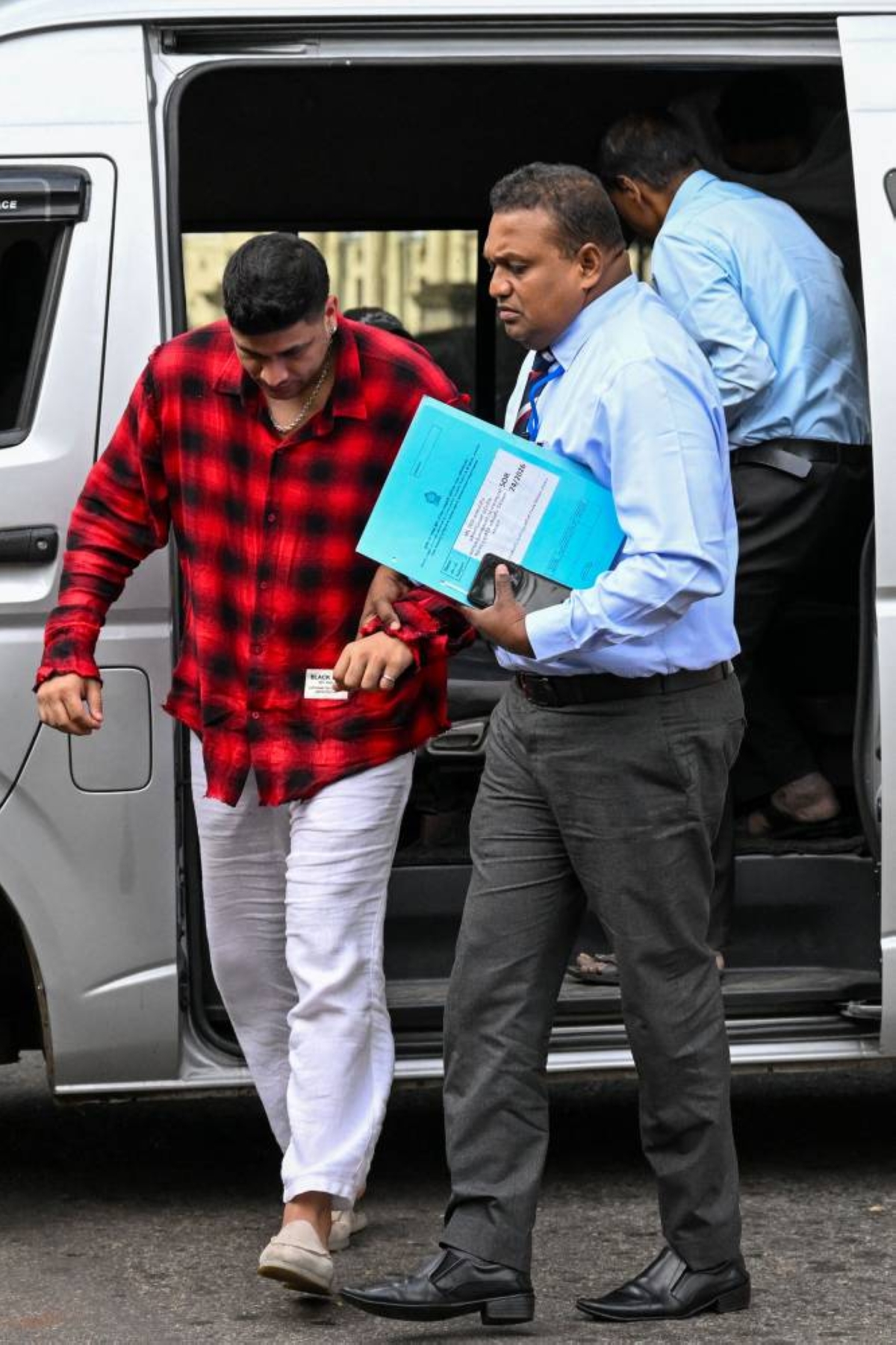
This picture taken last month shows Christopher Okello Onyum escorted by Uganda Prison guards during his trial at the Ggaba Community Church Grounds in Kampala. AFP A Ugandan court has sentenced a man to death for killing four young children this month at a nursery school, in an attack that sparked public outrage and concern for pupils' safety in the East African country.The judge said an investigation of Christopher Okello Onyum's phone and laptop had found searches including "schools near me" and "ISIS beheading", a reference to the Islamic State group.However, it was not clear if there was any political or religious motivation for the attack.In the attack, which took place on April 2 at a nursery school in the capital Kampala, 39-year-old Onyum stabbed his four victims – toddlers aged two and three years old – before a guard subdued him, police said.Angry parents tried to lynch him before he was detained.Prosecutors said Onyum, who holds Ugandan and US citizenship, confessed to the crime, believing the "human sacrifice" would help him become rich, although he eventually pleaded not guilty in court.The court earlier heard chilling testimony, including from a staff member at the Ggaba Early Childhood Development Centre."At first I thought he was beating a child. When I asked him why he was beating our children, before he responded I saw Kaisha (one of the victims) against a wall in the pool of blood," she told the court at the start of the trial."He got up and he had a knife in his hand. He was so quick that he immediately grabbed another child."I got one of the bicycles the children used. I threw it at him."When I threw the bicycle at him he left the child and started running after me. I ran but I later fell down. When I got up I found out he had cut the second child."The victims' parents also gave evidence, describing their last morning with their children before taking them to kindergarten, the phone call informing them of the attack and the discovery of the bodies at the hospital.One of Onyum’s lawyers had argued that he should be acquitted because he had long been mentally unstable and had been committed to a psychiatric hospital."I have no doubt in my mind that the search for 'ISIS beheading' prepared the accused person to launch this fatal attack," Judge Alice Komuhangi Khaukha said while delivering the sentence.She rejected his lawyer's assertion that Onyum was insane, saying that his attack, which took less than seven minutes, had been carefully planned.Onyum was seen laughing in the dock during his trial, which his lawyer said showed he was mentally ill.Although Uganda still hands down the death penalty for serious offences such as murder, the last execution was carried out roughly two decades ago.  Related Story