Boosie Badazz Sued By Security Guard for Assault
Boosie Badazz is being sued by a security guard who says the rapper smashed a glass hookah over his head ... the latest development connected to the alleged assault which landed Boosie in jail. Edward
21 Savage 'Nephew' Dies By Suicide ... After Allegedly Shooting Sister Published July 25, 2026 2:02 PM PDT A 14-year-old boy -- identified as a "nephew" to rapper 21 Savage -- took his own life
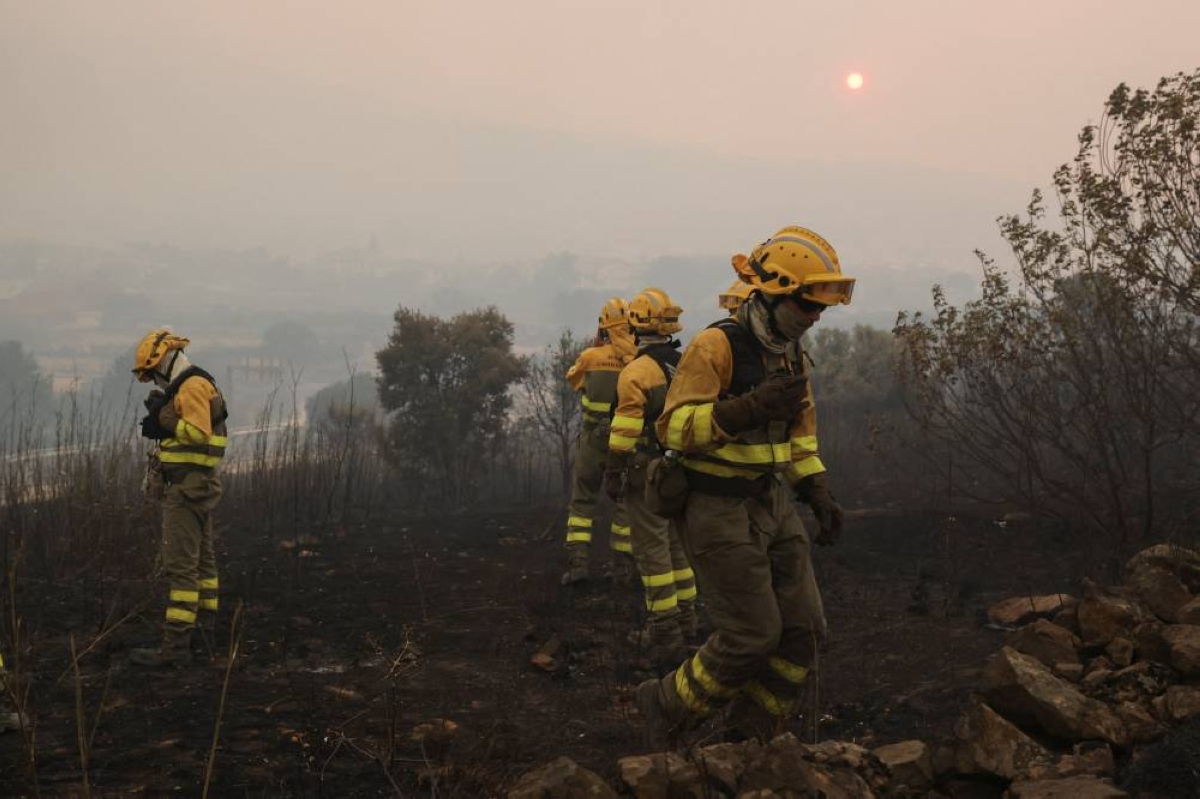
Spain’s Prime Minister Pedro Sanchez said yesterday firefighters were working to “save lives” in the blazes raging west of Madrid, as authorities said a separate fire in the east killed one person.The fires in the parched countryside have forced 60,000 people to flee their homes, the interior ministry said, in what officials have called the region’s worst fire on record. The central government delegate in Madrid had earlier given a higher estimate of around 70,000. “Our priority, our thinking, our aim is for your lives, to save your lives and protect inhabited areas,” Sanchez told reporters in the village of Cenicientos in the fire zone. “We are going to have some complex hours ahead because although the temperatures have gone down, we do not know exactly how the wind will develop, how strong it will be.”Early yesterday the smell of burning reached the streets of central Madrid, forcing them to keep their windows closed. The health ministry on X advised people to avoid staying outside for long periods because of bad air quality. Evacuees from surrounding villages were bussed in to shelter in sports halls around the capital.When flames reached the village of Robledo de Chavela, Rosa, 56, refused to leave at first because she wanted to arrange for carers to rescue the feral cats that she keeps. “I felt very ill because I have asthma. I started coughing and I threw up,” she told AFP at a gymnasium in the northern Madrid suburb of Alcobendas.“In the end... they (police) came to get me,” she said, asking not to be identified by her last name as she was concerned for her safety. “They didn’t do anything for the cats, but they told me I had get out of the house one way or the other.”The interior ministry said on X yesterday afternoon that another 30,000 people had been evacuated from villages near Madrid and nearly 30,000 from neighbouring Avila province, bringing the total who have fled to 60,000. It said 8,000 were ordered to stay in their homes in Madrid and 20,000 in Avila.Easing heat overnight offered a “window of opportunity this weekend to fight... this very serious fire”, Sanchez said. Two separate wildfires in the Madrid region combined on Friday to form one huge blaze, which threatened to merge with a third near Avila in the neighbouring Castilla y Leon region.A separate, smaller fire in a ravine near Valencia in the east meanwhile killed one person, the local authority in the affected town of Manises said on X, without giving further details. The Madrid regional government said on X that more than 2,000 people were being looked after in 14 emergency evacuation centres. Jacqueline Villafranca, 38, from Peru, told AFP she was evacuated in about an hour on Friday evening from the village of Navalagamella to Alcobendas with her husband and two daughters, aged 16 and two.When the fire alerts sounded on telephones, “I thought everything was going to burn, the house and everything,” she said at the sports hall, where they sat dozing and eating snacks. “Yesterday was unbearable. My daughter came home from holiday camp and said: ‘Mum, I can’t open my eyes, my eyes are burning’” from the smoke, she said.“And then the alerts started to sound and I evacuated.”So far this year fires have burned more than 168,000 hectares in Spain, according to the EU’s European Forest Fire Information System.Spain recorded its worst wildfire season in recent history in 2025, when more than 393,000 hectares were destroyed, EFFIS said.
World champion Lando Norris claimed his first win of the season and 12th of his career with a resounding triumph for McLaren ahead of Red Bull's Max Verstappen in Sunday's helter-skelter Hungarian Grand Prix.The 26-year-old Briton, who started from pole position but had to recover after a poor opening lap, came home 15 seconds clear of four-time world champion Verstappen with world championship leader Kimi Antonelli finishing third for Mercedes.The Ferraris of Charles Leclerc and seven-time champion Lewis Hamilton ended up fourth and fifth ahead of Isack Hadjar in the second Red Bull, George Russell in the second Mercedes and Racing Bulls' Liam Lawson.Nico Huelkenberg scored his first points of the season in ninth place for Audi ahead of rookie Arvid Lindblad in the second Racing Bulls. Norris repeated his success last season at the Hungaroring where McLaren have won for the last three years.Antonelli's determined drive, in a frantic race of divergent tyre strategies, lifted him 50 points clear of Hamilton in the championship.'Beautiful,' said Norris on team radio. 'The car was unbelievable today! Flying!'It's probably the best pace I've ever had,' he said 'This track is good for us.'Verstappen was critical of his car, but happy to claim another podium finish. 'I didn't expect it today - we had to work very hard for this,' he said.Antonelli said it had been a hard race. 'It was so tough to overtake, but it is the best result for me to go into the break and now we can keep pushing.'The race began in scorching heat with the highest temperatures of the weekend - 31 Celsius (air) and 51 (track).Ferrari gambling on soft tyres for the start while all the started on mediums.Oscar Piastri made a fast start to pass Leclerc. When Norris went wide at Turn Two and Piastri took the lead while Hamilton passed Leclerc for fourth behind Verstappen.Behind them, the luckless Russell's Mercedes went into anti-stall on the grid. He fell from from sixth to 20th while team-mate Antonelli advanced to sixth.Hamilton attacked Verstappen without success and by lap 10 was losing grip.'Max is slow,' reported Hamilton, who pitted to 'undercut' Verstappen on lap 14, rejoined 10th and stormed past Lindblad before Red Bull brought the Dutchman in on lap 15.Verstappen came out behind Hamilton, but regained his place with a lunge down the inside at Turn One.Piastri pitted from the lead, followed by Leclerc. It was frantic stuff and when Norris came in, Antonelli took over as leader.When the the Italian pitted, he returned in sixth. Piastri led folowed by team-mate Norris. The Briton requested a stop but McLaren brought in Paistri first.At halfway, Norris led Verstappen by five seconds.The Briton then pitted from the lead on lap 40 and returned in third, ahead of Piastri, the Australian having narrowly avoided a heavy collision with Carlos Sainz's Williams at Turn Two where they clashed. Sainz was given a five-seconds penalty.After Verstappen pitted again, Antonelli led with Norris in pursuit.Norris, on fresher tyres, regained the lead on lap 46 with a dive inside the young Italian at Turn One and built his advantage before Antonelli stopped again.Hopes of a McLaren 1-2 ended when Piastri slowed and retired with gearbox problems and a Virtual Safety Car (VSC) was deployed. Norris, Hamilton and Leclerc pitted for softs immediately.In a final flurry, Norris led Verstappen with Antonelli third, fending off Hamilton - penalised five seconds for speeding in the pit lane.
Taiwan's Chou Tien-chen overpowered his opponent in the China Open men's singles final on Sunday, becoming the oldest tournament champion in the category at age 36.World number six Chou vanquished 27-year-old Toma Junior Popov of France in three games, 21-15, 7-21, 21-13, to claim his first Super 1000 title since winning the Indonesia Open in 2019.The veteran needed just over an hour to seal the outcome in the championship matchup in Changzhou, eastern China.When an official video review showed that a final return from Popov had dropped out of bounds, an exhausted and emotional Chou kneeled face-down on the court, hands outstretched in victory.Popov, ranked 16th worldwide, had been chasing his first victory at a Super 1000 tournament.His younger brother Christo, ranked fifth, was eliminated in the round of 16 at this year's China Open.Earlier on Sunday, Japan's Akane Yamaguchi defeated host-country hope Chen Yufei to win the top prize in the women's singles final with an efficient 21-18, 21-16 performance.The final pairing represented a rematch of last year's World Championship in Paris, which was also won by Yamaguchi.26-year-old Yamaguchi is a three-time world champion and current world number three.In women's doubles, hosts Liu Shengshu and Tan Ning of China defeated Yuki Fukushima and Mayu Matsumoto of Japan in two games, 21-14, 21-19.The men's doubles competition saw reigning champions Fajar Alfian and Muhammad Shohibul Fikri of Indonesia defend their title, beating South Korea's Kim Won-ho and Seo Seung-jae in come-from-behind fashion 16-21, 21-19, 21-19.In the mixed doubles final, an all-China matchup saw Guo Xinwa and Chen Fanghui take down compatriots Feng Yanzhe and Huang Dongping in a closely contested 25-23, 20-22, 21-15 marathon lasting 88 minutes. Related Story
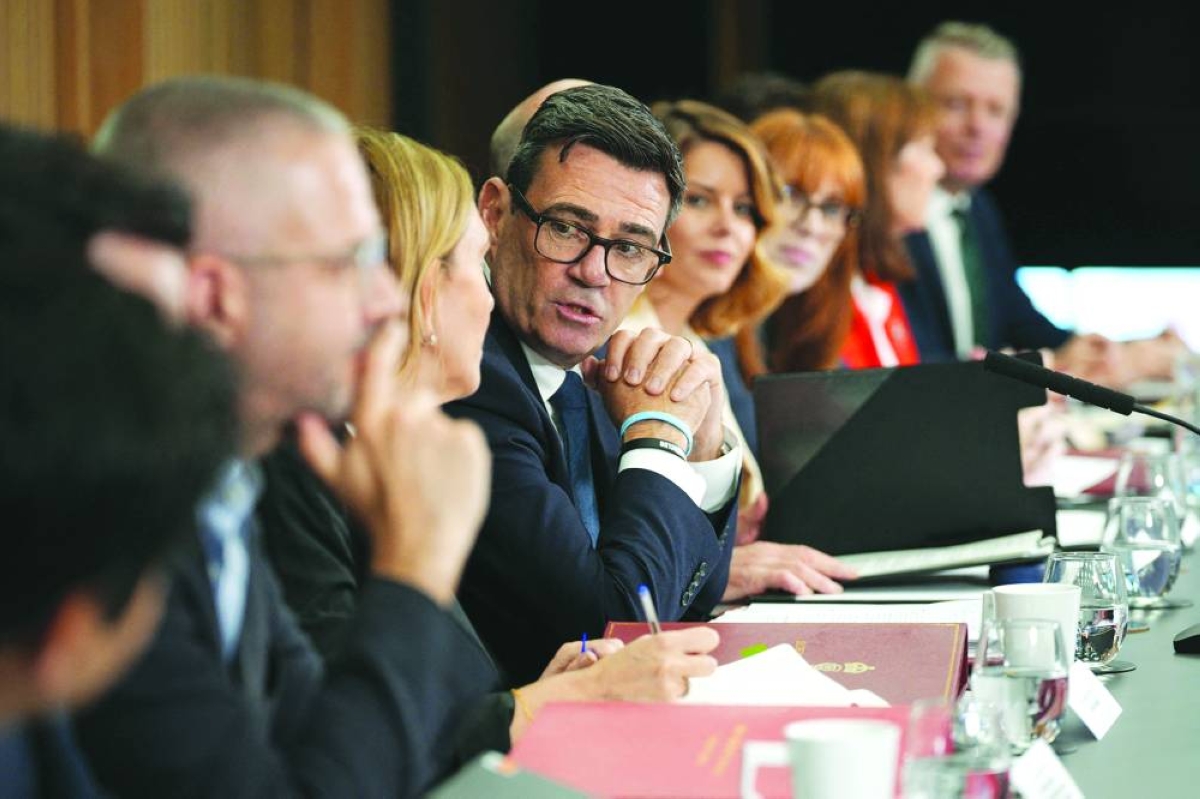
British Prime Minister Andy Burnham holds a National Economic Council meeting at No 10 North at Heron House in Manchester, north-west England on Friday. Burnham opened his newly created northern office as he bids to
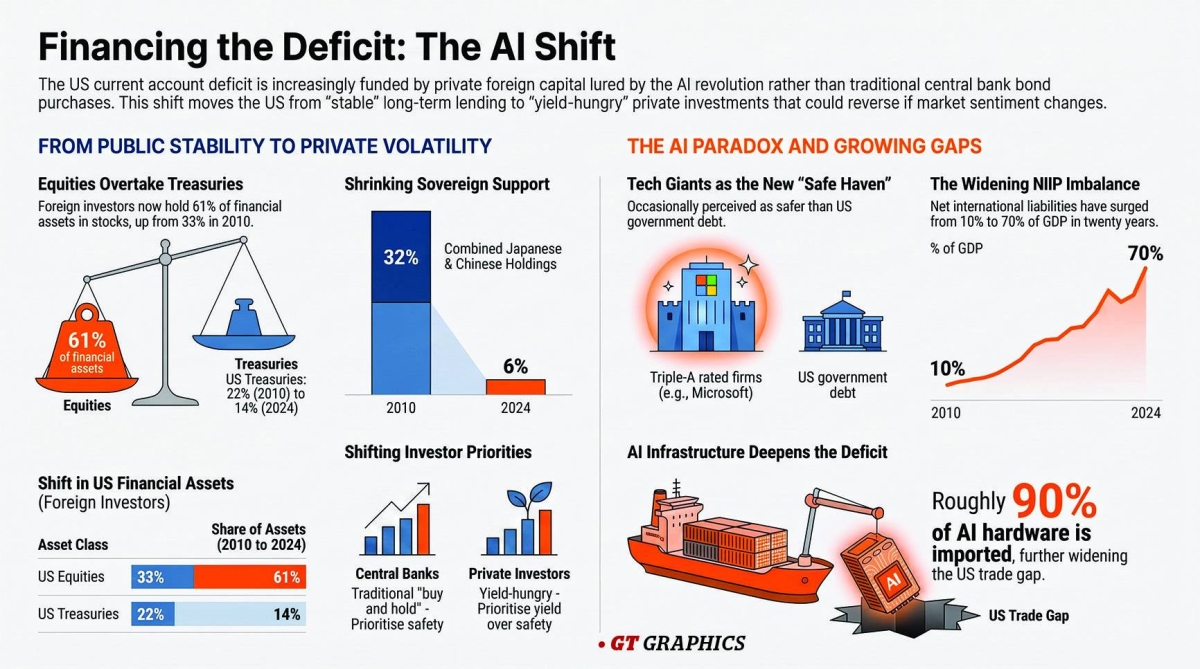
Foreign capital is flooding into Wall Street courtesy of the AI revolution. Paradoxically, however, this is intensifying the spotlight on America’s chronic external deficit. How long can this massive imbalance last? Investors around the world have poured trillions into the US stock market in recent years, lured by the juicy returns promised by the artificial intelligence boom, which has spurred the biggest capex spending spree in history. This flow of overseas money into US equities is now the key funding source for the US current account deficit, which has widened beyond pre-pandemic levels. America’s current account deficit represents the difference between the value of all the goods, services, interest, dividends, and income the US imports and what it exports. The US has been in deficit for decades. To fill that gap, foreigners must “lend” money to Uncle Sam by purchasing US assets. The Trump administration is striving to reduce that gap, especially the goods and services trade deficit, through a range of policies around immigration, domestic investment, and, of course, tariffs. It remains to be seen how successful those efforts will be. The trade gap has been hovering around 3% of GDP for the last few years, and the current account deficit is closer to 4% of GDP. These are big shortfalls in a $31 trillion economy. Attracting foreign capital to fill them is necessary to prevent the dollar from tumbling or bond yields from spiking. In theory, it doesn’t matter how the gaps are covered, just as long as they are. But some sources of capital may be preferable to others. Over the past 20 years, the composition of this funding mix has shifted - from the yield-insensitive “official” sector to return-hungry private investors - and that has arguably made America’s massive foreign liabilities look a lot more worrisome. In February 2005, then-Fed Chair Alan Greenspan noted a “conundrum”: US bond yields remained low despite a series of interest rate hikes. What could explain this? A month later, then-Fed Governor Ben Bernanke offered a potential answer. In a now famous speech, “The Global Savings Glut and the US Current Account Deficit,” Bernanke noted that emerging economies had, in a turnaround from previous decades, become a source of capital lending rather than borrowing. It was this flood of capital coming into the US, especially into the government bond market, that was suppressing interest rates. He had a point. In the decade leading up to the Global Financial Crisis, the US current account deficit was large, hitting a record 6% of GDP in 2006. This yawning deficit was financed by various sources of foreign wealth, whether from oil (“petrodollar” Gulf countries), trade surpluses (China, and much of Asia) or high levels of national savings (Japan). What all of these funding sources had in common was a thirst for US government debt, or Treasuries. Central banks were hoovering up Treasuries to keep their exchange rates competitive and build their foreign exchange buffers. Bernanke argued that this foreign demand for US debt delayed the reckoning that the widening global imbalances - the large US deficits and corresponding surpluses elsewhere - portended. While the day of reckoning may have appeared to come in 2007-08 in the form of the US subprime housing crisis, global credit crunch and Global Financial Crisis, these global imbalances are back. Now, though, the nature of US deficit financing has changed dramatically. The increasing integration of global financial markets in recent decades and loosening of capital controls in many emerging and developing economies have helped boost capital accumulation in the private sectors of these countries. These funds, in turn, have often found their way back into US financial assets as overseas investors have sought large, liquid markets and the prospect of high returns. As a result, private foreign capital has gradually replaced central bank capital as the primary funding source for the US current account deficit. Consider that in 2004, Japan’s official holdings of US Treasuries accounted for 18% of all outstanding US debt held by the public, and in 2010, China’s equivalent share represented 14%. These holdings have evaporated to less than 4% and just 2% today, respectively. Of course, overseas investors continue to buy Treasuries. Their total holdings stand at a record $9.4tn, more than half of which is now held by the private sector. But overall, foreigners now hold only 30% of all outstanding, publicly held US federal debt, compared to 50% in 2012. Foreign governments have gradually reduced exposure to US bonds for various reasons, including geopolitical, financial, and domestic economic considerations. Equities now hold more allure. In 2010, foreign investors held a third of their US financial assets in equities, and 22% in Treasuries. In the first quarter of this year, those shares stood at 61% and 14%, respectively. Foreign ownership of US stocks now stands at a record 18%, nearly double what it was in the mid-2000s. This shift could be a cause for concern. “Central banks tend to be ‘buy and hold’ investors to a large extent. Central banks typically care about safety, liquidity, then yield. In that order,” says Eswar Prasad, professor of economics at Cornell University. “For private investors, to some extent the order is flipped for them - they care about yield, liquidity and a little less about safety.” This isn’t an issue when Wall Street is booming. But it’s not difficult to imagine that dynamic suddenly turning, if Wall Street hits the skids or other markets suddenly look more attractive. Private capital flows could then slow, or worse, reverse, making America’s current account financing much more perilous. On the other hand, foreign investors may simply be onto something. It sounds counterintuitive, but by some measures, today’s US tech behemoths are just as “safe” an investment as Treasuries. Apple and Microsoft have a triple-A credit rating, unlike the US government, and the two-year yield on some corporate debt, like Microsoft bonds, is sometimes lower than the two-year Treasury yield. Moreover, some of the Big Tech firms are now so important to the US government from an economic, strategic and national security standpoint that it’s almost unthinkable that they would be allowed to fail. It’s not just private overseas sector capital that has been lured into Wall Street in recent years. Many central banks and sovereign wealth funds have increased exposures to trillion-dollar US megacaps like Apple, Microsoft and Nvidia. In essence, they’ve swapped the safety and liquidity of Treasuries for what many now consider the safety, if not the liquidity, of Big Tech. According to analysts at Deutsche Bank, the gap between increasing net flows into US stocks and slowing flows into US debt has never been wider. “The US fiscal position is weakening, while US corporate profitability is going from strength to strength,” they write, adding: “AI could accelerate these dynamics as companies get richer and the redistributive pressures on governments grow.” In fact, one unwelcome byproduct of the AI buildout may be a wider US current account deficit. A Fed paper this month found that investment-specific technology shocks are associated with a “persistent current account deterioration of roughly 10% relative to its historical average.” That is usually because imports surge as tech investment booms. This phenomenon threatens to be even more pronounced in the current AI investment frenzy because around 90% of the relevant equipment is imported from East Asia, the authors note. Fears about the US current account are nothing new, of course. If a crisis does eventually materialize, it won’t be out of the blue. It will come slowly over the horizon. It’s also good to remember that despite decades of warnings from deficit hawks about the imminent collapse of the US under its debt burdens, America is still the place to be for investors, and the dollar is still the undisputed global reserve currency. But the size of the imbalance is getting hard to ignore. Another way to look at the flood of capital coming into America is the country’s net international investment position (NIIP). This is essentially all US assets held by foreigners less all foreign assets held by Americans. This figure currently stands around $21tn, according to the Bureau of Economic Analysis, or around 70% of US GDP. Twenty years ago, that was closer to 10% of US GDP. Big numbers, big flows, and maybe one day, a big problem.

Authorities have evacuated more than 340,000 people and suspended work and rail services as Typhoon Noul approaches southern China, with flight cancellations announced in the financial hub of Hong Kong.The typhoon is forecast to make landfall along the coast between Shenzhen and Haifeng in Guangdong province early today, China’s National Meteorological Center said.The Chinese weather forecaster issued a red typhoon alert on Saturday night, the highest level in its four-tier system. Parts of Guangdong and neighbouring Hunan, Fujian and Jiangxi provinces are set to receive heavy rainfall from Saturday night to Sunday night, it said.When the typhoon makes landfall, it is forecast to have maximum sustained winds of 151-173kph (94-107mph).More than 340,000 people have been evacuated in Guangdong, Xinhua news agency said.Twelve cities across the province including Guangzhou, Dongguan and Shantou have suspended “classes, work, production, business operations, and transportation” either fully or partially, it added.All train services in the province will be halted on Sunday, state broadcaster CCTV said.Financial hub Hong Kong issued on Saturday night its third-highest typhoon warning, with local authorities saying it had opened 28 temporary shelters across the city.The Hong Kong Observatory said it would consider raising the warning to the second-highest early Sunday.“Local winds will strengthen significantly overnight,” it added.The city’s airport authority said yesterday that at least 49 flights were cancelled and 238 delayed, adding that “a large number of flights are expected to be affected tomorrow”.Hong Kong airline Cathay Pacific said it had cancelled all flights scheduled to arrive and depart from Hong Kong International Airport between 1:15am and 6:00pm local time Sunday (1715 GMT Saturday and 1000 GMT Sunday).“A small number of other flights will be delayed as we set up our flying plan to resume once the typhoon passes,” it said in a statement yesterday.Guangdong’s Shenzhen Bao’an International Airport said airlines would adjust flight schedules from Sunday morning to around midday “depending on weather conditions”.Typhoon Noul is “characterised by deep inland penetration, a prolonged duration, heavy cumulative rainfall, a path traversing complex terrain, and a high risk of causing disasters”, CCTV said, citing meteorologists.Authorities upgraded Guangdong’s emergency response for “flood and typhoon control” to the third level in its four-tier system on Saturday afternoon, Xinhua reported.A level-four flood emergency response for Jiangxi and Hunan was also activated, Xinhua added.Extreme weather has already wreaked havoc on southern and central China this month, with 39 people killed when Typhoon Maysak triggered devastating floods in Guangxi.Maysak also caused thunderstorms and gale-force winds that killed 11 people and injured 331 in the central province of Hubei.Scientists warn the intensity and frequency of global extreme weather events will increase as the planet continues to heat up because of fossil fuel emissions.China is the world’s biggest emitter of greenhouse gases, but it is also a global renewable energy powerhouse that aims to make its massive economy carbon neutral by 2060.
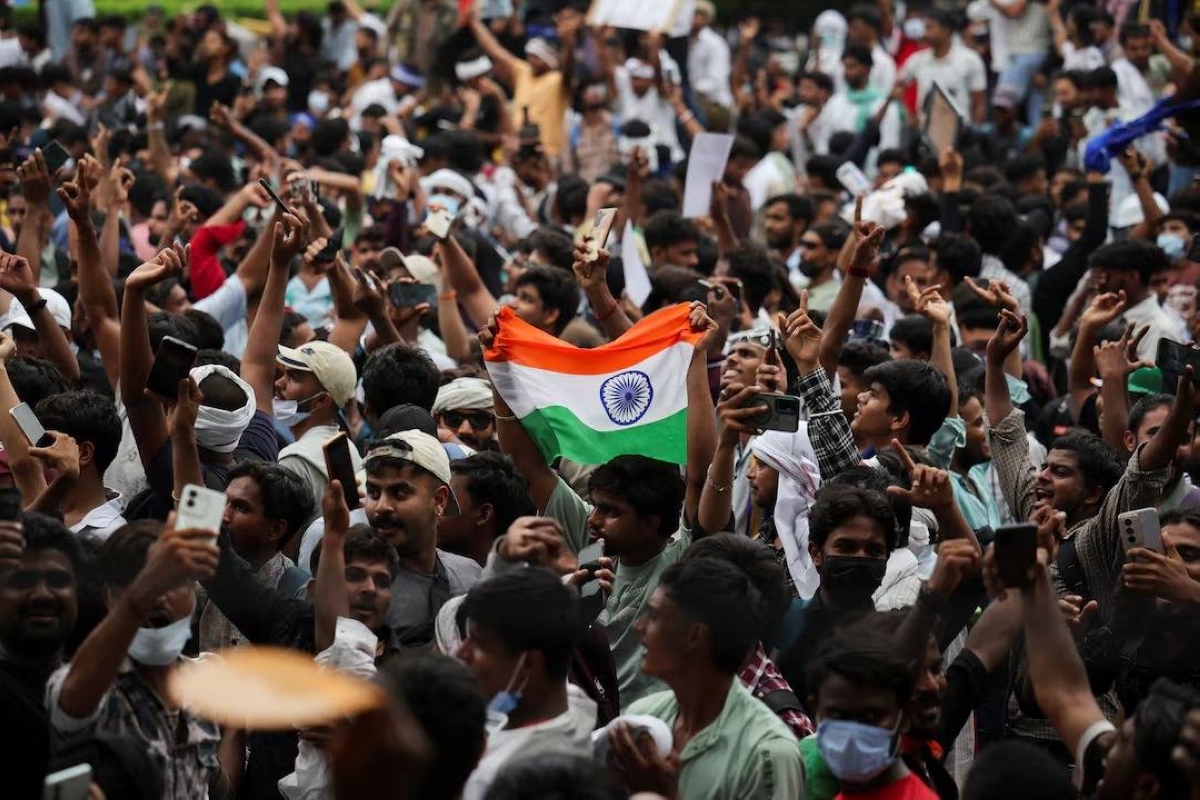
India’s Education Minister Dharmendra Pradhan quit yesterday after days of sustained public protests demanding his resignation for examination paper leaks in May that affected about 2mn students.Here is a look at what sparked the protests and the situation now: Why did protesters want Pradhan to quit?The immediate trigger for the demonstrations was the cancellation of the National Eligibility cum Entrance Test (NEET), India’s undergraduate medical school entrance exam, after its question papers were found to have been leaked.About 2mn students across India took the exam on May 3, but it was later scrapped, with more than a dozen student suicides linked to its cancellation. A re-test was held in June. Why is NEET important?The exam is the sole gateway to undergraduate medical courses across India, and millions of aspirants sit for it every year, competing for fewer than 150,000 seats, making it one of India’s toughest entrance exams.The situation is also symptomatic of broader strains on the country’s higher education system, where grossly limited spots leave millions cramming for months, or even years, and high-stakes entrance exams leave many of them burnt out and in debt. Have test papers been leaked before?Exam question paper leaks are fairly common in India, and the NEET questions themselves were similarly leaked in some places in 2024, although a re-test was not ordered at the time.Other examination papers have also been leaked in the South Asian nation of 1.4 bn people, including those for recruitment of police constables and teachers. Why is this leak different?The exam leak this year coincided with the birth of the self-named Cockroach Janta Party (CJP) satire movement, which appears to have channelled the frustration of the youth into the current protests.Analysts say the group, which amassed millions of Instagram followers within days of being created in mid-May, tapped into the concerns of under-30s — who make up more than half the country’s population — which include high youth unemployment and the latest exam paper leak. How did the government respond initially?Pradhan had said the government was committed to addressing the concerns of the youth and promised exam reforms, while Modi himself vowed to punish those behind the leaks.The government also proposed amending laws to allow imposing heavy fines and jail terms for culprits after they are tried in special courts created for the purpose. The protesters were, however, not impressed and insisted Pradhan should quit first. What is the situation now?Celebrations erupted yesterday at the Jantar Mantar protest site in central Delhi where the protesters have been camping for more than a month. But the founder of CJP said the government needs to fulfil two more of the protesters’ demands before the demonstration can end: compensate families of students who died by suicide due to the NEET paper leaks, and act against police officers accused of cracking down on protesters who marched on parliament on Monday.
There was a time, not so long ago, when a straightforward errand in Doha was measured not in minutes but in mornings. An attestation, a bank transfer, a specialist referral — each carried its own tax in patience, paid standing up. That this has changed so thoroughly, and with so little fanfare, is itself worth pausing over. The numbers tell a story of steady, unglamorous improvement. Hamad Medical Corporation, redesigning patient pathways across six clinics at Hamad General Hospital, cut average waiting times from 29 days to seven. MRI waits fell from around 75 days to roughly a fortnight. A fast-track system trimmed another service area by a third. At the Communicable Disease Centre, outpatient waits compressed from about seven weeks to two or three. The 2025 annual report records 75% of Qatari patients under one initiative seen within a fortnight, with an average wait of 15 days. None of these figures were achieved by a single grand announcement. They are the residue of process work — scheduling reviewed, capacity reallocated, referrals rerouted — the sort of endeavour that rarely makes a headline and almost never makes a ribbon-cutting. Scale makes the achievement more striking. The Primary Health Care Corporation recorded 5,169,998 visits in 2024, averaging more than 430,000 a month. Under that volume, 76% of patients were seen within 30 minutes. Virtual consultations accounted for 8% of the total. For a Doha resident such as Adele R, who told this newspaper her doctor now reviews test results and prescribes over the phone, leaving only a pharmacy collection, the gain is not abstract. It is a morning restored. Government services show the same pattern. Entities operating through Qatar’s integrated service centres completed 46,786 transactions in June alone, the Ministry of Foreign Affairs accounting for the largest share at 18,385, followed by the Ministry of Justice and the Ministry of Labour. The centres themselves embody the underlying principle: bring the counters to the citizen rather than sending the citizen from counter to counter. Document attestation, once the archetype of bureaucratic endurance, has been rebuilt around it. Applications submitted through Tawtheeq are reviewed within one working day; approval, payment, collection and delivery can be handled without an office visit. The ministry extended electronic attestation to police clearance certificates and government-school educational documents in October 2024, and in December opened the process to users abroad. Anyone who has assembled a file of certificates from another country will recognise how much friction that single change removes. Banking has followed. QNB’s queue-management function lets customers check waiting times, book an appointment or draw a ticket before leaving home — a modest feature that quietly transfers control from the institution to the customer. Its digital account-opening and remote transaction services do the rest. What connects these examples is not technology, which is available to everyone, but co-ordination — the willingness of separate institutions to share infrastructure and design around the person waiting rather than the desk serving. That is the harder part, and it is where Qatar’s digital-government strategy has earned its results. Candour is due on the remainder. Queues have not been abolished, nor should they be. Medical examinations, specialised consultations, biometrics, original-document verification and cases that genuinely need a human being across the desk will continue to require presence. The measure of success is not the elimination of the counter but the reservation of it for work that warrants it. That is the standard by which the next decade should be judged: not how many services move online, but whether the ones that stay physical are worth the journey. On present evidence, Qatar is asking the right question.