admin
admin At least six people, including three Afghan nationals, died after being swept away by flash floods triggered by heavy monsoon rains in Khyber district on Monday, as widespread downpours prompted fresh floods and landslide warnings across much of Khyber Pakhtunkhwa (KP) province.
According to Rescue 1122 Khyber, emergency teams recovered the bodies from flood-hit areas and shifted them to hospitals for legal formalities before handing them over to their families. A Rescue 1122 spokesperson said the death toll from the flash floods in Landi Kotal had risen to 6 after the bodies of a woman, a man, and a child were recovered during search operations.
Several other people were injured in separate rain-related incidents and were shifted to nearby hospitals for treatment. The heavy rainfall also damaged multiple link roads in and around Landi Kotal.
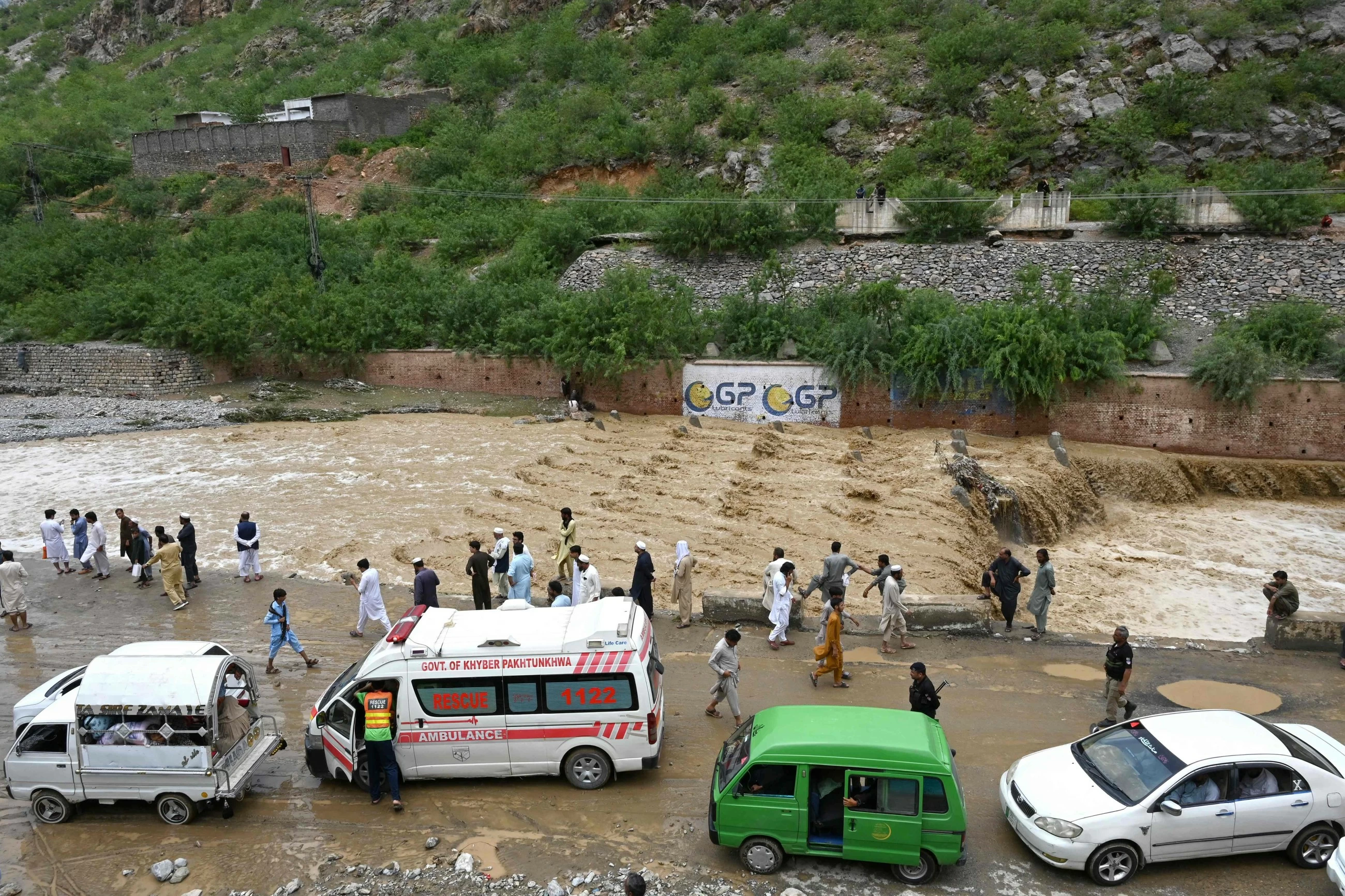
Commuters wait as floodwater swamps a road following heavy monsoon rains at Landi Kotal in Khyber Pakhtunkhwa province. AFP
Earlier, the Pakistan Meteorological Department has forecast widespread rain accompanied by thunderstorms in Khyber Pakhtunkhwa, Azad Kashmir, Islamabad, upper and central Punjab, and Gilgit-Baltistan, while hot and humid weather is expected to persist in southern parts of the country.
The National Disaster Management Authority (NDMA) has issued a flash flood alert for the mountainous regions of Gilgit-Baltistan, Azad Kashmir and Khyber Pakhtunkhwa. The authority warned that accelerated glacier melting could continue until July 25, increasing water flows in rivers and streams and raising the risk of flash floods.
Authorities have urged residents and travellers to avoid unnecessary movement in flood-prone areas and follow official advisories as rain continues across the northern regions.
According to media reports, the River Chenab has swelled to nearly 180,000 cusecs after torrential rains triggered flash floods in Jammu and Kashmir, with Islamabad complaining that India has not provided Pakistan with prior information on upstream river flows.
The Flood Forecasting Division (FFD) of the Pakistan Meteorological Department has forecast low to medium flooding in the river at Marala and the River Ravi at Jassar over the next 24 hours.
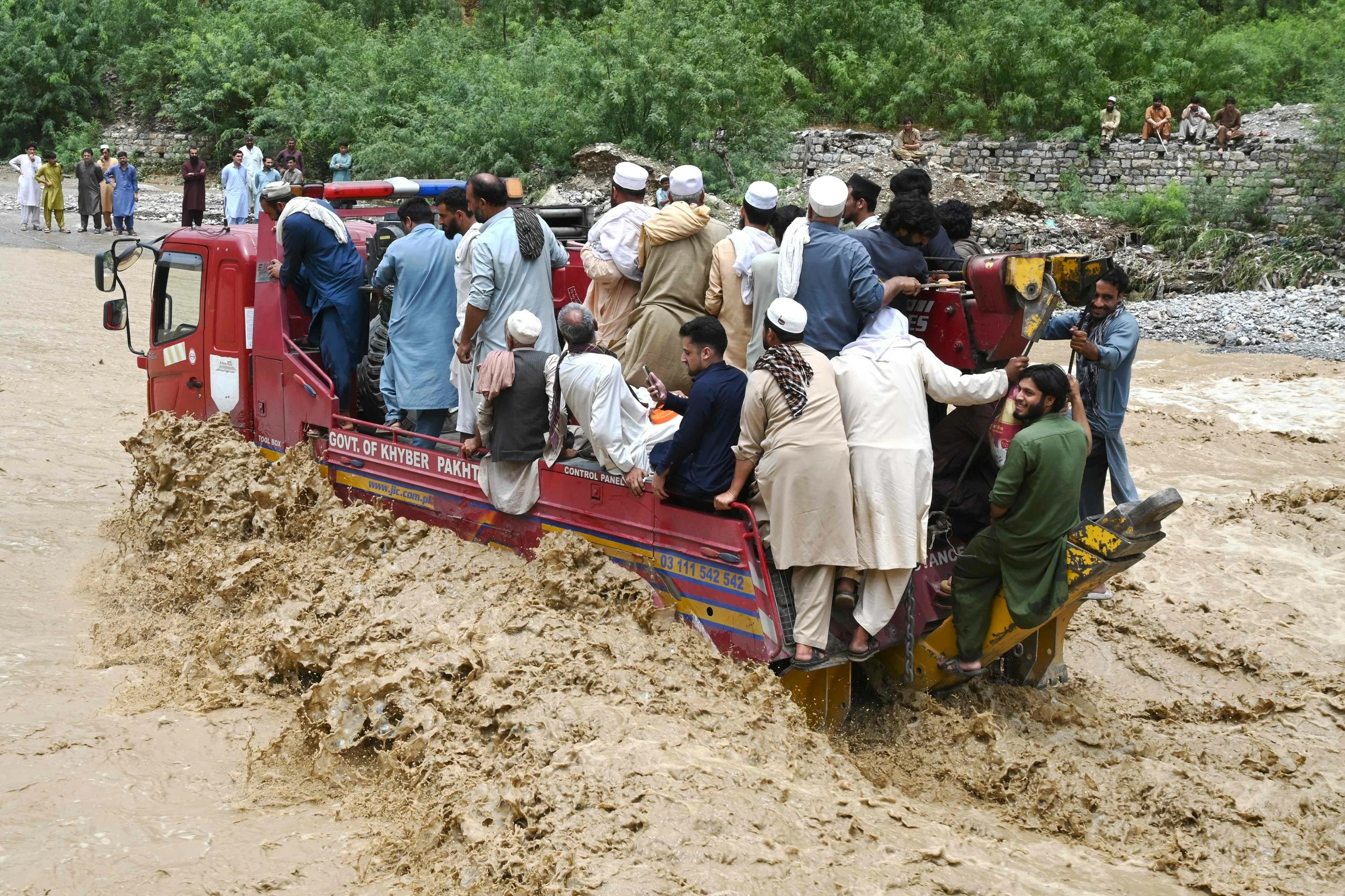
People ride a truck as they wade through floodwater following heavy monsoon rains in Khyber district. AFP
The influx pushed the River Chenab into the medium flood category, according to a senior official of the Punjab Irrigation Department.
The FFD warned that an approaching westerly wave, coupled with a strong monsoon system expected to remain active from July 20 to 24, could significantly increase flows in all major rivers. It forecast high flooding in the River Chenab at Marala, the River Jhelum upstream of Mangla, and in the associated nullahs of the Jhelum, Chenab and Ravi river systems.
The nullahs likely to be affected include Dora, Dotta, Dowara, Bhimber, Halsi, Aik and Palkhu in the Chenab basin, and Bein, Basanter, Deg and Sakki in the Ravi basin.
The FFD also warned of high flows in the River Kabul and its tributaries, flash flooding in the hill torrents of Dera Ghazi Khan, streams in Khyber Pakhtunkhwa (KP) and northern Balochistan, and urban flooding in several Punjab cities, including Rawalpindi, Jhelum, Gujranwala, Sargodha, Khushab, Sialkot, Gujrat, Narowal, Lahore, Okara, Sahiwal, Bahawalnagar and Faisalabad.
“Sunday was a surprising day for us, as we unexpectedly received a massive volume of water from India due to torrential rainfall in India-occupied Kashmir, raising the Chenab’s flow to around 180,000 cusecs for nearly two to three hours, a senior Punjab Irrigation Department official said.
According to the daily report of the Water & Power Development Authority (Wapda), inflows and outflows at Tarbela Dam on the River Indus were recorded at 196,300 cusecs and 195,500 cusecs, respectively.
On the River Kabul at Nowshera, both inflows and outflows stood at 31,700 cusecs, while at Khairabad Bridge, inflows and outflows were 216,500 cusecs each.
At Mangla Dam on the River Jhelum, inflows were 29,400 cusecs and outflows 14,000 cusecs. At Head Marala on the River Chenab, the report recorded inflows of 74,000 cusecs and outflows of 50,000 cusecs at 6am on Sunday, before the later surge.
The report recorded inflows and outflows at major barrages, with Jinnah Barrage receiving 228,400 cusecs and releasing 220,400 cusecs, while Chashma Barrage recorded inflows of 227,000 cusecs and outflows of 225,000 cusecs.