admin
admin 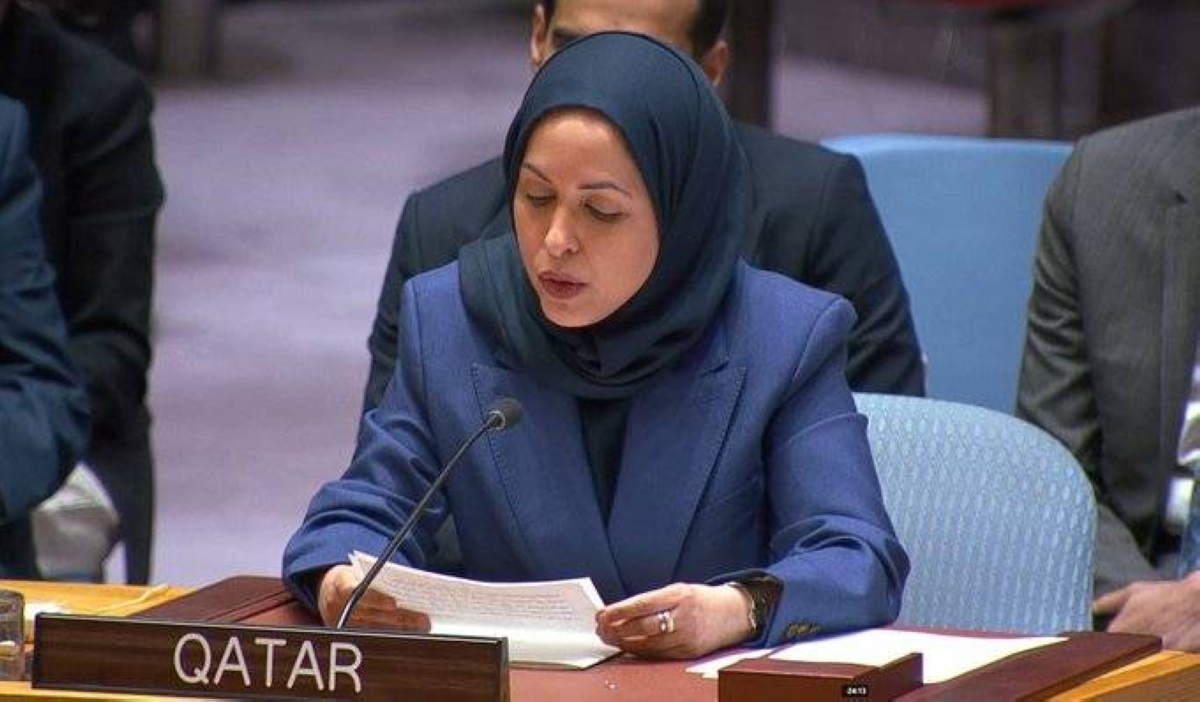
The State of Qatar affirmed that serious dialogue and adherence to the principles of international law and good neighbourliness are the fundamental pillars for resolving crises and avoiding their dangerous repercussions.
This came in a statement delivered by Her Excellency Permanent Representative of the State of Qatar to the United Nations, Sheikha Alya Ahmed bin Saif Al-Thani, before the United Nations Security Council’s quarterly open debate on the situation in the Middle East, including the Palestinian question at the UN headquarters in New York.
Her Excellency noted that the Council meeting is being held amidst the current situation in the Arabian Gulf region, since Feb. 28, and the subsequent serious and multifaceted repercussions for it has on international peace and security.
She reaffirmed Qatar’s condemnation of attacks by the Islamic Republic of Iran against Qatar and Gulf states, as well as all violations targeting the national sovereignty of Qatar and the countries of the region, including attacks on residential areas, vital infrastructure, and energy facilities, which resulted in civilian casualties and material losses, constituting violations of international law and international humanitarian law.
The UN Security Council Resolution 2817, submitted by the Kingdom of Bahrain on behalf of the Gulf Cooperation Council (GCC) states and Jordan and backed by 136 countries, underscored strong support for the territorial integrity, sovereignty, and political independence of these states, Her Excellency said, adding that it also emphasized respect for navigational rights and freedoms in accordance with international law, particularly concerning vital maritime routes.
Regarding developments in the Strait of Hormuz, HE Permanent Representative of Qatar to the UN stressed the importance of ensuring security of maritime routes, freedom of navigation and international trade in line with international law. The Strait’s security is linked to global energy security and supply chains, calling for concerted efforts to guarantee freedom of navigation and the opening of maritime routes, as it has regional and international implications.
She noted that Qatar welcomed the US-Iran ceasefire announcement on April 8, expressing appreciation for mediation efforts by Pakistan and other parties, and stressed the importance of full commitment to consolidating de-escalation and creating suitable conditions for dialogue.
Regarding the occupied Palestinian territories, Qatar condemned the illegal Israeli occupation’s measures in the West Bank, including reclassifying Palestinian land as so-called Israeli “state land,” accelerating settlement activity, approving legislation allowing the death penalty, and restricting freedom of worship in occupied Jerusalem. It reaffirmed its support for a two-state solution based on international legitimacy, ensuring the establishment of an independent Palestinian state on the 1967 borders with East Jerusalem as its capital, and the necessity of ending the occupation, settlement activity, and all illegal Israeli practices in the occupied territory.
Regarding the current situation in the Gaza Strip, Her Excellency explained that the State of Qatar emphasizes the necessity for all parties to fully implement the ceasefire agreement in Gaza and to open the crossings to ensure the sustainable and unhindered flow of humanitarian aid to the Strip. She affirmed Qatar’s full and unwavering commitment to the Peace Council since the inception of mediation efforts, up to and including the signing of the Sharm El-Sheikh Agreement with partners. She also reiterated Qatar’s continued coordination of humanitarian efforts with partners in the United Nations and the Peace Council, supporting the recovery and reconstruction process and enhancing the prospects for sustainable peace.
As for the situation in the Gaza Strip, Qatar stressed the need for full implementation of the ceasefire agreement, the opening of crossings to ensure sustained and unhindered humanitarian aid, and reaffirmed its continued commitment to mediation efforts and coordination with UN partners to support recovery, reconstruction, and prospects for lasting peace. HE affirmed Qatar’s unwavering commitment to the Peace Council up to, and including, the signing of the Sharm El-Sheikh Agreement with partners.
She also reiterated Qatar’s continued coordination of humanitarian efforts with partners in the United Nations and the Peace Council to support the reconstruction process and enhance the prospects for sustainable peace.
Her Excellency stated that Qatar reaffirms its support for the sovereignty and unity of Syria, condemning Israeli attacks that violate international law, and affirmed its firm stance on the unity, sovereignty, and territorial integrity of Lebanon, expressing full solidarity with measures taken to preserve its security and stability.
HE Permanent Representative of the State of Qatar to the United Nations also pointed out that Qatar welcomes the ceasefire as an initial step toward de-escalation and appreciates mediation efforts, including those by US President Donald Trump, stressing the need to uphold and build on the ceasefire.