
 admin
admin Convicted war criminals do not always get away with their crimes and die at liberty in bed at home. The “Butcher of Sarajevo” Ratko Mladic, a Serb general convicted over the first genocide on European soil since the Second World War, died last week in prison in The Hague at 84 years of age. He was among the most notorious military commanders of the conflict that followed the breakup of Yugoslavia. In May 1993, the Security Council created the special International Criminal Tribunal for the former Yugoslavia to deal with crimes committed in the Balkans.
The tribunal completed its work in 2017 and irreversibly altered international humanitarian law, provided victims an opportunity to testify to the atrocities they witnessed and faced, and demonstrated that politicians and officials responsible for crimes during conflicts can be called to account. Mladic was convicted of genocide, crimes against humanity and war crimes committed during the 1992–1995 war in Bosnia and Herzegovina. He was sentenced to life in prison.
In 1992 Bosnia and Herzegovina declared independence from Yugoslavia and following the example of Slovenia and Croatia, Bosnian Serbs established their own political and military structures and proclaimed Republika Srpska in territory covering roughly half of Bosnia and Herzegovina at the time. Under Mladic’s command, the Serb army devastated areas as it advanced. and massacred thousands of Bosnian Muslims.
The capital Sarajevo was surrounded and shelled by Serb forces for almost 44 months. Snipers positioned on the hills overlooking the city killed at least 11,500 people from all ethnic groups and wounded or displaced thousands. The Serbian campaign climaxed in Srebrenica when, after Dutch UN peacekeeping forces withdrew, thousands of Bosnian men and boys were rounded up, killed and their bodies bulldozed into mass graves.
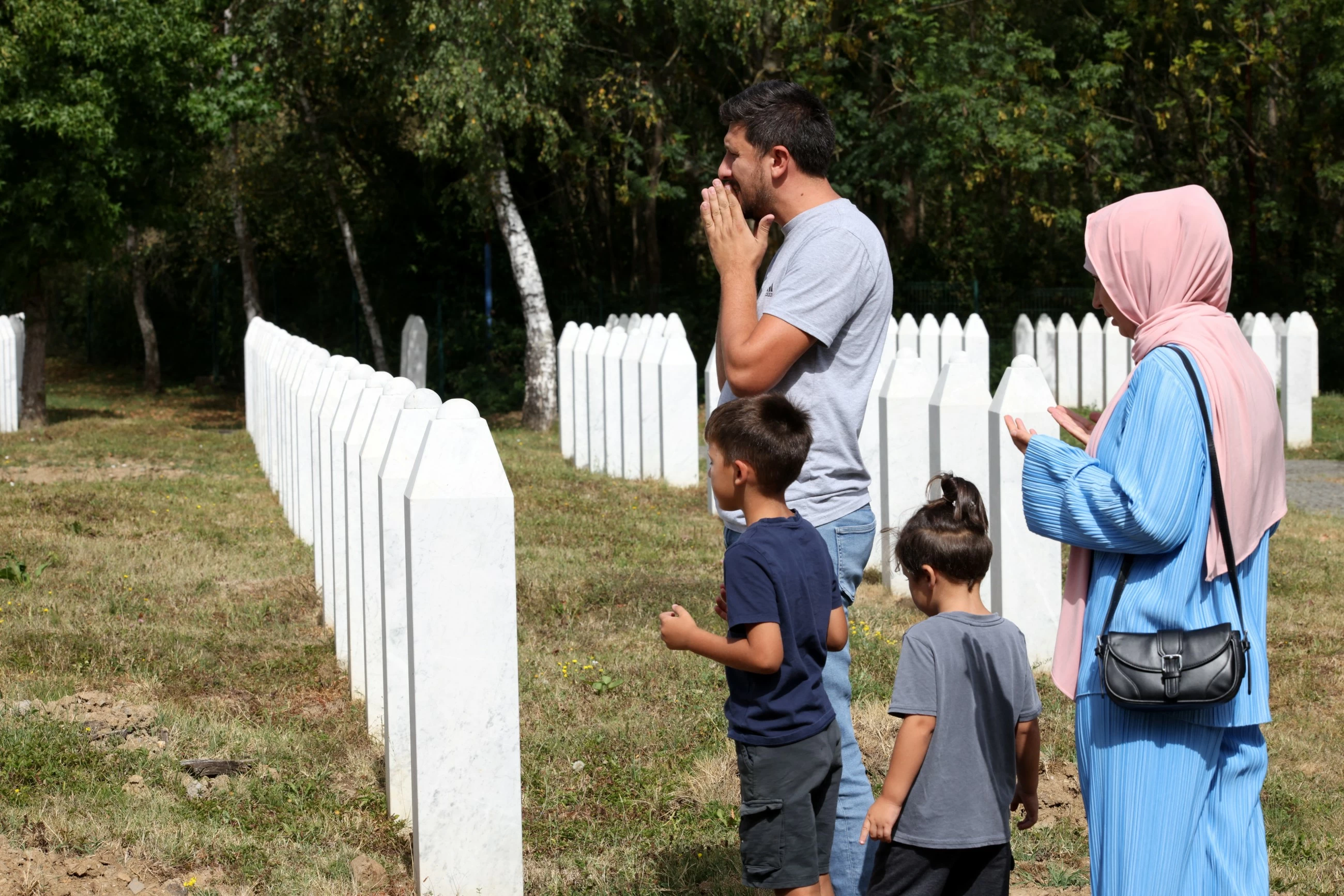
People pray as they visit the memorial cemetery where the victims. Reuters
While the course of this war received television and newspaper coverage, the global powers did not intervene to halt the Serb offensive when it began. NATO enforced a UN no-fly zone from 1992 and began limited strikes beginning in 1994. In 1995, Operation Deliberate Force, a three-week air campaign, degraded Bosnian Serb military infrastructure following two Sarajevo central market massacres which killed more than 200. These events compelled the US to belatedly call for negotiations in December 1995 at Dayton, Ohio, where the country was partitioned under a federal structure, ending the war.
The 1,425-day siege of Sarajevo under Mladic was a defining episode of the war and the longest siege of a capital city in modern history, surpassing the infamous World War II siege of Leningrad by more than a year. Once the war ended in 1995, Mladic escaped arrest and spent nearly 16 years in hiding.
Several other world leaders have also been accused of war crimes and crimes against humanity. Outstanding warrants have been issued for Russia’s Vladimir Putin for unlawful deportation and transfer of children from occupied areas of Ukraine to Russia. Israel’s Prime Minister Benyamin Netanyahu and former Defence Minister Yoav Gallant used starvation as a war method and targeting of civilians during the Gaza conflict. Sudan’s former President Omar al-Bashir was charged with mass murder, sexual assault, and pillage during the conflict in Darfur.
Leaders who have been put on trial are Yugoslavia’s President Slobodan Milošević who died in 2006 before a verdict was declared; Bosnian Serb Ratko Mladić and Radovan Karadžić who were convicted of genocide and war crimes; Iraqi President Saddam Hussein was convicted for the killing of 148 Shiite Muslims and was executed in 2006; and Cambodian Khmer Rouge leaders Khieu Samphan and Pol Pot’s regime were convicted of genocide, war crimes, and crimes against humanity by a UN-backed tribunal. Palestinian Hamas military commander Mohammed Deif was accused of crimes against humanity and war crimes but was killed in an Israeli air strike in Gaza in 2024.
The International Court of Justice (ICJ) was established in 1945 the same time as the United Nations to prosecute crimes committed by states against each other. The International Criminal Court (ICC) began operations in 2002. It is the only permanent international court to prosecute individuals for the crimes of genocide, war crimes, aggression, and crimes against humanity.
The ICC only asserts its authority only if national courts do not prosecute alleged criminals. The ICC has handled 34 core cases, issued over 60 arrest warrants, and secured 13 convictions for grave international crimes. However, the ICC has been criticised for focusing on African leaders and officials because there is little or no US, European and Middle Eastern resistance to tackling crimes in Africa.
Central African Republic leader Abd Al-Rahman was found guilty of war crimes and crimes against humanity and sentenced to 20 years. His appeal is pending. Al Hassan of Mali was convicted and in July 2025 ordered to serve nine years while in 2026 ordered to pay reparations. Democratic Republic of Congo’s Thomas Lubanga was the first conviction in 2012 for conscripting child soldiers and was released after completing his sentence.



