admin
admin 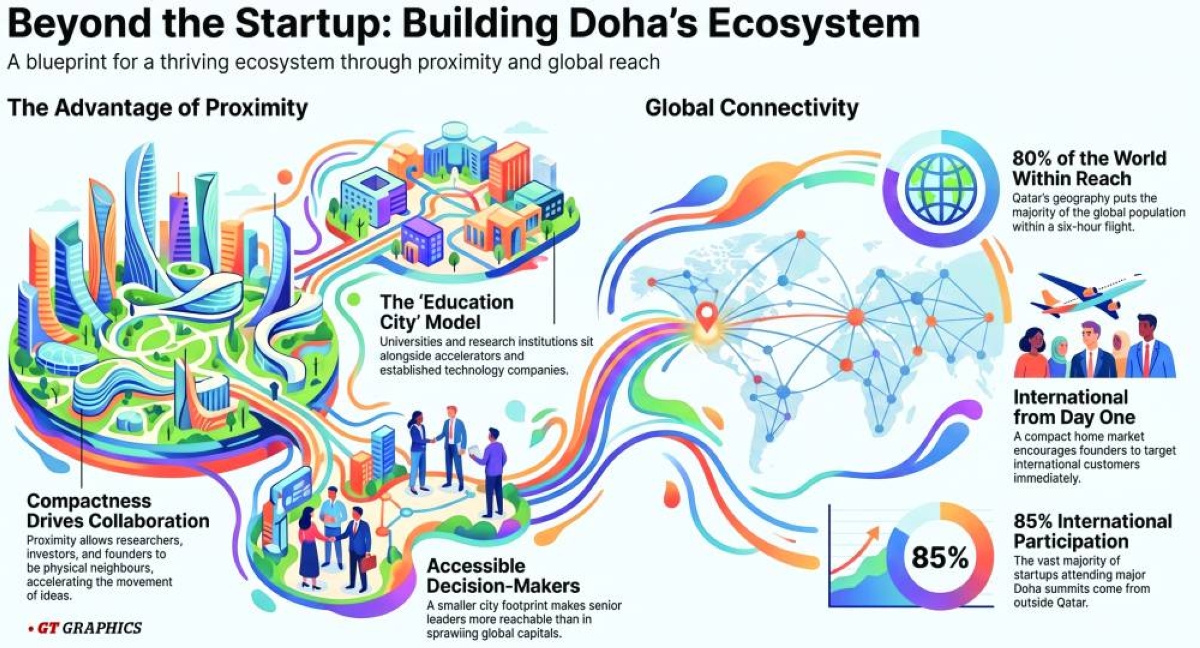
Spend enough time investing in technology and you become wary of attempts to manufacture the next Silicon Valley. Plenty of cities want to become startup hubs. Capital is announced, accelerators open, conferences arrive and founders are encouraged to set up shop. Sometimes it works. Often, a lot of activity never quite turns into an ecosystem that can sustain itself.
The reason, I think, is that successful entrepreneurial hubs aren’t really built around startups themselves. They’re built around everything that allows startups to succeed. Founders need money, clearly, but they also need access to research and talent, experienced people who can help them, customers willing to take a chance on a young company, and other founders around them. They need somewhere an idea can move out of a university or laboratory and become a business.
I’ve been thinking about this in Doha because Qatar has spent years assembling many of these pieces, and they’re now starting to connect in interesting ways.
What strikes you in Education City is how physically close much of this infrastructure is. Universities and research institutions that might sit in different cities, or even different regions, elsewhere are effectively neighbours. Qatar Science & Technology Park and its technology community are part of the same landscape. Around that research base sits a wider support system, including Qatar Development Bank and a growing community of investors, accelerators, established companies and entrepreneurs.
None of this guarantees that great companies will emerge. Startup ecosystems are far too unpredictable for that. But it gives them somewhere fertile to emerge from.
Doha’s size helps too. We tend to assume scale is an advantage in tech, but sometimes the opposite is true. In larger economies, the people and institutions a founder needs can be scattered across different cities and networks. Doha is compact. One of its less obvious advantages is simply how accessible people can be to one another. A researcher, investor, founder and senior decision-maker can be much closer here, both geographically and institutionally, than they would be in most major capitals.
Ideas still travel largely through people, however sophisticated technology becomes. Proximity makes it easier for those people to find each other.
I have seen Web Summit Qatar grow quickly, but what interested me earlier this year wasn’t just the scale. Over 30,000 people from 127 countries came to Doha, including 1,637 startups and 931 investors. Attendance has doubled in two years. The figure that caught my attention was 85%: the proportion of participating startups that came from outside Qatar.
You feel that international mix across the city throughout Web Summit week. The conversations don’t stop at the conference doors. Meetings continue across West Bay and Msheireb, and for a few days you get a particularly vivid sense of how a relatively compact city can become a meeting point for people who might otherwise be several flights apart.
The numbers also suggest something bigger than the growth of a domestic startup scene. Doha is starting to become a place where entrepreneurial communities from different parts of the world encounter one another.
Geography gives Qatar an interesting hand to play here. Around 80% of the world’s population lives within a six-hour flight of Doha. Europe, Asia and Africa are all within easy reach, with the wider Middle East on the doorstep. Its domestic market is relatively compact, but I don’t see that as a barrier.
Some of the best tech companies are international from the day they’re created. If you’re building a company in Doha, you have good reason to think about customers in Riyadh, London, Singapore or Mumbai very early on. There’s little temptation to build for a huge home market first and worry about the rest of the world later.
Something similar applies to capital. Doha is attracting more investors and international companies, but the real benefit isn’t simply having more capital available. Good investors bring experience with them. They know people, companies and markets elsewhere. They have seen businesses succeed and fail, often more than once.
When that experience becomes part of a local ecosystem, its effects don’t stop at the edge of a portfolio. An investor can introduce a Qatari founder to customers overseas or help an international technology company establish itself in the Gulf. Someone who has built a company before can help a researcher encountering the realities of building one for the first time. Over time, founders who succeed tend to invest in and advise the people coming behind them. That accumulated experience is difficult to manufacture quickly, but once it starts building, it can become a real advantage. For all our fascination with technology, it still comes down to people.
Qatar has invested heavily in education and research, attracting talent from all over the world. The opportunity now is to make it easier for more of that knowledge to find its way into new companies. Not every graduate has to become a founder, of course. But someone with a genuinely good idea should be able to imagine a route from that idea to a business. They need access to people who have done it before, early capital when the idea is still uncertain, and an environment where an unsuccessful first attempt isn’t treated as the end of the story.
This is why I’m mostly interested in the connections forming across Doha. The ingredients are already substantial. The question is how often a university researcher meets an entrepreneur, how easily a young company can find its first serious customer, whether an international investor spends enough time here to become part of the community, and whether people who have built successful businesses stay involved with the generation that follows them.
For years, Silicon Valley shaped our idea of what a successful technology ecosystem was supposed to look like. I think we’ve moved beyond that. The most interesting hubs emerging today aren’t replicas of one another. They grow out of their own universities, industries, sources of capital, geography and culture. What works in California doesn’t have to be the template for Doha, Singapore, London or anywhere else.
Doha has its own advantages. It is compact and strikingly international. It has strong universities and research institutions, access to capital and unusually good connections to the rest of the world. Perhaps most importantly, there is a natural willingness here to take a long view. Building an entrepreneurial culture takes time, and the institutions around it need time to mature as well.
Doha’s increasingly busy calendar of major international events brings a constant flow of people through the city: founders, investors, business leaders, researchers and policymakers who might not otherwise find themselves in the same place. Those moments matter, but I’m just as interested in what happens between them. Who stays? Which relationships continue? Which ideas get funded? Which companies are still growing here five or ten years from now?
That’s how a startup ecosystem becomes something more permanent. Qatar has already built a great deal of the infrastructure around entrepreneurship. Its next opportunity is to make those connections denser, more frequent and harder to replicate elsewhere.
There is no reason for Doha to follow somebody else’s model. I’m much more interested in seeing what we can build from what we already have here.
- The writer is an international investor and entrepreneur with more than two decades of experience investing across technology, healthcare, media and sport. She is the founder of NJF Holdings and NJF Capital.