admin
admin 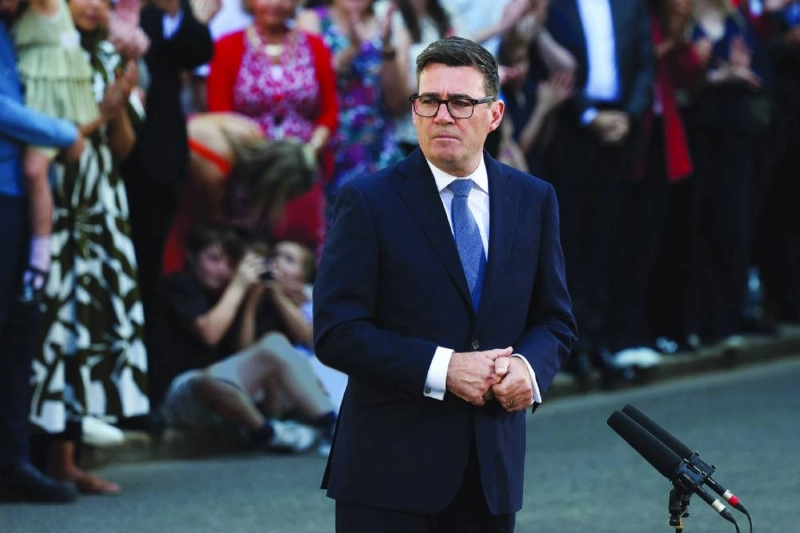
Britain’s newly appointed Prime Minister Andy Burnham delivers a speech outside 10 Downing Street after taking office, in London, yesterday. (Reuters)
 Britain now changes prime ministers at roughly the rate other nations lose patience with a long-running television series. Six of them in a decade; seven since 2016, if you start the tally at the referendum that blew the fuses on the entire arrangement. The lectern outside No 10 has been wheeled out and folded away so many times that it must qualify as the most well-travelled item of furniture in Whitehall: a small wooden monument to a governing class that keeps promising stability and then providing the opposite. The removal vans have practically worn a groove in the tarmac.
Into this carousel steps Andy Burnham, the former mayor of Greater Manchester who engineered his own return to the Commons through a byelection whose only real purpose was to prise Keir Starmer’s fingers off the door of Downing Street. He stood on that over-familiar spot, watched by his wife and a scattering of allies, and did something none of his five immediate predecessors had thought to attempt. He opened not with a victory lap, but with a confession.
The anatomy of an apology
Take the scalpel to the speech and the first thing you notice is the tone. Most incoming premiers arrive drunk on their own momentum, eager to tell the country how much better everything is about to become. Burnham began instead by counting himself into the long line of failure. “I am acutely conscious that I am the sixth person in the last 10 years to walk up this street, the seventh prime minister since 2016,” he said, framing his arrival not as a coronation but as a symptom. Then the admission proper: “We have not been good enough, and we need to be better.”
This is calculated humility, and it is shrewd. A public that has watched the revolving door spin until it is dizzy does not want another saviour; it wants someone who will at least acknowledge the mess. By naming the rot up front, Burnham inoculates himself against the charge that he is simply the next in the queue. He also lowers the bar he will later have to clear — always sensible for a man who has just inherited a fiscal straitjacket.
The centrepiece is the phrase he clearly wants stitched onto the era: a “circuit breaker” for Britain, promising “the biggest changes in the last 40 years. A new political model and a new economic model.” It is an Attlee-sized ambition dressed in the language of an electrician. He reaches back to the 1980s — “Britain took some wrong turns,” he says — and lays the blame on power centralised in Westminster, industry privatised, whole regions hollowed out and never rebuilt. The remedy, in his telling, is to push authority out of the capital and “into every postcode in the land.” For a man who built his brand on Manchester devolution, this is autobiography as manifesto.
Then comes the boldest move of the morning: his first instruction in office is to end rough sleeping. It is brave to the point of recklessness, and the reason is written into his own record. Burnham set precisely this target as mayor and missed it; rough sleeping in his city rose across four consecutive years. Confronted with that awkward arithmetic, he did not duck. He argued that a single city cannot solve the problem alone — “you won’t be able to get the numbers down if you’re the only place and people are coming to Manchester” — and that the answer is everyone pulling together, as, he insists, the country managed during the pandemic. Most politicians, caught out by a failure, quietly change the subject. Burnham has chosen to double down on his in front of the nation.
There is a ghost hovering over that pledge, too. Jeremy Corbyn once revealed that had he won in 2017, ending rough sleeping would have been his day-one order. Burnham has, in effect, discovered his inner Corbyn — a signal to the Labour left that will land warmly, and one he may need if, as expected, the party’s harder-edged home affairs instincts are about to be rewarded with the great offices of state.
The list he cannot talk his way out of
Contrition is cheap; the in-tray is not. Burnham takes charge of an economy that has been treading water since the 2008 crash, its ankles further weighted by Brexit and the pandemic. He has boxed himself in by honouring Labour’s promise not to touch the main rates of income tax, National Insurance or VAT — which leaves him the narrowest of ledges from which to fund anything transformational. His first concrete offerings, trailed for this week, are cushioning measures on energy bills and bus fares: breathing space now, the ten-year plan later.
Abroad, the map is no kinder. The war in Ukraine grinds on, the Middle East smoulders, and the “special relationship” is fraying at the seams. Starmer cultivated the American president assiduously before infuriating him by declining to fully endorse the US-Israeli strikes on Iran. Washington remains Britain’s indispensable security partner; the current occupant of the White House remains deeply unloved on British streets. Squaring that circle — how much charm to expend on a mercurial ally — is now Burnham’s problem, and the retention of Starmer’s national security adviser suggests continuity rather than reinvention.
Defence is its own trap. A predecessor’s defence secretary resigned over spending judged too meagre, only for a belated £15bn uplift to be announced with the crucial question — where the money comes from — left conveniently unanswered. That bill has now landed on Burnham’s desk, and someone’s budget will have to bleed to pay it.
On immigration, the politics are treacherous precisely because the facts have moved. Net migration has fallen sharply, yet polling shows voters neither know it nor much care; the anxiety persists regardless. Burnham has signalled he will keep the tough line, even as it grates against his own backbenchers. And then there is welfare, where an ageing population, a rising tide of working-age mental-health claims and the sacred triple lock on pensions combine into a cost curve no one wants to bend in public. Starmer tried, and his own MPs mutinied.
Where the money will actually come from
So how does a man forbidden from raising the big three taxes find the cash for social housing and hope? By hunting where the manifesto still permits. Burnham has already declared that Britain “overtaxed labour and undertaxed” wealth — a sentence that points like a compass needle towards capital gains, council tax reform, and a rebalancing of business rates away from the beleaguered high street and onto the out-of-town sheds. The overall tax take is already forecast to reach its highest share of the economy since 1948, which tells you how little slack remains and how creative the Treasury will have to be.
The confession at the door bought Burnham a moment of grace. The nation, weary and cynical, may even want to believe him when he says this is the moment “Britain starts to believe again.” But belief is the easy part to promise from a lectern. The hard part — the funding, the trade-offs, the backbench rebellions — is exactly where his six predecessors came unstuck. The street has seen this walk before. What it has not yet seen is anyone finish it.
- The writer is Deputy Managing Editor, Gulf Times.