admin
admin An international seminar on Indus Waters Treaty was held in Islamabad to highlight Pakistan’s water rights under the treaty.
Pakistan’s Deputy Prime Minister and Foreign Minister Ishaq Dar warned that sabotaging international river treaties could come at a heavy cost, saying attempts to block river flows set a dangerous precedent in international relations.
Dar and other government officials made the remarks at an international seminar on the 1960 World Bank -brokered treaty, which governs the sharing of water from the Indus River system between the nuclear-armed neighbours.
Speaking at the seminar, Dar said water should never be used as a political tool. “Shared waters must never be weaponised. They should remain a bridge between nations, guided by cooperation, dialogue, and respect for international law for the benefit of present and future generations,” he said.
He described water as essential to human dignity, food security, economic development, and environmental sustainability, arguing that rivers crossing international borders should foster cooperation rather than confrontation.
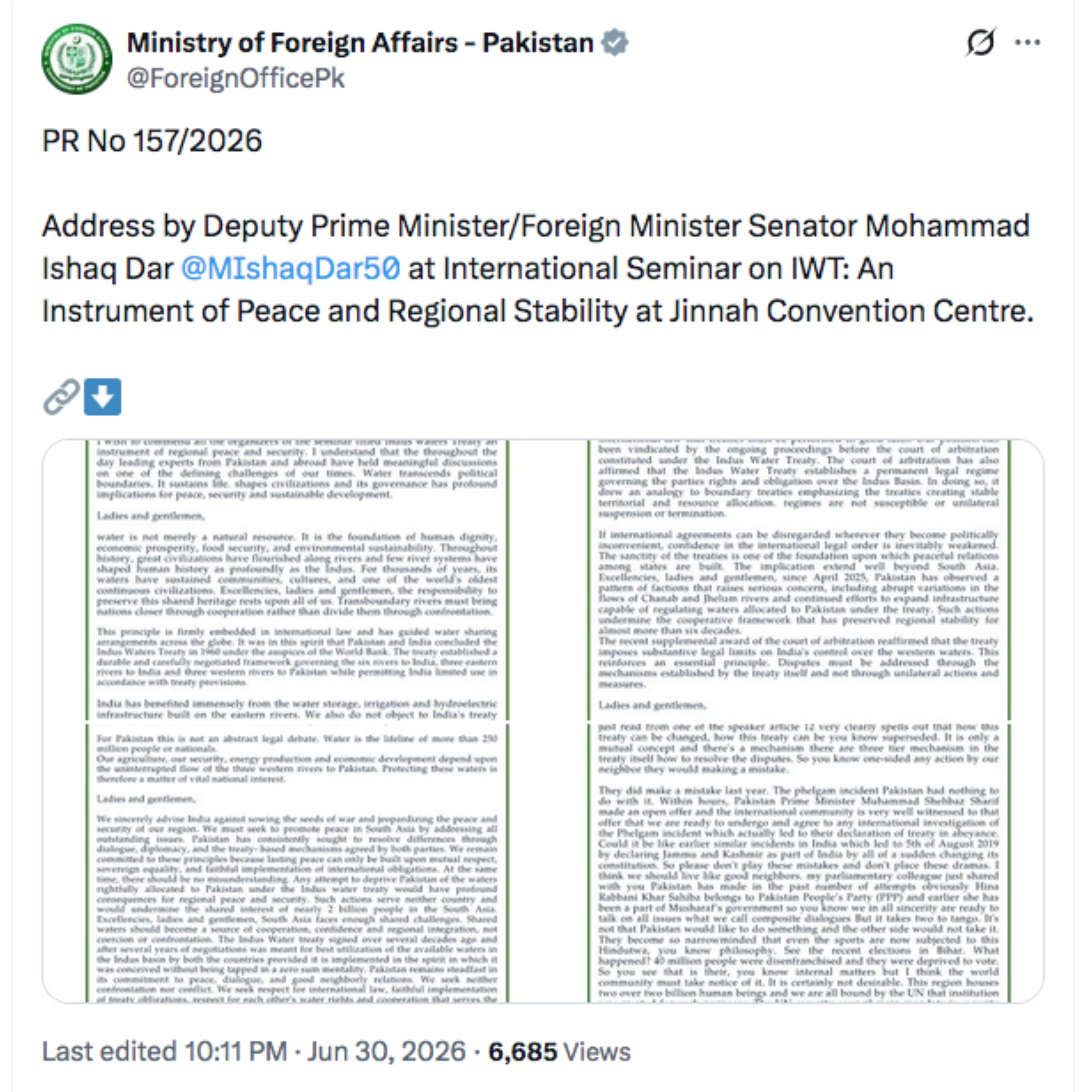
Dar called India’s 2025 decision to suspend the treaty “illegal” and said Pakistan considered the agreement to remain valid and legally binding.
“No party can unilaterally suspend or terminate obligations under a treaty that contains no such provision,” he said, adding that international agreements must be implemented in good faith.
He also reiterated Pakistan’s position that any attempt to divert, interrupt or reduce water allocated to Pakistan under the treaty would be treated as an “act of war,” referring to a decision adopted by Pakistan’s National Security Committee after India announced the suspension.
During Tuesday’s seminar, Mehar Ali Shah, chairman of Pakistan’s Indus River System Authority, alleged that India reduced water flows in the Chenab River in recent months in violation of the treaty. There was no immediate comment from New Delhi.
Earlier, Information Minister Attaullah Tarar said the treaty could not be amended, revoked, suspended, or placed in abeyance unilaterally. He argued that protecting the agreement had become increasingly important as climate change, shrinking glaciers and growing water scarcity threatened the region’s long-term stability.
Brokered by the World Bank and signed in 1960, the Indus Waters Treaty regulates the distribution of water from the Indus River system. Under it, India controls the eastern rivers, Ravi, Sutlej and Beas, while Pakistan receives the waters of the western rivers – the Indus, Jhelum and Chenab.
Agencies