admin
admin 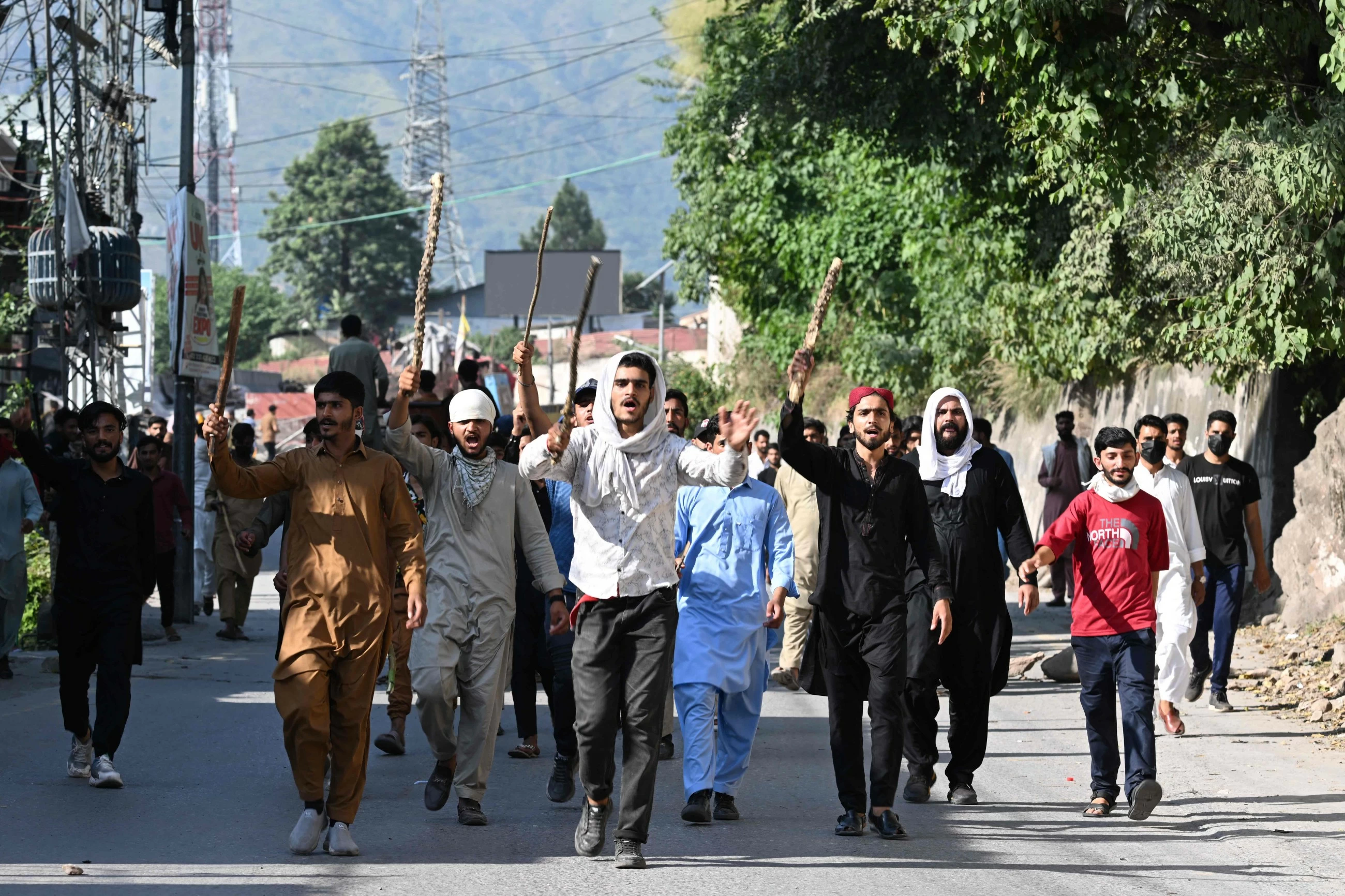
It was the deadliest day in Azad Jammu and Kashmir (AJK) since the proscribed Joint Awami Action Committee (JAAC) started its violent protest movement a few weeks back.
At least nine persons including the law enforcement personal were killed in armed confrontations between the JAAC supporters and police and paramilitary forces.
The killings took place as the AJK government tried to clear all obstacles that were preventing the free movement of people and goods in the region. Seven JAAC activists were killed while two law enforcers embraced martyrdom.
The first clash occurred when law enforcement personnel raided Mutyalmera, on the outskirts of Rawalakot, following what officials described as intelligence about a large cache of weapons and ammunition allegedly stored in a house.
However, officials said they encountered resistance from JAAC supporters, leading to an exchange of fire.
Supporters of the JAAC, a movement demanding economic and governance reforms, vowed to march towards the regional capital Muzaffarabad this week in defiance of official warnings.
“Seven civilians, one paramilitary personnel and one police officer were killed during violence that erupted on Tuesday,” Sardar Waheed, the top civilian official in Poonch district, where protests have been heavily concentrated, told AFP.
“The authorities will stop the march if the protesters attempt to proceed towards the capital,” Waheed added.
The unrest follows a local government ban on the JAAC under anti-terrorism laws in June, after which clashes between protesters and police killed 22 people, according to an AFP tally of official figures.
Supporters of the group have rejected the “terror” designation, calling it an act of “oppression” and insisting their campaign seeks legitimate economic and political rights.
Sit-ins by protesters have continued for more than a month in different parts of the region and authorities have sealed the JAAC’s main office and arrested hundreds of its supporters.
Shops remained largely shut and public transport suspended across Poonch as protesters maintained road blockades.
In a statement, AJK police said operatives of the proscribed JAAC had erected blockades at various points along the Kotli-Trarkhal highway, disrupting traffic and the supply of essential commodities.
The statement said that law enforcement personnel had launched a clearance operation to reopen the highway and restore the movement of traffic and supplies when “armed groups of the proscribed JAAC opened unprovoked and indiscriminate fire on security personnel” at Baithak Baloch. It confirmed that at least one police constable was martyred in the exchange, while around eight other law enforcers and a couple of Public Works Department employees suffered injuries.
Police said the situation had been under control, adding that operations to clear blocked highways and ensure the uninterrupted movement of traffic and essential supplies would continue.
Asked about the JAAC’s planned long march, the Poonch deputy commissioner said security forces were fully prepared to prevent the protesters from entering Rawalakot, which has remained under curfew since early last month.
Elsewhere in AJK, however, daily life largely continued as normal. Markets remained open and witnessed a steady flow of shoppers.
The government also allowed additional bank branches to resume operations in selected areas, where customers were seen queuing to carry out financial transactions. Internet services, however, remain suspended across the region, disrupting online education and affecting the livelihoods of those dependent on digital connectivity.
Meanwhile, a division bench of the AJK High Court is scheduled to hear two petitions challenging the suspension of internet services on Thursday.
The JAAC has demanded the abolishment of 12 seats in the local legislature reserved for those who left what is now the India-administered portion of Kashmir.
The JAAC says the seats are used by major Pakistani political parties to tip the composition of the local parliament in their favour with those who mostly reside outside the region. The next regional elections are set for late July.