admin
admin Iranian Foreign Minister Abbas Araghchi arrived in Islamabad on Friday night as the White House said that United States special envoy Steve Witkoff and adviser Jared Kushner would travel to Pakistan on Saturday for talks.
Foreign Office Spokesperson Tahir Andrabi said he was received by Deputy Prime Minister and FM Ishaq Dar and Chief of Defence Forces and Chief of the Army Staff Field Marshal Asim Munir, along with other senior officials upon arrival.
“During the visit, the Iranian foreign minister will hold meetings with Pakistan’s senior leadership to discuss the latest regional developments as well as ongoing efforts for regional peace and stability.”
The trip to Pakistan comes as officials there have been trying to get the United States and Iran to a second round of ceasefire negotiations. The report said the trip, beginning Friday, is focused on “ongoing regional developments” and the US-Iran war.
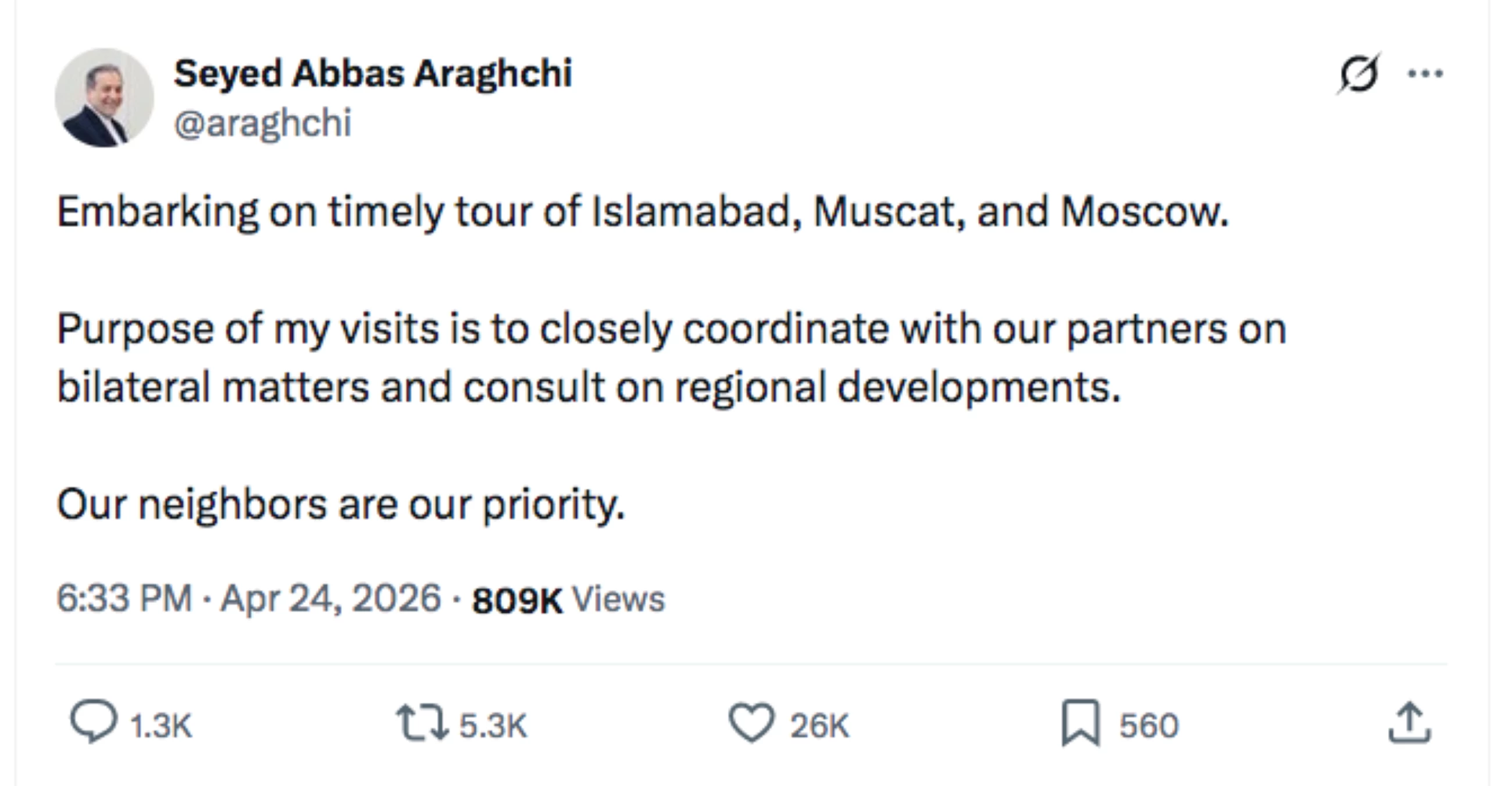
Araghchi wrote on X that he was on his way to Pakistan, Oman and Russia on a trip focused on “bilateral matters and regional developments.”
Earlier, two Pakistani officials told reporters that Araghchi was heading to Pakistan with a small government delegation.
The officials spoke on condition of anonymity because they were not authorised to speak to the media.
The White House did not immediately respond to questions about Araghchi’s trip to Pakistan and whether a United States delegation would also do so.
Islamabad has sought to reinject momentum into the negotiations between Iran and the United States, which had been set to resume this week but did not materialise.
Separately on Friday, the White House said President Donald Trump issued a 90-day extension to the Jones Act waiver, making it easier for non-American vessels to transport oil and natural gas in the wake of the war.
Trump first announced a 60-day waiver in mid-March, a move seen as helping to stabilise energy prices and making it easier for more ships to travel to the United States following the effective closure of the Strait of Hormuz.
The post on social media by a White House press aide said: “New data compiled since the initial waiver was issued revealed that significantly more supply was able to reach US ports faster.”
The price of Brent crude oil, the international standard, retreated on the news, falling to around $104 a barrel.
Earlier it had edged up to more than $107, a level nearly 50% higher than where it was on Feb.28, when the United States and Israel attacked Iran to start the war.
As part of the diplomatic push earlier on Friday, Araghchi and Pakistani officials discussed details of the ceasefire in the war with the US and Israel, part of an effort by Islamabad to get Iran to send a delegation for a second round of negotiations with Washington.
Pakistan has been trying to get US and Iranian officials back to the table after Trump this week announced an indefinite extension of the ceasefire with Iran, honouring Islamabad’s request for more time for diplomatic outreach.
That hasn’t lowered tensions in the strait the strategic waterway through which a fifth of the world’s oil and natural gas is shipped during peacetime.
Iran has kept its stranglehold on traffic through the strait, attacking three ships earlier this week, while the United States has maintained its blockade of Iranian ports and ordered the military to “shoot and kill” small boats that could be placing mines.
Washington now has three aircraft carriers in the region after the USS George H.W. Bush arrived in the Indian Ocean this week. The USS Abraham Lincoln is in the Arabian Sea and the USS Gerald R. Ford is in the Red Sea.
It is the first time since 2003 that three American carriers have been operating in the region simultaneously.
The force includes 200 aircraft and 15,000 sailors and Marines, United States Central Command said.
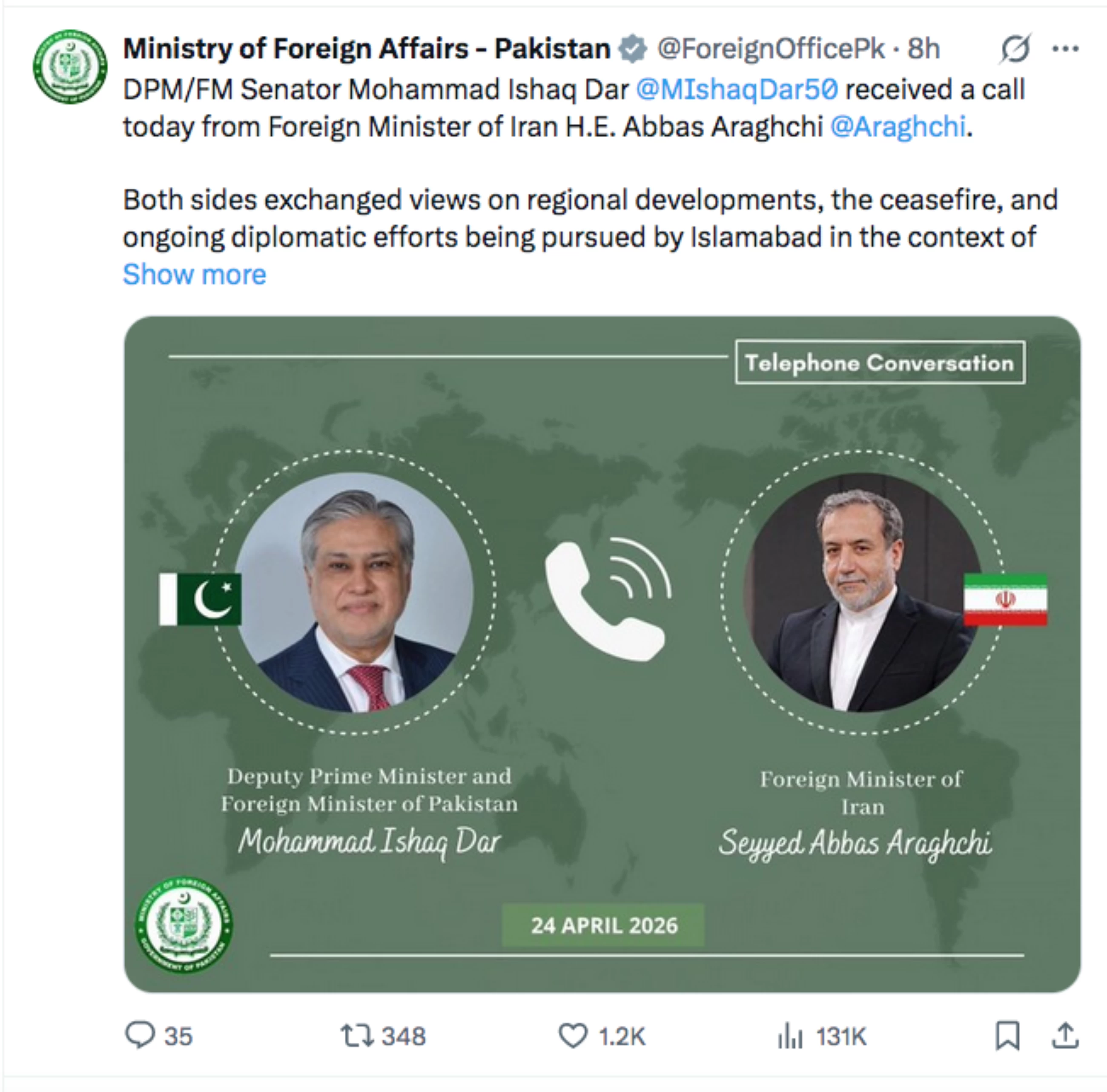
In their call on Friday, Araghchi, his Pakistani counterpart Ishaq Dar and Pakistan’s army chief Field Marshal Asim Munir, talked over “regional developments and issues related to the ceasefire,” a statement from Araghchi said. It did not go into further detail.
Later, Pakistan’s Foreign Ministry said that “both sides exchanged views on regional developments, the ceasefire, and ongoing diplomatic efforts being pursued by Islamabad in the context of US-Iran engagement.”
Agencies