admin
admin Severe flooding in China’s northern Hebei province and northeastern Liaoning province submerged roads and swept away cars, while people swam, paddle-boarded and wake surfed along neighbourhood streets, videos on social media showed.
Water levels rose to more than two metres on roads in Kuancheng, a county in Hebei, according to a resident’s account that was broadcast by local official media.
Kuancheng is home to around 240,000 people and is located on the banks of the Luan River.
Several cars were filmed crashing into each other in Kuancheng as they bobbed up and down a waterlogged road before being carried away by the strength of the current. The floods came after Typhoon Bavi, the most powerful storm to strike mainland China this year, brought heavy rain to the eastern coast and violent winds to the area’s densely populated cities, testing the country’s ability to cope with extreme weather.
Authorities warned the storm would dump torrential rain across the provinces of Jilin, Liaoning, Hebei, Shandong, Jiangsu and Anhui, exacerbating flood risks in areas that had already been soaked by earlier downpours.
Around 1,800 villagers in Kuancheng were stranded, state broadcaster CCTV reported, while authorities said that relocating and resettling residents was their top priority. In Liaoning, authorities raised the red alert for flash floods, warning of very high risks.
“During a red alert for heavy rain, all work stoppages, business closures, and gatherings must be fully implemented,” Hebei authorities said in a statement on WeChat.
Swimming, paddleboarding
Videos on RedNote, known in China as Xiaohongshu, showed a person swimming backstroke down a road in Shenyang, Liaoning, with the rows of parked cars on the side of the streetalmost completely submerged by the water. Another clip on RedNote showed someone standing on a paddleboard to navigate the flooded streets. A man was also filmed wake surfing behind a car on a wide road that had been inundated with water in Shenyang, a video on China’s WeChat showed. In a separate clip, police could be seen pushing a submerged car through the city’s floods. Many train services in Shenyang were also suspended, China Railway said on Monday, with more than 30 railway sections affected.
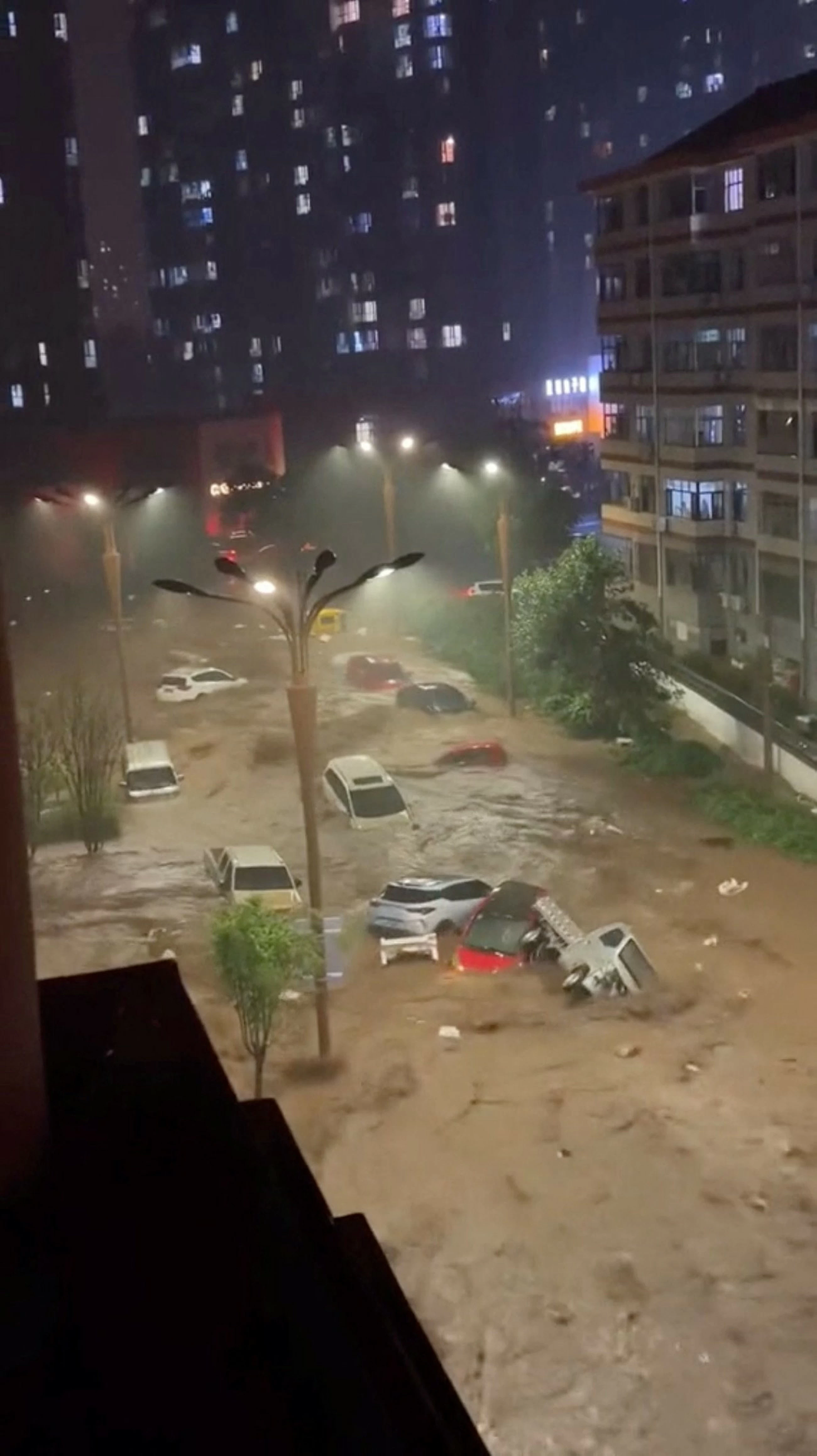
Vehicles are swept away by floodwater on a street in Chengde, Hebei Province, China, in this screengrab taken from social media video released on Sunday. Reuters
Schools have also been closed across many areas including the northeastern province of Jilin.
Some areas in northeastern China will experience thunderstorms or hailstorms of Force 8 or above, CCTV reported, citing the country’s Central Meteorological Observatory.
“In some areas of central and northern Jiangsu, thunderstorm winds of level 10 or above will occur, with maximum winds reaching force 11 or above, and tornadoes may occur locally,” it said. Force 11 winds can reach speeds of up to 117 kph (73 mph). Bavi, covering an area the size of France, formed in the Pacific Ocean 13 days ago. Its structure remained largely intact on Monday even after making landfall in eastern
China on Saturday night, making it the longest-lasting tropical cyclone in the Asia-Pacific region this year. Its longevity is largely due to its unusually well-preserved warm core, Chinese meteorologists say, allowing Bavi to retain much of its moisture as it churns north towards the Korean peninsula. Intense rainfall is expected when Bavi, currently classified as a tropical storm, slows further and starts to release all the moisture that it has been holding.
Forty-six rivers nationwide are experiencing flooding above warning levels, CCTV reported, citing China’s Ministry of Water Resources.
Reuters