admin
admin 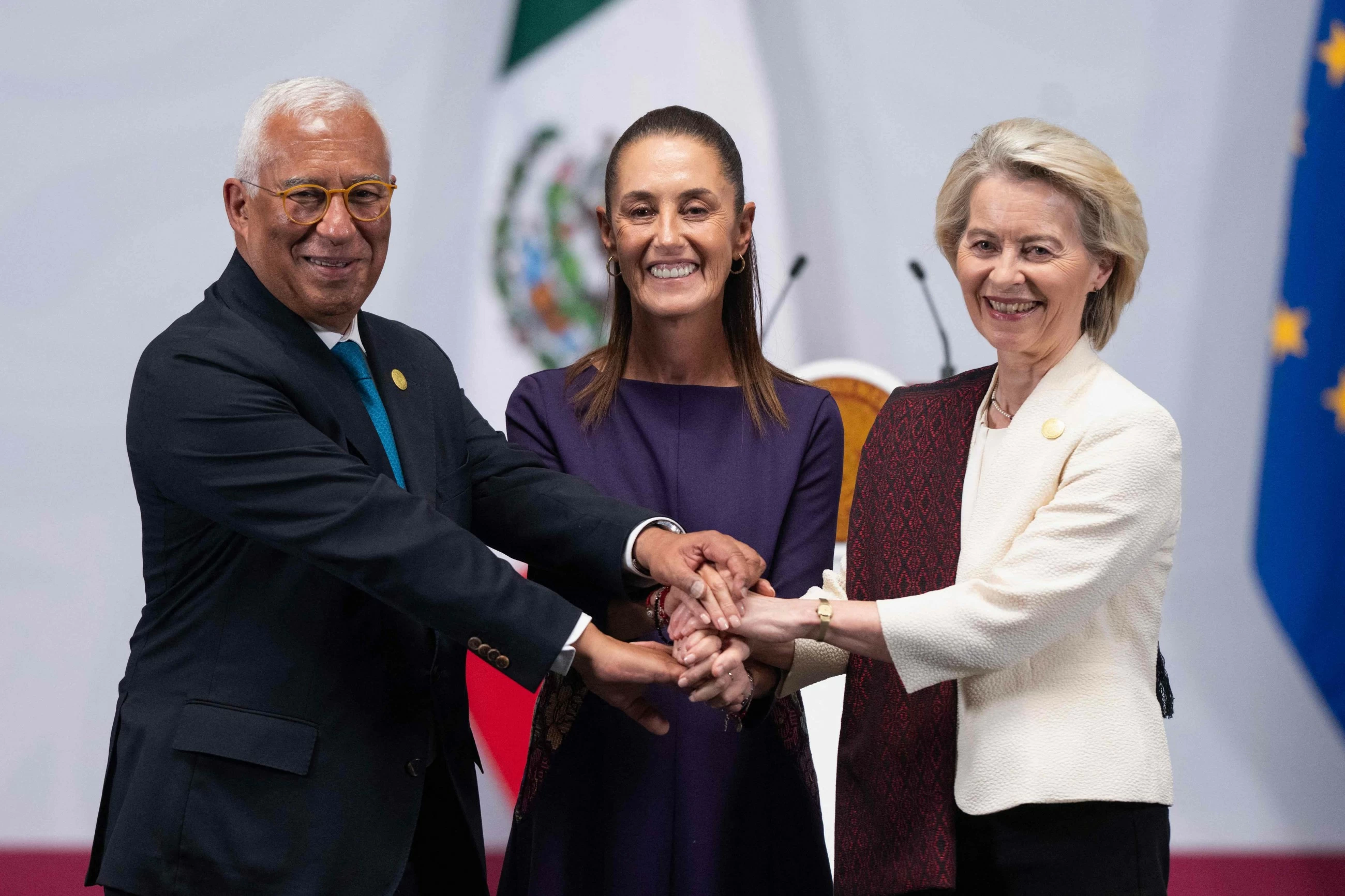
The European Union and Mexico on Friday signed a deal reducing tariffs on each other’s goods as both seek to lessen their dependence on trade with the United States.
The expansion of an accord dating to 2000 comes as Mexico fights hard to preserve a three-way free trade agreement with the United States and Canada, which is crucial to all three economies.
The EU is Mexico’s third-largest trading partner, lagging far behind the US and China.
Mexican President Claudia Sheinbaum has stressed the importance of “opening other horizons” at a time when both Mexico and the EU are grappling with US President Donald Trump’s tariff offensive.
The updated agreement, signed by Sheinbaum and European Commission President Ursula von der Leyen during the eighth EU-Mexico Summit, removes most remaining barriers to trade and investment.
“At a time marked by increasing turbulence and profound transformations, we have chosen to expand, deepen and update the bonds of our Strategic Partnership,” a joint statement read.
The updated accord facilitates trade in auto parts, a sector particularly affected by Trump’s tariffs.
Mexico also agreed to recognize hundreds of food and drink products from specific EU regions, such as Parma ham and Roquefort cheese.
The agreement will lower tariffs on more products, and give duty-free access to pasta, chocolate, potatoes, canned peaches, eggs and certain poultry products.
“Mexico wants to reduce its dependence on its northern neighbor, but also on Asian, or rather, Chinese, supply chains, and in Europe we are pursuing the same objectives,” an EU official told AFP on condition of anonymity.
On a visit Thursday to Mexico City, the EU’s foreign policy chief Kaja Kallas said the deal would create new opportunities for “both economies to compete globally” and build on the momentum of the past decade, which has seen a 75 percent leap in EU-Mexican trade.
Earlier this week, the European Union moved to end a trade standoff with Trump by agreeing to implement a deal signed last year with the US, which sets tariffs on most European goods at 15 percent.
Average US tariffs on Mexican goods are a quarter of that — with many avoiding levies altogether under the United States-Mexico-Canada Agreement (USMCA).
Sheinbaum said Mexico’s respective trade agreements with the EU and the US were “not contradictory.”
“On the contrary, they strengthen Mexico, strengthen Europe and strengthen the United States,” she told a press conference.
Brussels has said the update to the pact would make it easier for “like-minded partners” to export and invest in each other’s markets.
The lower tariffs enjoyed by Mexico will benefit the EU, according to Sergio Contreras, president of the Mexican Business Council for Foreign Trade.
Mexico will be “the point of convergence, the platform for the European Union and North America to come together,” he said.
More than 11,000 European companies operate in Mexico, supporting over five million direct and indirect jobs, European Commission President Ursula von der Leyen, who attended the EU-Mexico summit, said following the signing of trade agreements between Europe and Mexico.
Von der Leyen said Europe is the second-largest destination for Mexican exports.
The EU and Mexico have taken a major step forward in their partnership by signing the Modernised Global Agreement (MGA) and interim Trade Agreement (iTA).
At the 8th EU-Mexico Summit in Mexico City, both sides agreed to deepen their political and economic cooperation at a time of growing global uncertainty.
She said: “The EU and Mexico are committed to a close strategic partnership. Today’s modernised Agreements set out our shared vision of the future and will deliver many benefits for both sides. We will boost trade and investment to support jobs and growth, and cooperate across a range of policy areas.’’
In April it was announced that the the interim trade agreement between the European Union and the Mercosur bloc of South American countries will enter provisional application from 1st May, in a move the EU said will deliver immediate and tangible benefits to European businesses, workers and citizens by reducing tariffs and opening new opportunities in one of the world’s largest trading regions.
The deal provides for the gradual elimination of tariffs on more than 91 per cent of EU goods exported to Mercosur, a market of over 700 million people, and will from tomorrow remove or reduce duties on key exports including cars, pharmaceuticals, wine, spirits and olive oil.
European farmers and food producers will benefit from reduced or eliminated tariffs, enhancing the competitiveness of their products in Mercosur markets. The EU expects its agri-food exports to the region to increase by 50 percent, with initial tariff quotas and reductions taking effect from tomorrow.
A total of 344 protected European geographical indications will receive legal protection in Mercosur markets, preventing imitation or misuse.
Agencies