admin
admin 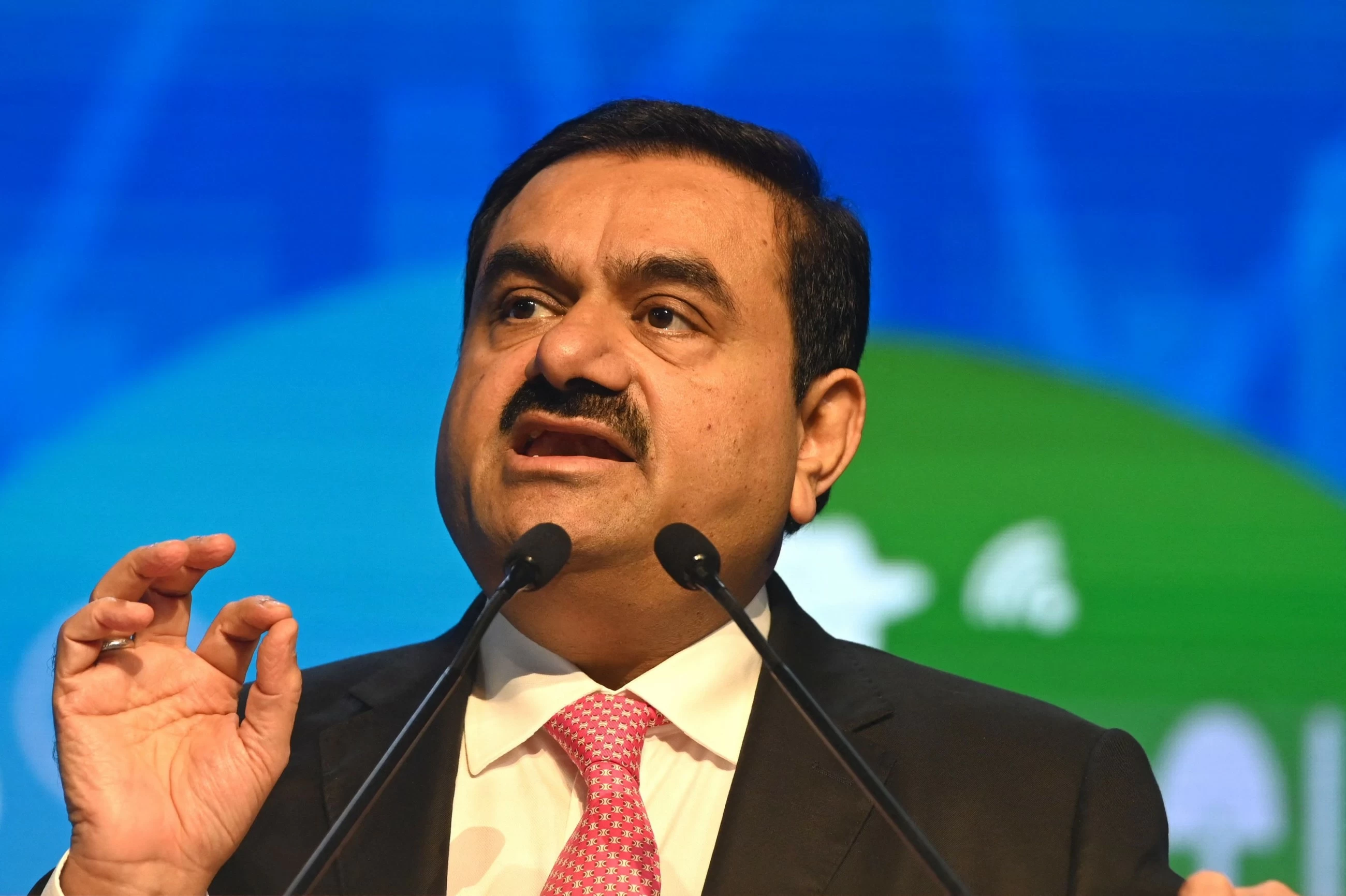
Billionaire industrialist Gautam Adani, Chairman of the Adani Group, has become Asia’s richest individual, overtaking Reliance Industries Chairman Mukesh Ambani, according to the latest Bloomberg Billionaires Index.
Gautam Adani’s net worth rose to $92.6 billion, placing him 19th globally, while Mukesh Ambani slipped to the 20th position with a net worth of $90.8 billion.
The reshuffle at the top highlights the ongoing volatility in global wealth rankings in 2026, amid rising geopolitical tensions and market fluctuations.
In Thursday’s stock market session, Adani Group stocks witnessed a sharp rise, outperforming benchmark indices, which led to an increase of around $3.56 billion in Gautam Adani’s net worth in a single day.
Globally, Tesla CEO Elon Musk continues to top the list with a net worth of $656 billion, followed by Google co-founder Larry Page at $286 billion.
Other names in the top 10 include Amazon’s Jeff Bezos, Meta’s Mark Zuckerberg, Oracle’s Larry Ellison, Dell Technologies’ Michael Dell, Nvidia’s Jensen Huang and LVMH CEO Bernard Arnault, among others.
Notably, seven of the world’s top 20 richest individuals have recorded a decline in their net worth so far in 2026.
Moreover, Arnault has seen the steepest drop, losing $44 billion during the period.
Other billionaires who have witnessed significant erosion in wealth include Steve Ballmer, Larry Ellison, Bill Gates, Warren Buffett and Amancio Ortega.
A sectoral analysis of the index shows that technology entrepreneurs continue to dominate the global rich list, while industrials, energy and retail billionaires have seen relatively higher volatility in their net worth.
Among other Indian billionaires, Lakshmi Mittal ranked 62nd globally with a net worth of $36.9 billion.
HCL founder Shiv Nadar stood at the 70th position with $33.5 billion, followed by Shapoor Mistry and family at 71st with $33.2 billion.
Savitri Jindal, chairperson emeritus of the OP Jindal Group, was ranked 73rd globally with a net worth of $32.7 billion.
Other prominent Indian names on the list include Sunil Mittal and family, Azim Premji, Kumar Mangalam Birla and Radhakishan Damani.
Meanwhile, Adani Group stocks such as Adani Total Gas, Adani Ports, and Adani Power climbed up to 3 per cent on Friday during the intra-day trading.
Adani gets clean chit fom competition regulator
Meanwhile, the Competition Commission of India (CCI) has given a clean chit to Adani Enterprises and Adani Green Energy in an SECI tender case, finding no prima facie case of contravention of fair market competition norms warranting an investigation.
“Upon consideration of the facts and circumstances of the present case, the Commission is of the view that there is no prima facie case of contravention of provisions of Sections 3 and 4 of the Competition Act warranting an investigation into the matter. Therefore, the matter is directed to be closed forthwith under Section 26(2) of the Act,” the CCI ruling stated.
Regarding the allegation of abuse of dominant position by the Adani Group, the Commission noted that power in India is generated through various sources such as coal, solar, wind, hydro and nuclear.
It added that both private and public sector companies operate in the power generation market.
The Commission observed that the Informant had not placed on record any evidence to establish why solar power, or public and private power generation companies, should be treated as distinct markets.
It further noted that the power generation market in India comprises several significant players, including National Thermal Power Corporation, Power Grid Corporation of India Ltd., Tata Power Co. Ltd., Torrent Power and Reliance Power. The Adani Group, therefore, prima facie, does not appear to be a dominant player in the market.
Even in the renewable energy segment, other prominent players such as Tata Power, JSW Energy and Suzlon Energy are present, the Commission noted.
The Commission also observed that the allegation of deriving benefits such as cross-subsidisation and economies of scale from other Adani Group entities does not establish dominance under Section 4 of the Act.
Regarding other allegations – including leveraging, exclusion, creation of entry barriers, bid rigging and discrimination – the Commission said no cogent evidence had been produced by the Informant.
With regard to clause-specific allegations, the Commission observed that no evidence was provided to show that the Request for Selection (RfS) documents were designed to favour only large players.
It noted that tender design is based on the specific requirements of the procurer.
The Commission further observed that stipulating capacity generation and financial eligibility criteria in tenders is a standard practice and cannot be faulted merely because the market includes a large number of smaller players.
Therefore, under the purview of the Act, the clauses in the RfS cannot be said to have been inserted with the intent of excluding competition.
Indo-Asian News Service