1. Home
  2. Author Blogs

Author: admin

admin

Opinion
Redistricting and the Supreme Court have cut voters out of US House races

Redistricting and the Supreme Court have cut voters out of US House races

The number of competitive US House of Representatives districts in this fall’s midterm elections was already near historic lows before the US Supreme Court’s decision on Wednesday opened the door to even more aggressive efforts to draw district lines for political gain. The court’s ruling, which arrived amid what was already an unprecedented national fight over congressional redistricting, may usher in a new era of nakedly partisan gerrymandering that results in still fewer competitive elections, leaving voters with less power than ever. The lack of competitive races means that control of the US House of Representatives will likely be determined in November’s midterm election by fewer than 10% of Americans, with the winners in the vast majority of districts all but assured before a single ballot is cast, a Reuters analysis found. Only 32 of the House’s 435 seats are currently considered competitive, according to the analysis. Those districts were rated either toss-ups or leaning toward Democrats or Republicans by three leading independent forecasters: Cook Political Report, the University of Virginia’s Crystal Ball, and Inside Elections. Most other districts are simply out of play. Cook, for instance, rates 375 seats, more than 85% of the House, as either “Solid Republican” or “Solid Democrat”, which means its analysts do not expect them to be seriously contested. Another 28 races are “likely” Republican or Democratic, according to Cook, meaning they are not competitive at present but might become so under new conditions. This year boasts the fewest competitive House races at this stage of the election cycle since at least 2008, according to an archive of prior Cook ratings. Democrats need to gain just three seats to win a House majority, giving them the power to block President Donald Trump’s legislative agenda and initiate investigations into his administration. The shrinking House battlefield is the result of several factors, including increased political polarisation. However, the weaponisation of congressional redistricting, or gerrymandering – which has gone into overdrive since last year, when Trump began pushing Republicans to draw new maps – is a critical element that is only going to accelerate after the Supreme Court’s ruling, according to experts. “We are now in a cycle of gerrymandering wars,” said Justin Levitt, a professor at Loyola Law School who maintains the website All About Redistricting. “What used to be a cold war has gotten very hot.” The court hollowed out a provision of the federal Voting Rights Act that had blocked state legislatures from dismantling districts with mostly racial minority voters. Political observers expect Republican-led states to target a dozen or more Democratic-held majority-Black and majority-Latino seats that previously enjoyed stauncher protections. “I think it gets worse before it gets better,” Levitt said. “And I think there’s plenty of room for it to get worse.” The lack of competitive districts can have consequences for Congress, said Matthew Klein, a House analyst with Cook. If House candidates only need to appeal to their base voters to win elections, rather than moderates or members of the opposing party, they are more likely to move toward the extremes instead of the political middle. “If you look at Congress and how it acted 20 years ago, 30 years ago, even farther back, you see a Congress that is both less acrimonious and also more productive,” he said. “There used to be bills that passed with huge majorities on major issues. We just don’t really see that anymore.” Gerrymandering has long been a feature of American democracy, but the practice has been supercharged in recent years as guardrails, both legal and institutional, have been torn down. In 2019, the Supreme Court found that while partisan gerrymandering may be undemocratic, federal courts had no role in regulating it. Last year, Trump successfully pressured Texas Republicans to rip up their map and draw a new one targeting five Democratic incumbents, triggering a nationwide arms race that spread to nearly a dozen other states. That move eviscerated what had been a traditional norm limiting most redistricting to the start of each decade, after the US Census population count is completed. The Supreme Court’s ruling on Wednesday, meanwhile, has given even more leeway to lawmakers to draw districts for their party’s benefit. And all of those developments have come against a backdrop of technological advances, with mapmakers able to identify Democratic and Republican voters down to the census block. “If there are no guardrails, there are no guardrails,” Levitt said. “I think the constraint is now realpolitik and imagination, not, ‘We just don’t do that.’” Gerrymandering is not the only culprit to blame for the lack of competitive districts. Voters have become more geographically sorted, as rural areas have trended conservative while suburban regions moved left. And just as House members have become more polarised, so too have voters. Split-ticket voting, in which voters choose a candidate of one party for a higher office and another for a lower office, was once fairly common, but no longer. In 2000, there were 86 House members elected whose districts voted for the opposing party’s presidential candidate, according to research by Kyle Kondik, the managing editor of Crystal Ball. In 2024, that number was down to 16. 

World
Trump says US is holding ‘very positive discussions’ with Iran

Trump says US is holding ‘very positive discussions’ with Iran

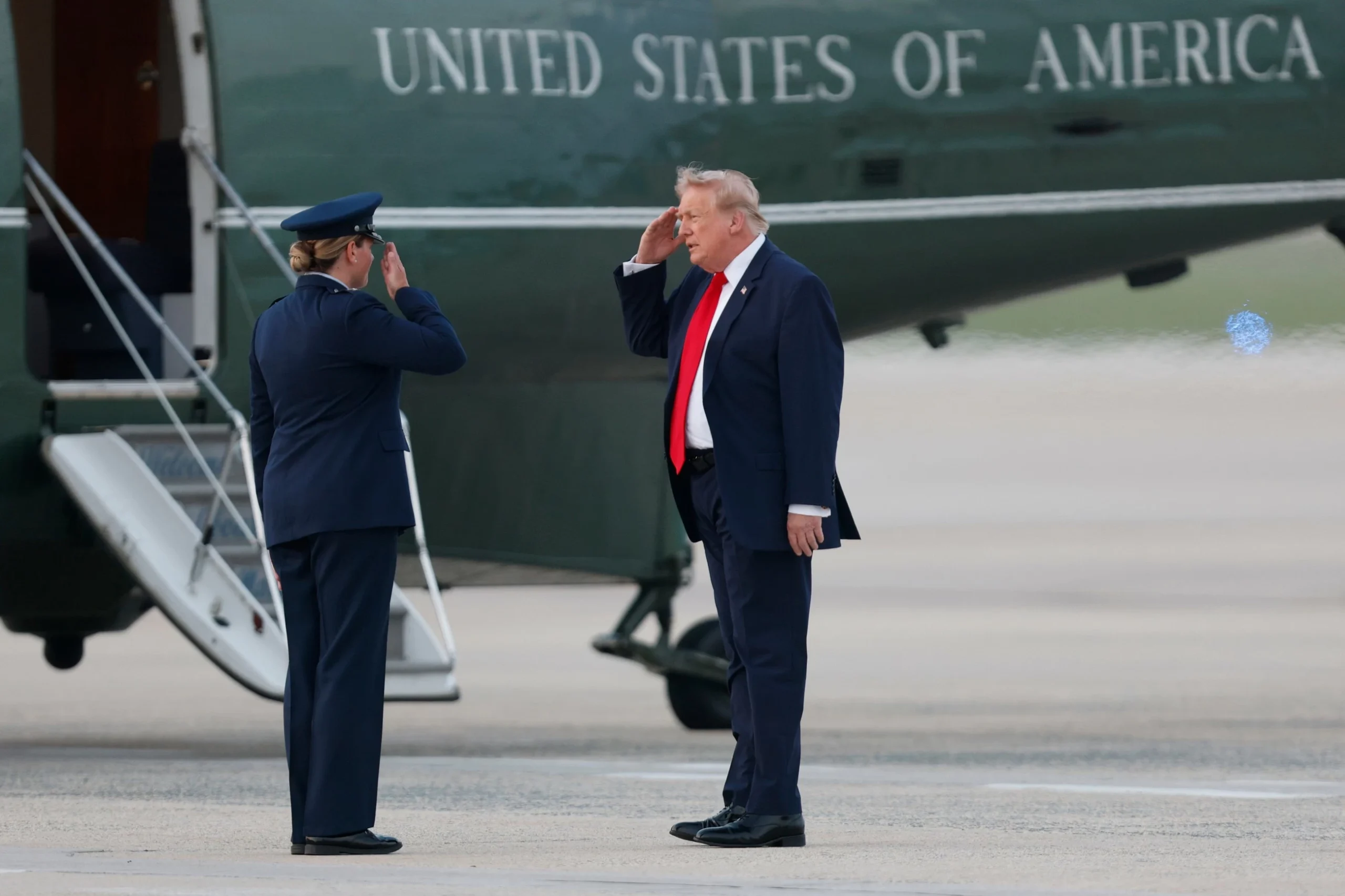
US President Donald Trump speaks to journalists before boarding Air Force One at Palm Beach International Airport. (AFP) US President Donald Trump said yesterday that US officials were holding “very positive discussions” with Iran over potential steps toward ending the war that has upended the Middle East. “I am fully aware that my Representatives are having very positive discussions with the Country of Iran, and that these discussions could lead to something very positive for all,” Trump posted on his Truth Social platform.Iran’s foreign ministry earlier said that Tehran had submitted a 14-point plan “focused on ending the war” and that Washington had responded to it in a message to Pakistani mediators. Trump also said the United States will escort ships through the Strait of Hormuz from today, claiming that “countries from all over the world” had requested it. “For the good of Iran, the Middle East, and the United States, we have told these Countries that we will guide their Ships safely out of these restricted Waterways, so that they can freely and ably get on with their business,” Trump posted on his Truth Social platform. “This process, Project Freedom, will begin Monday morning, Middle East time.” Earlier, Iran said it had received a US response to its latest offer for peace talks, a ‌day after President Donald Trump said he would probably reject the Iranian proposal because “they have not paid a big enough price”.  Related Story

Opinion
Journalists in conflict zones increasingly being targeted

Journalists in conflict zones increasingly being targeted

Journalists are increasingly becoming direct targets in conflict zones rather than mere witnesses, amid an unprecedented rise in violations against them while the world marks the World Press Freedom Day under escalating risks to media workers.Attacks by Israeli occupation forces against journalists have intensified in Palestine and Lebanon, as well as during incursions into southern Syria.The direct targeting of journalists has escalated alongside the expansion of Israeli military operations in the region, to the point that it has become a deliberate pattern.According to the Committee to Protect Journalists (CPJ), Israel has become the government entity most responsible for the deliberate killing of journalists.Data from the CPJ, based on a long-term methodology, shows that Israeli forces have killed five journalists and media workers in the Gaza Strip and the West Bank, in addition to eight journalists and media workers in Lebanon since the beginning of this year.Various other violations have also been recorded, including raids on their homes, interrogations, and the use of live ammunition and tear gas against Syrian journalists during military incursions.CPJ’s regional director for the Middle East and North Africa (Mena) Sara Qudah affirmed that they have documented 47 cases of journalists killed worldwide last year due to their work, 81% of whom were killed by Israel.In an interview with the Qatar News Agency (QNA), she said that since the events of October 7, 2023, the CPJ has verified that at least 64 journalists and media workers were directly targeted and killed by Israeli forces in retaliation for their work.Qudah added that investigations are ongoing into many other suspected cases of deliberate targeting, noting that over a 22-year period, the CPJ has documented the killing of at least 20 journalists by Israeli army fire, describing it as a “deadly pattern”.She pointed out that severe restrictions imposed on Gaza – including Israel’s ban on foreign media access, the destruction of communications infrastructure, mass displacement, and widespread casualties – have made verification of information extremely difficult.Qudah suggested that the total number of deliberate killings is likely much higher, especially given the destruction of substantial evidence, which may mean the true number of deliberately targeted Palestinian journalists in Gaza may never be known.The CPJ’s documentation shows that Israel has killed eight journalists and media workers in Lebanon this year alone, she said, confirming the motives behind the killing of four of them and classifying them as victims of deliberate assassination by Israeli fire.In Syria, particularly in Quneitra and areas near the occupied Golan Heights, the CPJ documented incidents involving journalists who reported that Israeli forces obstructed their work, detained and interrogated media workers, and in some cases destroyed their equipment or forced them to leave the areas they were covering.Qudah stressed that the prevailing culture of complete impunity enjoyed by Israel is a direct factor in the continued targeting of journalists without deterrence, alongside evasion of international legal obligations and the failure to conduct transparent and credible investigations.In Lebanon, Minister of Information Paul Morcos said that nine journalists were killed in direct attacks by Israeli entity over the past two months, with three others injured.He told the QNA that from October 2023 to January, 20 Lebanese journalists were killed by occupation fire.Morcos noted that the ministry has initiated legal action to compile a case on the targeting of journalists, co-ordinate with the United Nations and international rapporteurs, and submit formal complaints to international bodies, including Unesco and the Human Rights Council.He added that the ministry has intensified meetings with international officials from the United Nations, the European Union, and the United Nations Interim Force in Lebanon (UNIFIL), aiming to build international pressure to halt these violations.Morcos also highlighted co-ordination with the Bar Association and Journalists Syndicate to strengthen the legal case being prepared, including drafting a legal study aimed at prosecuting Israel over the systematic destruction of civilian infrastructure across Lebanese cities and towns, and exploring ways to enhance accountability and ensure necessary protections for journalists.The minister condemned the repeated and direct targeting of journalists by Israeli forces while performing their professional duties, most recently the killing of journalists Zeinab Faraj and Amal Khalil.Morcos stressed that such acts constitute a grave violation of international humanitarian law, particularly the provisions of the 1949 Geneva Conventions and their 1977 Additional Protocols, which guarantee the protection of journalists during armed conflicts.He called for an independent and transparent international investigation into these crimes and for deterrent measures against Israel to stop the targeting of journalists, affirming that such attacks will not deter Lebanese journalism from fulfilling its role in conveying the truth, while placing responsibility on the international community.Meanwhile, the deputy head of the Palestinian Journalists Syndicate, Omar Nazzal, said that the reasons that previously drove the Israeli occupation forces to target journalists were to deter the press and media from conveying the facts and details of the crimes committed against the Palestinian people, and to try to cover up those crimes, as they feared for their image in front of the world.However, he continued, after the events of October 7, 2023, the matter became different and took a different direction; the main battle became the battle of narrative and storytelling between the occupation and its allies in the world, which declined and crumbled globally, in contrast to the ability of Palestinian journalists to convey the Palestinian narrative about the right of the landowners to defend their rights.Nazzal told the QNA that, in light of the battle over narratives in Palestine, the Israeli occupation saw this critical situation as an incentive to target Palestinian, Arab, and foreign journalists, conveying the message that anyone who continues to work in the Palestinian territories in a manner that reinforces the Palestinian narrative will pay the price, whether through arrest, killing, being prevented from reporting, or even having their family targeted.About 600 members of journalists’ families were killed during the last war, he said, which serves as a deterrent message to Palestinian journalists that their continued work in journalism may affect their families, which aims to stop coverage completely.Nazzal stressed that incitement had reached its peak on the political and military levels, and even among some Israeli journalists at various levels, to the point of describing it as a crime punishable by death against Palestinian journalists.He pointed to an escalating pattern of Israeli attacks against Palestinian journalists, which witnessed a significant rise after the events of October 7, 2023, affecting the entire Palestinian, Arab, and foreign media body, until there became an Israeli system working to stifle and kill journalists who only want to convey one narrative.He also touched upon the prosecution of the Israeli occupation for its crimes against Palestinian journalists.Nazzal said that the Syndicate has submitted a number of cases to the International Criminal Court since the killing of journalists Ahmed Abu Hussein and Yasser Murtaja in 2018 in Gaza, in addition to the bombing of about 50 media headquarters in the sector and other cases, but the court has not taken any action in these cases or opened a serious investigation.In Syria, during the Israeli incursions into its territory, attacks on journalists continue in the same context, through the firing of live ammunition, preventing coverage, raiding their homes and arresting them, as confirmed by journalist Muhammad Fahd, Syria TV correspondent in Quneitra.He stated that a force from the Israeli occupation army, consisting of 50 members and four military vehicles, stormed his house in March at dawn in the town of Jubata Al-Khashab in Quneitra Governorate, southwest of Syria, and terrorised his family members.Fahd told the QNA that the occupation forces brandished their weapons immediately upon him opening the door, and despite informing them that his family members were in the house, they did not respect the sanctity of the home, and searched all the contents of his work, including cameras, his personal devices and his phone, and subjected him to interrogation for a full hour inside his home.He indicated that the Israeli occupation forces threatened him with taking action against him if he continued to film the occupation army patrols that had entered the governorate, which led to his work being restricted later, as he no longer filmed what was happening in terms of Israeli attacks inside his country, especially since the questions focused on his work in monitoring Israeli incursions and filming army patrols.Fahd believes that what happened to him has been repeated in various incidents with his colleagues in other media outlets, which directly affected their work.He stressed that this constitutes a clear violation of press and media freedom.The targeting of journalists in conflict zones is no longer merely collateral damage of war, but has become a systematic pattern that threatens the very essence of journalism and the world’s right to know the truth.Between Gaza, Lebanon, and southern Syria, testimonies and facts intersect to confirm that the battle is no longer just military, but is also a battle over the narrative, in which force is used to silence the voice that conveys reality as it is.World Press Freedom Day is supposed to be an occasion to promote the protection of journalists but violations present the international community with a real test: either to implement international laws into effective accountability mechanisms, or to accept the continuation of impunity.Meanwhile, journalists continue their work on the front lines, driven by the responsibility to convey the truth, whatever the cost. 

Opinion
Gulf plans to bypass Hormuz still far off

Gulf plans to bypass Hormuz still far off

The war in the Middle East has forced the Gulf monarchies to rethink their oil and trade routes, but rerouting them will be no simple task, experts say.Faced with the closure of the Strait of Hormuz, the only maritime entry point to the Gulf, the region’s Arab nations are looking for ways to bypass Tehran’s stranglehold on their exports.Badr Jafar, the UAE’s special envoy for business and philanthropy, wrote in the Financial Times in early April that the Gulf states would never “return to a posture of strategic dependence on a narrow strait controlled by an unpredictable neighbour”.He insisted that new pipeline and port capacity would be built and “the power grids, water systems and trade corridors connecting the region’s economies... formalised”.Economics, politics and regional diplomatic rivalries are likely to get in the way, however , experts told AFP.While Kuwait, Qatar and Bahrain have no coastline outside the Gulf and no alternative to the strait for seabound oil and gas, Saudi Arabia and the United Arab Emirates both have pipelines allowing them to ship at least some of their output from ports beyond Hormuz – and plan more.Nevertheless, these pipelines only cover a fraction of the two nations’ pre-war exports and would need to be expanded if either country wanted to completely end their reliance on the Strait of Hormuz.Robert Mogielnicki, of the Arab Gulf States Institute in Paris, said that building new pipelines “will take time” and such infrastructure would “still possess vulnerabilities”.“Diversifying energy export supply routes is nevertheless going to be crucial in the years ahead,” he added.For liquefied natural gas (LNG), of which Qatar is by far the dominant producer in the region, the dependency on Hormuz is even greater.Yet, as Frederic Schneider, a senior fellow at the Middle East Council on Global Affairs, explained, building alternative natural gas infrastructure would likely prove economically unattractive.“The idea of a trans-Arabian gas pipeline has occasionally been floated but never progressed,” he said. “The distances, political complexity, and cost make it unattractive against LNG tankers in normal conditions, and normal conditions are what pipeline economics are built on.”The Gulf’s major container ports are mostly located on its southern shores, including Dubai’s Jebel Ali, the region’s main logistical hub.With the Strait of Hormuz off limits, ships have been diverted to Oman and Saudi Arabia’s Red Sea coast with containers then shipped onwards overland.However, overland capacity is limited while costs are “significantly higher” said Schneider.One possibility for boosting land-based transport capacity would be the Gulf Co-operation Council (GCC)’s planned rail network.Yet the project, which is supposed to link all six member states by 2030, has been plagued by delays.Another possibility could be the India-Middle East-Europe Economic Corridor project, launched in 2023, which partially aimed to bypass both the Strait of Hormuz and the Suez Canal, using rail links across the Middle East to connect European and Indian shipping routes.However, the idea remains “tenuous, if not hypothetical” said Schneider, not least because the project would involve linking Saudi Arabia with Israel at a time when Riyadh has cooled on establishing diplomatic relations with Israel.While Gulf governments talk about integration, analysts warned that their own self-interest may get in the way.“Tensions around the strait will generate some tailwinds supporting regional integration projects, but these will also have to contend with some serious economic headwinds and governments that will be super focused on their domestic fronts,” said Mogielnicki.The budgetary pressures created by the war, which have not only halted oil and gas exports but also hit tourism, aluminium and fertiliser production, may also make co-ordination less likely.Previous conflicts in the Gulf, Schneider pointed out, did not lead to more regional integration, even if there were bilateral deals.While the shock of closing Hormuz is much greater, he said, “I would be cautious about treating a geopolitical shock as a substitute for the political will and institutional capacity that have been missing so far”. – AFP 

World
Japan eyes slice of rising global defence spending

Japan eyes slice of rising global defence spending

Long-pacifist Japan has shed its self-imposed ban on lethal weaponry exports, gunning for a prominent place in the global defence trade — a challenging feat that analysts say could take years to achieve. Under Japan’s once-strict stance adopted following its World War II surrender and the atomic bombings of Hiroshima and Nagasaki, it has generally restricted arms exports in recent times to non-lethal categories like rescue, transport and surveillance. Prime Minister Sanae Takaichi’s government scrapped these constraints last month, allowing firms to supply lethal weaponry to any of the 17 countries where Japan has defence cooperation agreements. Prohibitions on sales to nations at war remain but can be circumvented under special circumstances. Five Japanese firms, including Mitsubishi Heavy Industries and Kawasaki Heavy Industries, are already in the top 100 global defence companies, according to the Stockholm International Peace Research Institute (SIPRI). But they have largely lived off domestic demand from Japan’s military, often in cooperation with US defence firms. Analysts say a focus on high-tech sectors could help the transition, but caution that it could take years for defence exports to become a big contributor to economic growth, hampered by capacity and workforce shortages. Bloomberg Intelligence analyst Ian Ma said it was a “transition from a domestic, ministry-led procurement model to a normal practice which companies could drive business opportunities just like other global companies are doing.” He added that as newcomers on the global market, Japanese firms should focus on “higher-tech niches” like naval and propulsion systems, advanced missiles, sensors and electronics. No ‘immediate impact’With conflicts raging around the world, the international defence market is huge and fast growing, soaring by 41% between 2016 and 2025 to almost $3 trillion, according to SIPRI.While Japanese firms may only export to 17 countries, those include some of the world’s biggest defence spenders like the United States, Germany, India and Britain. Evolutions in technology and the way wars are fought — notably with drones — are also making the global arms market more diffuse, which could benefit Japan, according to analysts at the Stimson Center. Along with a steep decline in Russian arms exports, Washington’s “increasingly unpredictable, extractive, and at times confrontational approach” has also pushed importers to seek alternatives to the United States, the Stimson Center said in a research note. “Though the trend remains nascent, for Japan, the wandering eyes of traditional US defence partners could add to the demand for the sorts of sophisticated capabilities Tokyo is well-prepared to offer.” Even before the new changes, Japan has been no slouch. Last year Mitsubishi Heavy Industries won a landmark order for 11 warships from the Australian navy. Japan is also developing a new fighter jet with Britain and Italy, and countries in Southeast Asia are reportedly interested in acquiring used Japanese submarines and warships. But Mitsubishi Electric, which supplied a radar system to the Philippines and may soon make air-to-air missiles with US partners, told AFP that the new rules would not have a “significant immediate impact on our business”. Rival IHI said that the changes “will not lead to an immediate acceleration of our defence equipment business”, but “will have a significant impact on creating a market environment that accelerates international cooperation”. ‘Homework’Ma cautioned that Japan has “homework” to do, including on production capacity, skilled labour, second and third-tier suppliers, certification, testing, maintenance support and the ability to “deliver on time”. Beyond the economic stakes, deepening security ties is also a strategic necessity for Japan, said Heigo Sato, a professor at Takushoku University, in a region where China is flexing its muscles and home to nuclear-armed North Korea. “When it comes to defence industry cooperation, Japan is by no means a country with the world’s most advanced weaponry; therefore, we must actively work to build relationships with other nations,” Sato told AFP. The Japanese public is not at all comfortable with the new strategy, with 55 % of respondents in a recent Nikkei poll saying that they were opposed to the expansion of arms exports.Days after Takaichi announced the new rules, dozens of protestors rallied in Tokyo. In World War II, “Japan committed acts of aggression, and in turn suffered enormous damage from the atomic bombs,” demonstrator Yura Suzuike told AFP. Japan’s pacifist constitution that followed had been drafted “with the resolve that we must never again wage war or kill people”, she said.  Related Story

Sports
Chakravarthy, Narine help Kolkata stay alive in IPL

Chakravarthy, Narine help Kolkata stay alive in IPL

Kolkata Knight Riders’ Varun Chakravarthy pats Sunrisers Hyderabad’s Travis Head of Australia for his innings after Head’s dismissal during the IPL match in Hyderabad Sunday. (AFP) Spinners Varun Chakravarthy and Sunil Narine helped Kolkata Knight Riders to their third straight win in the IPL as they beat Sunrisers Hyderabad by seven wickets Sunday. Chakravarthy returned figures of 3-36 and Narine claimed 2-31 to help bowl out hosts Hyderabad for 165 in 19 overs despite opener Travis Head’s blistering 61 off 28 balls. Three-time champions Kolkata chased down their target in 18.2 overs with Angkrish Raghuvanshi, who hit 59, and skipper Ajinkya Rahane (43) putting together a key stand of 84. Rahane and Raghuvanshi departed before Rinku Singh, unbeaten on 22, and Cameron Green, three not out, steered the team home to snap Hyderabad’s five-match winning streak. Hyderabad, led by Pat Cummins, are third on the 10-team table with six wins and four defeats from 10 matches. Kolkata are eighth, but still in the hunt for the playoffs with three wins from nine matches. Top four teams at the end of the league stage will move into the playoffs. Kolkata’s New Zealand opener Finn Allen provided the early fireworks in his 13-ball 29 as he took on Australia pace ace Cummins with two sixes and two fours. Cummins took revenge in the 27-run over when he got Allen caught out on the last ball but the blazing start put Kolkata on course to victory. Raghuvanshi, a wicketkeeper-batter, and Rahane then put on a defiant stand to close in on victory before the left-handed Rinku hit the winning four. The bowlers set up victory as pacer Kartik Tyagi took down Abhishek Sharma for 15 after the left-handed opener climbed to the top of the batting chart with 440 runs in 10 matches. Australia’s Head hammered the bowlers to all parts of the ground as he hit nine fours and three sixes before Chakravarthy had him caught at mid-wicket by Green. Narine dismissed Ishan Kishan for 42 and the Hyderabad batting lost its way in the final 10 overs with the spinners applying the choke. Tyagi took 2-30 and complimented his teams’spinners with his quick bowling. BRIEF SCORESKolkata Knight Riders 169 for 3 (Raghuvanshi 59, Rahane 43, Sakib 1-17) beat Sunrisers Hyderabad 165 (Head 61, Kishan 42, Varun 3-36, Tyagi 2-30, Narine 2-31) by 7 wickets  Related Story

World
Nigeria to evacuate 130 citizens from South Africa after attacks

Nigeria to evacuate 130 citizens from South Africa after attacks

A child looks on next to her mother holding a placard, during a march by a South African anti-xenophobia group following a recent campaign by another group which called on the government to prioritise jobs

Opinion
Troop cuts show limits of Nato efforts to keep US on board

Troop cuts show limits of Nato efforts to keep US on board

European officials have been working on ways to convince Donald Trump to keep the United States in the North Atlantic Treaty Organisation (Nato) despite severe tensions over the Iran war. However, his abrupt move to cut US forces in Germany is the latest sign that such efforts have their limits and are far from certain to succeed. The substance of the decision announced last week to remove 5,000 troops from Germany did not come as a surprise to Nato officials. European leaders have agreed with the US president that Europeans will take over more responsibility for their own security from US forces. Dropping a plan to deploy long-range US Tomahawk missiles to Germany was more concerning for Berlin. However, even that was not a huge shock, as that deal was made by Trump’s predecessor, Joe Biden, and US Tomahawk stocks have been depleted by the US-Israeli war against Iran. More alarming for European governments was how the move was made – with little prior notification or consultation and with US officials linking it to Trump’s displeasure at German Chancellor Friedrich Merz’s criticism of US conduct of the Iran war. “What is worrying is not the figure of 5,000 troops, but the political signal from Washington that longstanding, absolutely reliable partnerships no longer seem to count for anything and appear to be subject to arbitrary decisions,” said Siemtje Moeller, a senior lawmaker from Germany’s Social Democrats, who are part of Merz’s governing coalition. The move followed accusations by Trump that US alllies have not been doing enough to support the US in the Iran war and suggestions by him that this meant Washington no longer needs to honour the alliance’s Article 5 mutual defence clause. Trump also pushed the alliance to the brink by threatening to take Greenland from Denmark, a fellow Nato member. Nato Secretary-General Mark Rutte helped to defuse that crisis but the underlying dispute has not been resolved. European diplomats say they fear Trump may make further moves that could test the alliance before a summit of its 32 national leaders in Ankara in July, especially if the Iran war is not over by then and he is still venting anger at allies. “The longer game for Nato and European allies is getting through Ankara,” said a European diplomat, speaking on condition of anonymity. “We need to do things with the Americans if we can, and without them if we must.” Defence experts say Europeans have little choice but to try to keep the US on board, given their heavy reliance on the United States to deter any possible attack by Russia. As part of their efforts to convince Trump of the value of European allies, officials have said many European countries are honouring agreements to allow US forces to use bases on their soil and fly in their airspace during the Iran campaign – even if they are not keen to advertise the fact, given Trump and the war are deeply unpopular in much of Europe. European officials are also working to make a broader case to Trump, other US officials, lawmakers and Republican-friendly think tanks that it is in their interests to stick with Nato. While there is broad support for these efforts across the alliance, the crisis has also exposed stark differences among European Nato leaders over how to respond to the war on Iran. Leaders of Western European countries such as Spain, France and Germany have voiced blunt criticism, reflecting domestic public opinion but risking Trump’s ire. Rutte, by contrast, has made clear he sees anti-war rhetoric as unhelpful. Some eastern European countries, fearing any weakening of Nato will embolden Russia, have taken a similar view, diplomats say. Rutte has also said that several countries were “pre-positioning essential logistical and other support” such as minehunters and minesweepers near the Gulf to be ready for a possible Strait of Hormuz mission after the war ends. The Netherlands, Belgium and Germany have said they are sending ships that could be part of such a mission. France, which is leading planning of a potential mission with Britain, also has ships in the Middle East that could take part. “European leaders have gotten the message, they’ve heard the message from the US loud and clear,” Rutte told reporters at a summit of European leaders in Armenia.    

World
Merz not ‘giving up’ on Trump

Merz not ‘giving up’ on Trump

FILE PHOTO: U.S. President Donald Trump and German Chancellor Friedrich Merz reach to shake hands as they meet in the Oval Office at the White House in Washington, D.C., U.S., March 3, 2026. REUTERS/Jonathan Ernst/File

Entertainment
Kid Rock Filmed Concert Opening Video With Pete Hegseth

Kid Rock Filmed Concert Opening Video With Pete Hegseth

Kid Rock Let's Go For A Ride, Secretary Hegseth ... Debuts New Video With Helicopters at Concert Published May 3, 2026 1:56 PM PDT Kid Rock's using his Department of War connections to get fans