admin
admin 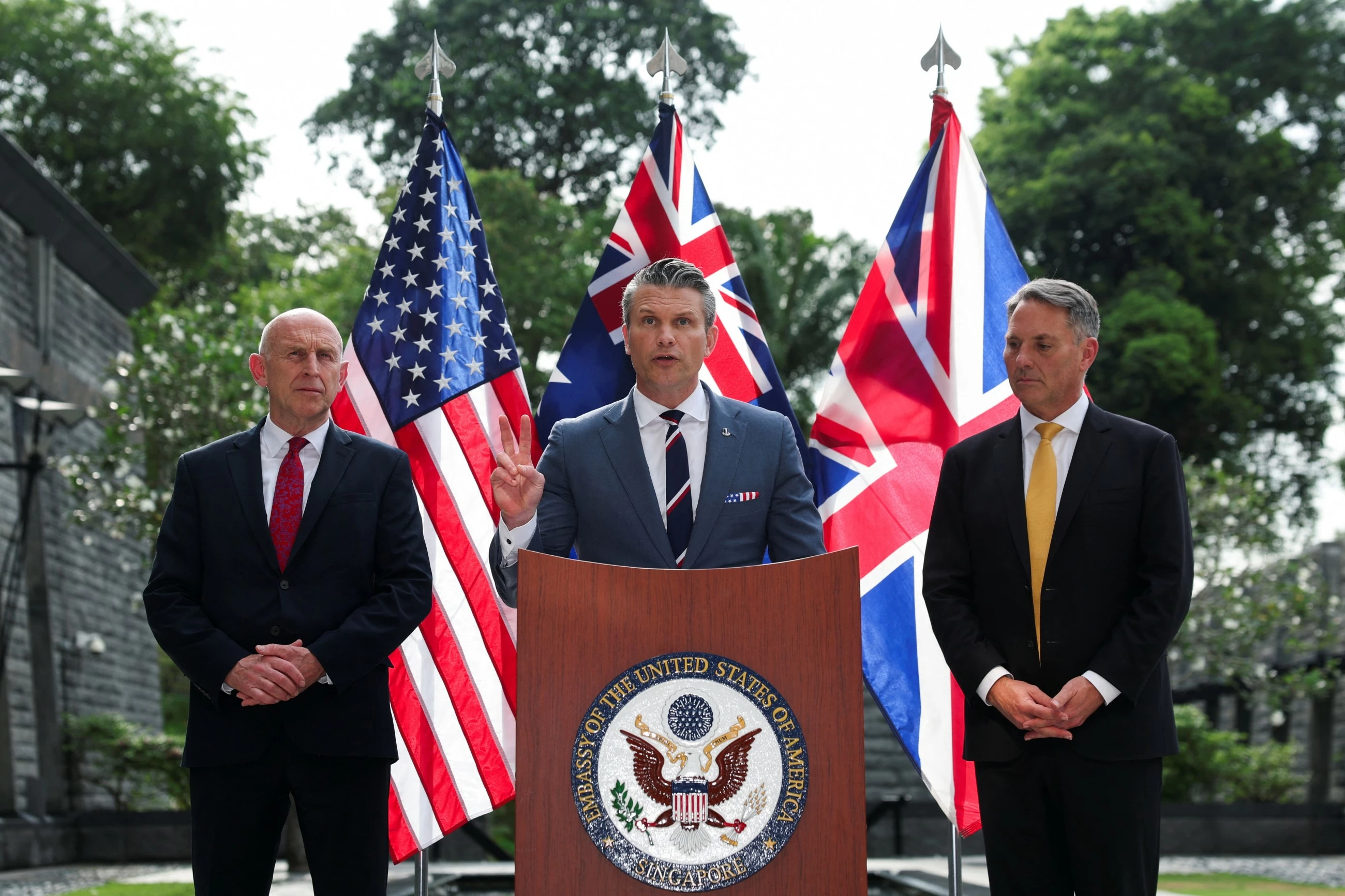
The United States, Australia and Britain are developing high-tech payloads for uncrewed underseas vehicles under their trilateral security partnership, Pentagon chief Pete Hegseth announced on Saturday.
Hegseth met his Australian and British counterparts on the sidelines of the Shangri-La Dialogue in Singapore, where they reviewed progress on the AUKUS pact, aimed at bolstering their presence in the Indo-Pacific and beyond.
“Today, we’re pleased to announce the first AUKUS Pillar 2 signature project, focused on fielding advanced uncrewed undersea vehicles, or UUVs,” Hegseth told reporters at a briefing at the US embassy in Singapore.
“This signature project will deliver a suite of highly adaptable multi-mission UUV payloads designed to support undersea operations and maintain our collective advantage in the maritime domain,” he said.
The delivery of the vehicles will start in 2027.
AUKUS’s Pillar 1 focuses on Australia’s acquisition of conventionally armed, nuclear-powered submarines, while Pillar 2 pools the talents of each nation’s defence sector to develop advanced military capabilities.
The pact is framed as supporting a “free and open Indo-Pacific”, though it is widely viewed as a bulwark against a rising China, which strongly opposes it.
British Defence Secretary John Healey said that the planned technology, a “range of cutting edge sensors and weapons systems” for underseas drones, “will rapidly give our forces the very most advanced battlefield technologies.”
Healey added that the unmanned undersea vehicles will sharpen all three countries’ ability to respond to threats, including those targeting underwater cables and pipelines.
The systems will be deployed on uncrewed underwater vessels, Healey added.
The protection of underwater infrastructure has been a major topic of discussion at Asia’s premier annual defence summit at a swanky Singapore hotel.
“The seabed has become a major field of contest over the past 18 months,” Australian Defence Minister Richard Marles earlier told delegates.
“We have witnessed a series of attacks against subsea critical infrastructure at a scale and frequency that is historically unprecedented.”
There has been several incidents in the past two years of seabed cables being damaged by ships, both in the Baltic and around the Asian region.
Nearly all of Australia’s internet traffic flows through just 15 subsea cables, Canberra’s top diplomat pointed out.
“Our ability to operate as a modern economy and a functioning state, all of it is critically dependent on infrastructure that is exposed, that cannot move.”
“As we’ve now seen demonstrated in the Baltic, (it) can be cut with an anchor in the middle of the night,” he said.
Agencies