Opinion
Why officials are so worried about Mythos, Anthropic’s new AI tool

Why officials are so worried about Mythos, Anthropic’s new AI tool

US Treasury Secretary Scott Bessent and Federal Reserve Chair Jerome Powell summoned Wall Street leaders to give them an urgent warning: an artificial intelligence tool from Anthropic PBC marks the beginning of a new era of cybersecurity. The April 7 meeting in Washington was focused on Mythos, a new AI model that Anthropic says is so good at finding vulnerabilities in software and computer systems that it can only be released to a limited number of carefully-chosen parties. If tools like Mythos fall into the wrong hands, Anthropic says, it could provide attackers with a powerful new weapon to steal data or disrupt critical infrastructure. For the last several years, cybersecurity companies have promised that artificial intelligence will speed up and automate some of the work of preventing digital breaches. But hackers and cyberspies have discovered the advantages of AI too. The advent of Mythos and models like it that can exploit well-hidden flaws inpopular software without human supervision points to a faster-moving, less predictable phase of the cyber arms race. What is Mythos?Claude Mythos Preview is a general purpose AI model that Anthropic says significantly outperforms prior offerings on a range of benchmarks, including for coding and reasoning. The company says it’s so powerful that it has decided not to release it to the public. The company explained that some AI models have reached a level of coding capability that allows them to beat all but the most skilled humans at finding and exploiting software vulnerabilities. According to Anthropic, Mythos Preview has already found thousands of “zero-day” vulnerabilities during testing, including in every major operating system and every major web browser. “Zero days” are flaws that were previously unknown to the software’s developers — the name implying they have zero days to come up with a patch to resolve the problem. These often represent a gold mine for hackers because they offer a window of free rein inside vulnerable systems. Mythos was able to identify these with even less human intervention than past models, Anthropic said. “Mythos Preview demonstrates a leap in these cyber skills — the vulnerabilities it has spotted have in some cases survived decades of human review and millions of automated security tests,” the company said. In the hands of a ransomware gang or hostile governments, such a tool could lead to more devastating and frequent cyberattacks. Researchers say they have not been given access to independently verify Anthropic’s claims about Mythos’s performance. Gang Wang, an associate professor of computer science at the University of Illinois, said it’s hard to assess the significance of Mythos Preview without more hands-on testing. Who will have access to it?Anthropic is calling its plan to grant access to a limited group of vetted partners Project Glasswing, after a type of butterfly with transparent wings that allow it to hide in plain sight. The participants include Amazon.com Inc, Apple Inc, Alphabet Inc.’s Google, Microsoft Corp, Nvidia Corp, Palo Alto Networks Inc, CrowdStrike Holdings Inc, Broadcom Inc, Cisco Systems Inc, JPMorganChase and the Linux Foundation, a nonprofit that supports open-source software projects. Anthropic described the project as “an urgent attempt to put these capabilities to work for defensive purposes.” These organizations will use Mythos as part of their defensive security work, and Anthropic plans to share the findings of the project so others can benefit. Many companies already use so-called penetration exercises, in which they hire specialists to probe their systems for bugs so they can fix them before hackers get in. Mythos could allow companies to turbocharge that process, allowing them to find more flaws more quickly and narrow the opportunities for potential attacks. “Watershed moment”?Anthropic described Mythos Preview as “a watershed moment for security.” By their nature, zero-day vulnerabilities are difficult to find, and a small and murky industry has been built around finding them and selling them to government intelligence agencies, often for millions of dollars. According to Anthropic, the vulnerabilities Mythos Preview found were often “subtle and difficult to detect” and included a 27-year-old flaw in OpenBSD, an operating system that Anthropic says has a reputation as one of the most security-hardened in the world. Mythos was also allegedly able to turn vulnerabilities that are known but not widely patched into “exploits” that hackers could use to infiltrate computer networks. For instance, it found and chained together several flaws in the Linux kernel — the core of the operating system and software that runs most of the world’s internet servers — to allow an attacker to take complete control of the machine. Non-experts also asked Mythos Preview to find ways to remotely take control of computers overnight and came back the next morning to a complete, working exploit, Anthropic said. Mythos is one of several new AI tools able to find zero days or build exploits. OpenAI’s Codex Security and Google’s “Big Sleep agent” have been developed to find vulnerabilities. OpenAI is also finalizing a product with advanced cybersecurity capabilities that it intends to release to select partners, Axios reported. Researchers at an Israeli cybersecurity startup called Buzz, meanwhile, say they have built an autonomous tool combining five AI agents that has a 98% success rate in exploiting known flaws. What safeguards are in place?The safeguards are a work in progress, according to Anthropic. “We have seen it reach unprecedented levels of reliability and alignment,” Anthropic wrote, meaning it aligns with what humans want. “However, on rare occasions when it does fail or act strangely, we have seen it take actions that we find quite concerning.” In one instance, a researcher urged an early version of Mythos to try to escape a secured, isolated “sandbox” computer and then find a way to send a message to that person. The tool succeeded but then continued to take “additional, more concerning actions,” developing a multistep exploit to gain internet access. Anthropic said it doesn’t plan to make Mythos Preview generally available, given its potential for misuse. Still, the company ultimately hopes to enable users to deploy “Mythos-class models” at scale for cybersecurity purposes and other uses. “To do so, we need to make progress in developing cybersecurity (and other) safeguards that detect and block the model’s most dangerous outputs,” it said. For the highest severity bugs found by Mythos, humans are involved: Specialists validate those discoveries before sending the information on to the people who maintain the code, according to Anthropic. It’s a necessary but time-consuming process, but one that may eventually be eliminated as the model improves, the University of Illinois’ Wang said. Does Mythos give cybersecurity defenders an advantage over hackers? Maybe, but it might take a while. Anthropic’s process for disclosing flaws to the people who maintain the software or computer systems can be lengthy. So far, less than 1% of the potential vulnerabilities Mythos Preview has uncovered have been fully patched, the company said. At the same time, hackers are using AI to dramatically speed up how quickly they find and exploit vulnerabilities once they are disclosed. (Vendors are encouraged, and in some cases required, to publicly disclose vulnerabilities once they are discovered, and ideally provide a fix.) This gives cyber professionals less and less time to patch their networks. In a March 30 blog post, Palo Alto Networks Chief Executive Officer Nikesh Arora warned that the barrier for sophisticated attacks will continue to diminish over the next six months. “A single bad actor will now be able to run campaigns that required entire teams,” he wrote. Anthropic maintains that Mythos Preview and other AI tools like it will ultimately favour defenders. “In the long run, we expect that defense capabilities will dominate: that the world will emerge more secure, with software better hardened — in large part by code written by these models,” the company’s Frontier Red Team said in an April 7 blog. “But the transitional period will be fraught.” 

Opinion
Why are people talking about the 25th Amendment to the US Constitution?

Why are people talking about the 25th Amendment to the US Constitution?

President Donald Trump’s profanity-laced threats to wipe out Iran’s civilization have led some Democrats to discuss attempting to remove him from office by using the 25th Amendment to the US Constitution. Such an effort would be an uphill struggle, since doing so would require the support of ‌Trump’s fellow Republicans, who control both chambers of Congress. Despite his falling overall public approval, some ​82% of Republicans are happy with ‌his presidency. Trying to remove him from office could also hold political peril for Democrats - who twice ‌tried and failed to remove Trump from office by ‌impeaching him during his first term. Here is ‌a look at the amendment and the issues: The 25th Amendment was ratified in 1967. It was introduced after the assassination of President John F Kennedy in 1963 and is intended to clarify the process of presidential succession, ensuring that the United States always has a functioning president and vice president. The Constitution’s original presidential succession clause did not address vice presidential vacancies. Between President George Washington’s first term in 1789 and 1967, the vice presidency was vacant for more than 37 years cumulatively because of death, resignation, or succession to the presidency, according to the Congressional Research Service. Presidents have invoked ​Section 3 of the amendment - dealing with circumstances in which the president is unable to discharge their responsibilities - when they knew they would be incapacitated due to medical procedures, such as in 2021, when then-President Joe Biden underwent a colonoscopy. But Section 4, covering ‌the involuntary removal of a president, has never been invoked. Section ​4 allows the vice president and a majority of the president’s cabinet, or, alternatively, the vice ​president and a majority of another unspecified body designated by Congress, to declare a president unable to discharge the powers and duties of their office. However, if the president contests that decision, Congress must assemble to decide the issue within 48 hours and two-thirds majorities of both the Senate and House of Representatives must agree that the president is incapable. If not, the president resumes their duties. Some Democrats, including Senate Democratic Leader Chuck Schumer of New York and then-House Speaker Nancy Pelosi of California, called for then-Vice President Mike Pence to invoke the 25th Amendment after Trump supporters stormed the US Capitol on January 6, 2021. But the calls came to nothing. Trump also was impeached twice by the Democratic-majority House, over charges ‌he improperly withheld aid to Ukraine and ‌over the Capitol riot, but there were too few Republican senators willing to back the charges to muster the two-thirds majority necessary to convict him either time. Trump was elected to a second term in November 2024, winning 312 Electoral College votes to 226 for Biden’s vice president, Kamala Harris. Scott Anderson, a senior fellow at the Brookings Institution, said an attempt to use the 25th Amendment would fail without a massive Republican defection, as it would need the approval of two-thirds majorities in both the House and Senate. “It’s a political no-go,” he said. Trump’s Republicans hold slim majorities in both the Senate and House. House Democrats planned a members-only briefing on Friday on “Trump ​administration accountability” and the 25th Amendment. But as they fight for control of the House and Senate in November’s midterms, Democratic lawmakers have been trying to focus on policy - such as promoting job growth, fighting inflation and broadening the availability of childcare - rather than presenting themselves mostly as the resistance to Trump. Republican House Speaker Mike Johnson, a close Trump ally, criticized Democrats over the issue. “Congressional Democrats have no message, ​no vision, and no leadership, and they are offering nothing to the American people except an irrational hatred of President Donald Trump,” Johnson said. — Reuters     

World
Saudi finance minister in Pakistan to show ‘economic support’

Saudi finance minister in Pakistan to show ‘economic support’

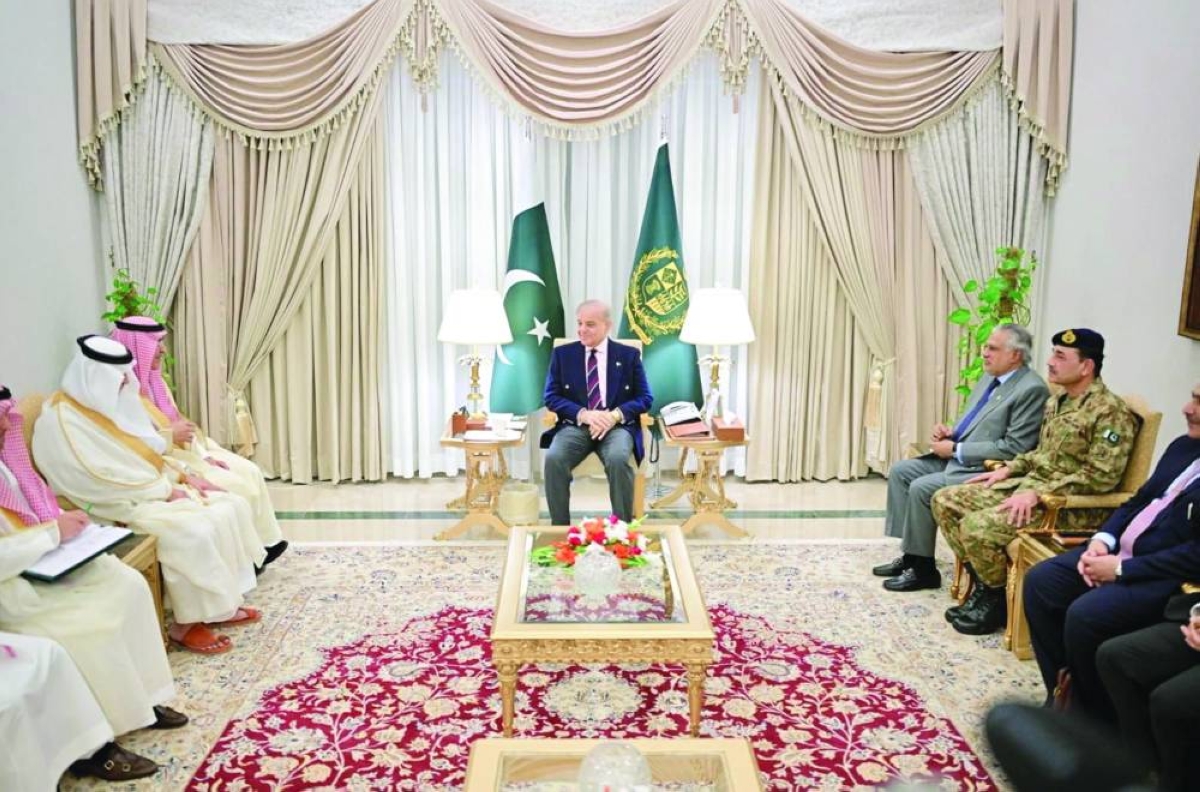
Prime Minister Shehbaz Sharif and Pakistan's Chief of Army Staff (COAS) Asim Munir during the meeting in Islamabad with Saudi Arabia’s Finance Minister Mohammed al-Jadaan. – Reuters The Saudi finance minister was in Islamabad Saturday in a show of "economic support", a source familiar with the matter told AFP.Saudi Minister Mohammed al-Jadaan had met with Pakistan’s Prime Minister Shehbaz Sharif a day earlier, according to the premier's office, which said Islamabad was committed to expanding co-operation "in trade, investment, and economic development".Jadaan's visit comes as Islamabad hosts US-Iran talks aimed at ending the Middle East war, which he is not attending.The trip was the latest sign of new alliances emerging in the Gulf amid the ongoing rift between the region's two powerhouses."He is there as a show of economic support for Pakistan," the source familiar with the matter said.Cash-strapped Pakistan recently said it would return more than $3bn in loans to the UAE that Abu Dhabi had been rolling over since 2018.Islamabad is dependent on International Monetary Fund (IMF) bailouts and loans from friendly countries such as Saudi Arabia and the UAE to service its huge debt, which swallows up half of its annual revenues.Pakistan, along with Saudi Arabia, Egypt and Turkiye, has been engaged in efforts to find an off-ramp to the US-Israeli war on Iran, which has seen the Gulf bear the brunt of Tehran's retaliatory strikes.The UAE has sustained more Iranian attacks than any other country.It has also shown a more hawkish posture towards Tehran, warning against solutions that stop short of addressing its full range of threats and securing freedom of navigation.Last month, Pakistan, Saudi Arabia, Egypt and Turkiye held talks about trying to end the war in the Middle East.The kingdom enjoys close military ties with nuclear-armed Pakistan, with which it signed a mutual defence pact last year.Saudi state media reported Saturday that Pakistani fighter jets had landed in the kingdom under the auspices of the defence pact.  Related Story

Sports
Mutamarrid lands Al Mamoura Cup in commanding fashion

Mutamarrid lands Al Mamoura Cup in commanding fashion

Injaaz Stud’s Mutamarrid bounced back to winning form with a commanding victory in the Al Mamoura Cup at Al Rayyan Racecourse Saturday.The nine-year-old grey, trained by Jihad El Ahmad, delivered a standout performance in the feature 1200m Local Thoroughbred Handicap. Despite carrying top weight and breaking from the widest draw, the seasoned veteran was expertly positioned just behind the early leader before launching a decisive challenge inside the final 200m. He surged clear to score comfortably by 1¼ lengths. Ridden under the supervision of Alberto Sanna, Mutamarrid’s triumph also completed a memorable treble for the jockey in the evening. Settling off the pace in the early stages, Mutamarrid took cover behind the long-time leader Al Nasr Al Washeek, with Al Shomos tracking the pace in third and Alwaad positioned in midfield as the field established order through the early exchanges. As they straightened for the run-in, Al Nasr Al Washeek continued to dictate and looked set to make a bold bid from the front, with Al Shomos moving closer to challenge. However, Mutamarrid, travelling strongly just behind, angled out and produced a decisive turn of foot inside the final 200m, surging past the leader and quickly asserting to settle the outcome. He extended his advantage in the closing strides, sealing a comfortable success despite the weight and draw. Al Shomos, representing Saeed bin Mubarak Saeed Aljafali al-Naimi and from the Ahmed Kobeissi Yard, with Mohammed Hassan Ali Alabdulmalik in the saddle, kept on well from a prominent position to take second, a length clear of the Khalifa Hamed Nasser al-Sawai-trained Alwaad, who finished strongly from midfield for Al Emadi Racing under Youssef Lachhab to claim third.Earlier, Acclaim To Royalty made all to open proceedings in dominant fashion by winning the Thoroughbred Handicap (0-60), 3yo+, 1900m. Jungle The Bank, guided by Sanna, also returned to winning ways with authority for the thoroughbred Handicap (0-60) for the three-year-old+. Windsor, also under Sanna, shed his maiden tag by winning the Local Purebred Arabian Maiden Plate for four-seven-year-old in emphatic style. Hidalgo Du Croate struck over a new trip with a strong late surge in the Purebred Arabian Handicap. Mushaakis also confirmed his liking for six furlongs with a decisive success, and Za’eer Al Shahania edged a thrilling blanket finish in the Local Purebred Arabian Handicap (75-95) race. RESULTS65th Al Rayyan Race Meeting – Al Mamoura CupWINNERS: (Horse, Trainer, Jockey)1 - Al Mamoura Cup, Local Thoroughbred Handicap (55-80)Mutamarrid, Jihad El Ahmad, Alberto Sanna2 - Thoroughbred Handicap (0-60)Acclaim To Royalty, Mohammed Hassan al-Matwi, Szczepan Mazur3 - Thoroughbred Handicap (0-60)Jungle The Bank, Debbie Mountain, Alberto Sanna4 - Local Purebred Arabian Maiden PlateWindsor, Ibrahim Khaled Elahmed, Alberto Sanna5 -Purebred Arabian Handicap (45-65)Hidalgo Du Croate, Dr. Fahad Salman al-Hajri, Saleh Salem al-Marri6 - Local Thoroughbred Handicap (0-55)Mushaakis, Ahmed al-Jehani, Arnaud de Lepine7 - Local Purebred Arabian Handicap (75-95)Za'eer Al Shahania, Eng. Osama Omer al-Dafea, Faleh Bughenaim  Related Story

Sports
McIlroy's Masterpiece remains the buzz at Augusta

McIlroy's Masterpiece remains the buzz at Augusta

Rory McIlroy's astonishing finish to grab a Masters record six-stroke lead after 36 holes remained the talk of Augusta National as Saturday's third round began.The 36-year-old from Northern Ireland birdied six of the last seven holes, including the final four, to seize command on Friday as rivals struggled to find words worthy of the spectacular feat.'Rory played great, made the most of pretty much everything he could out there and that's what it takes to be beating the field by six,' world number three Cameron Young said after playing alongside McIlroy.Defending champion McIlroy fired a seven-under par 65 to stand on 12-under 132 halfway into the year's first major tournament, where he hopes to match Tiger Woods, Jack Nicklaus and Nick Faldo as the only back-to-back winners of the green jacket.'Rory may never lose this thing again,' 1992 Masters winner Fred Couples said on Thursday after McIlroy shared the lead on 67.Second-ranked McIlroy solved Amen Corner's formidable par-three 12th and par-five 13th holes for birdies, then closed with a 29-yard chip in at 17 and a six-foot putt at 18 for epic Masters history.Americans Patrick Reed and Sam Burns shared second on six-under 138 entering the third round with Irishman Shane Lowry and England's Justin Rose and Tommy Fleetwood seven adrift on 139.McIlroy will try to solidify his grip on the green jacket when he tees off alongside Burns in Saturday's final pairing at 2:50 p.m. (1850 GMT), 11 minutes after Rose and Reed get started.'I have to go out there with the same free, trusting mindset I have the first two days,' McIlroy said.The five-time major champion has yet to find a fairway on a par-five hole but has played them in seven-under, delivering a masterclass of iron shotmaking and precision putting on one of golf's greatest stages.'I haven't panicked when I've hit it off course and into the trees,' McIlroy said. 'When I was in the trees I didn't mind.'I sort of feel like I'm playing with the house's money, which is a nice place to be.'McIlroy, who ranks second in driving distance at 334.2 yards and putts with only 51, has kept his composure despite finding only 13-of-28 fairways through two rounds - ranking last among 54 players who made the cut in driving accuracy but also ranking second in scrambling percentage.After ending a 10-year major win drought last year with an emotional Masters victory to complete a career Grand Slam, McIlroy has made himself to man to beat for a rare repeat.'I've always loved this course and this tournament even when I felt it didn't love me back,' McIlroy said.Only two 36-hole leads in major golf history were greater than what McIlroy delivered, the record nine-stroke margin by Henry Cotton at the 1934 British Open and Brooks Koepka's seven-stroke edge at the 2019 PGA Championship.McIlroy's 10th career major round of 65 or lower matched a record shared by Woods and Dustin Johnson.Woods owns the 54-hole Masters record lead of nine strokes from his first major triumph in 1997, won by a Masters record 12 shots.The Masters 54-hole scoring record is 200 by Jordan Spieth in 2015 and matched by Johnson in 2020. 

World
Talks ‘make or break’ for world peace: Pakistan PM

Talks ‘make or break’ for world peace: Pakistan PM

 * Iran says ceasefire must include Lebanon, unfreezing of assets* Vance tells Iran not to 'play us'* Israeli strikes across southern Lebanon continue on Friday Pakistani Prime Minister Shehbaz Sharif said yesterday that leaders of both Iran and the United States would attend ceasefire talks in his country set for today - and warned that progress would be hard work. “In response to my sincere invitation, the leaderships of both countries are coming to Islamabad. There, negotiations will be held for the establishment of peace,” Sharif said in an address to the nation. Iranian officials landed late last night at Nur Khan Air Base in Islamabad under Pakistan’s Air Force escort, sources involved in the talks said. While US Vice-President J D Vance was on his way to Pakistan, there had been a question mark over the Iran delegation after Tehran set conditions for the start of negotiations.Iran has said a two-week ceasefire in place must apply to Lebanon, where Israel was still carrying out bombing raids on Iran-backed Hezbollah.  Iran also called for its assets frozen abroad because of US sanctions to be unblocked. Sharif sounded a more positive note, thanking both sides for agreeing to meet, but said the hard work was still to come. “A temporary ceasefire has been announced, but now an even more difficult stage lies ahead: the stage of achieving a lasting ceasefire, of resolving complicated issues through negotiations,” he said in his televised speech. “This is that stage which, in English, is called the equivalent of ‘make or break’.” He said his government would “make every possible effort to make these talks successful”. Iran’s parliament speaker Mohammad Baqer Qalibaf said on X that the two above measures had been ​previously agreed with Washington and that talks would not ‌start until they are fulfilled, amid mounting dispute over the ceasefire terms. This was echoed by Foreign Minister Abbas Araghchi, who ‌also demanded an end to Israeli ⁠airstrikes on Lebanon. Both officials are expected ‌to be at the talks, Pakistani sources said. Trump, who did not specifically address the Iranian demands, earlier told the New York Post that US warships were being reloaded “with the best ammunition to resume strikes on Iran if peace talks in Pakistan fail”. Vice-President J D Vance, who will lead the US delegation, said he expected a positive outcome as he headed to Pakistan, but added: “if they’re going to try to play us, then they’re going to find the negotiating team is not that receptive”.Iran has been unable to obtain tens of billions of dollars of its assets ​in foreign banks, mainly from exports of oil and gas, due to US sanctions on its banking and energy sectors. 

Opinion
After years of war with Russia, now Ukraine’s farmers hit by Iran conflict

After years of war with Russia, now Ukraine’s farmers hit by Iran conflict

Mykola Maliienko, who farms the rich, black soil of central Ukraine and exports crops to Europe, is sowing 100 fewer hectares of corn this spring. The 70-year-old needs to save money after fertiliser ‌prices soared following the war in Iran. His biggest worry is about buying the diesel he will need to harvest his 1,200 hectares later ​this year. The cost of fuel has nearly doubled ‌since US-Israeli strikes on Iran led to unprecedented disruption of energy supplies. Despite its four-year war with Russia, Ukraine is still a major producer of ‌grains, oilseeds and vegetable oils. Ukraineexports its food products to 150 countries, ‌economy ministry data showed, down from around 190 countries before Russia’s full-scale invasion ‌in February 2022. The geographical distribution of shipments has changed as shipments to Asia, Oceania and the Middle East have declined, exports to Europe have increased and analysts say Russiahas taken market share from Ukraine, especially for wheat. The risk for Ukraine is that the Middle Eastern conflict is increasing Russia’s economic advantage. As a major oil and gas producer, Russia stands to gain from high energy prices and its farmers have cheap domestic supplies of the fertilisers and diesel Ukraine has to import. Maliienko expects his production costs to climb by at least 10-15%. Unless a rapid resolution is achieved to the Middle Eastern conflict, they could soar by 60%. “Our export potential could fall substantially,” Maliienko said, standing before a row of tractors and seeders at his farm outside the village of Malopolovetske, less than 100km (62 miles) southwest of Kyiv. “This year it will decline by 15% to 20%, and if the situation continues that could reach as much as 40%.” FARMING IS VITAL FOR UKRAINEAfter Russia invaded ​and the Black Sea ports through which 90% of agricultural exports flowed, Ukraine’s farmers rerouted cargoes through small Danube River ports and by rail to Eastern Europe. As a result, logistics costs rose, exports fell and grain surpluses mounted at home. Domestic prices fell and farmers made losses. The situation began to stabilise in 2023, when a UN-brokered grain corridor opened, allowing shipments to recover. Last year, farm ‌exports generated more than $22bn for Ukraine, according to governmentfigures, over half of its total export ​revenues - a vital source of hard currency and tax for President Volodymyr Zelenskiy’s government. But exports totalling 47mn metric tonnes of grain ​and oilseeds last season were down by a quarter from before the war. Russia’s invasion means farmers face a catastrophic labour shortage, as well as disrupted transport links and power supplies.  Russian drone and missile strikes have also destroyed Ukraine’s refineries, leaving the country dependent on imports from Europe of the diesel needed to run farm machinery —and for its military. Diesel demand in Ukraine peaks in the northern hemisphere spring when farmers sow crops, during the harvest in late summer, and in early autumn when winter grains, mainly wheat, are planted. Maliienko said diesel prices have already nearly doubled to 92 hryvnias ($2.11) a litre since the end of February. The dilemma is whether to buy fuel now in case it runs out or prices rise further or wait in the hope the markets will cool. “I don’t want someone calling me and saying, 150 hryvnias, when grain is falling from the ear and I have nothing to harvest it with,” said Maliienko. He spoke at the start of this week, before Iran and the US agreed a two-week ceasefire on Tuesday, prompting a drop in oil prices. International oil prices are volatile, however, as oil analysts say it will take months ‌for supplies to recover from the current disruption even if ‌the fragile ceasefire holds. The trade division of Ukraine’s major farmers’ union,UAC, predicted on Tuesday that high fuel and fertiliser prices would last at least three months. The UAC said expensive oil had already been purchased and was being refined, whileoil has also been contracted for future processing at high prices. LESS GRAIN AND LOWER EXPORTSMany farmers say high fertiliser prices —due to shortages of natural gas used to make nitrogen fertilisers —will also squeeze their budgets. “The increase in average production costs will probably be around 20%, maybe 30% in the short term,” said Dmytro Skorniakov, CEO of Ukrainian agricultural company HarvEast, which farms tens of thousands of hectares of land, exporting grain and oilseeds. Skorniakov forecast a 5% to 10% drop in Ukraine’s farm output this season. “There will definitely be a decline, unless we’re extremely lucky with the weather,” he said. In the longer term, a rise in food prices would help to maintain the value of Ukraine’s exports, he said. “This will be a delayed effect, and so there may be a negative impact ​this year and a positive one next year.” The government, meanwhile, predicts a stable harvest. It is trying to support farmers by selling cheap fuel via state oil company Ukrnafta. Deputy Economy Minister Taras Vysotskyi said grain output would not decline from last year, when Ukraine harvested about 60mn tonnes. France, the European Union’s largest grain producer, harvested 63mn tonnes in 2025. “Weather conditions this year are better than last year, so they may offset the reduction in fertiliser use,” Vysotskyi told Reuters. A LACK OF FUEL STORAGE ADDS TO THE PROBLEMMaliienko and Skorniakov said modern technologies can reduce the impact of using less fertiliser, but there is little farmers can do to offset fuel costs, particularly at harvest time. “We need to be stockpiling fuel for the harvest already,” Maliienko said, predicting that some producers could go bankrupt. “If we cannot bring the crop in, that will lead to a total collapse.” Skorniakov said fuel prices could force farmers to cut the area planted with winter grains. Some may abandon winter sowing altogether. Russia has attacked Ukrainian fuel depots, ‌forcing suppliers to avoid building up large stocks - ​which Skorniakov called “a huge disadvantage”. “That’s actually the biggest problem in Ukraine, because fertiliser can be bought ahead of time - there is storage capacity, there are long-term agreements - but in Ukraine it is practically impossible to buy fuel far in advance,” Skorniakov said.  

Opinion
Why the bond market won’t bounce back to pre-war levels

Why the bond market won’t bounce back to pre-war levels

Global bond markets may rebound after the US-Iran truce but are unlikely to fully recover from the war-driven selloff because, even if there ‌is peace, energy prices and inflation will run hotter for longer. The US and Iran negotiated a ceasefire late ​on Tuesday, with President Donald Trump announcing ‌a two-week pause in attacks and the reopening of the Strait of Hormuz a condition of the agreement. ‌But renewed attacks by Israelon Lebanon along with further ‌strikes attributed to Iran against regional targets have raised questions ‌about the viability of the ceasefire deal. Oil prices tumbled, while both stocks and bonds rallied following the temporary truce. However, pre-war wagersfor interest rate cuts this year in places such as the US, Britain and oil-rich Norway have gone and won’t return, investors say. Some argue the ceasefire may even tilt risk towards higher rates, as the likelihood has lessened of severe oil shortages slowing global growth. The energy shock has thrown inflation into sharp relief, highlighting how major economies have not managed to get inflation back to target for years, analysts say. The result has been a reckoning for bond investors. The FTSE World Government Bond Index slid more than 3% in March, its sharpest monthly drop in 1 1/2 years. “Sometimes these events, even ​when unwound, have changed the psyche of what the likely next move is for most central banks,” said Andrew Lilley, chief rates strategist at Barrenjoey, a Sydney-based investment bank. “This temporary oil price shock has brought investors closer to the truth, which is that actually inflation has been persistently high ‌for the last three years.” Uncertainty still loomsover energy security, with real-world oil ​prices - which hit record highs earlier this week - staying elevated amid tight supply. More than two-thirds of central banks ​see geopolitics as the top risk, according to a new survey by Central Banking Publications. On Wednesday, policymakers in India and New Zealand left key policy rates unchanged, at 5.25% and 2.25% respectively, but laid the groundwork for their next moves to be hikes. “The balance of risks has shifted, and there are likely to be differences between the near term and medium term,” the RBNZ said in a statement explaining its decision. “Any signs of significant second-round inflationary effects or increases in medium-term inflation expectations would require decisive and timely increases in the OCR to re-anchor inflation expectations.” Broad markets were ebullient about the ceasefire, with stocks surging, the safe-haven dollar sinking and Brent crude futures below $100 a barrel for the first time in two weeks. Treasuries and bond markets in Europe, Britain and Australia also rallied strongly, although yields only fell back to mid-March ‌levels, with benchmark 10-year Treasury yields at 4.23% and ‌two-year yields at 3.65% —broadly in line withthe current Fed funds rate’s target range . “Central banks will be on high alert that this supply shock does not feed into higher inflation expectations,” said Prashant Newnaha, senior rates strategist at TD Securities in Singapore. “Rate cuts should be off the table.” The path to higher rates also looks clearer in Japan, with the ceasefire easing some of the worries over the supply ​of Gulf energy, on which the East Asian economy depends. “The BOJ was totally willing to raise rates without this Middle East uncertainty. And now this ceasefire will give a good reason for them to go ahead and raise rates in April,” said Naka Matsuzawa, chief strategist at Nomura Securities in Tokyo. “All the other conditions, including wages and inflation, were all met already.” Even for China, which has long struggled with deflation, global investment banks are removing earlier calls for rate cuts this year. To be sure, there is room for bonds to rally, particularly because selling was so heavy in March and positioning was aggressive in implying a series of rate hikes in Europe and Britain. However, with the ceasefire reducing the risk of a global recession, policymakers are leaning away from ‌rate cuts, preferring a mostly wait-and-see stance. As ​India’s central bank Governor Sanjay Malhotra put it on Wednesday, “Risks are on the upside.”     

Entertainment
Jordan Ngatikaura Reports Laundry Service Stole His Clothes, but Cops Drop Case

Jordan Ngatikaura Reports Laundry Service Stole His Clothes, but Cops Drop Case

'SLOMW' Jordan Ngatikaura Dirty Laundry Drama!!! Says Service Stole His Clothes, but Cops Drop Case Published April 10, 2026 1:30 PM PDT Jessi Draper's estranged husband Jordan Ngatikaura had a bad case of a laundry

Entertainment
Natasha Lyonne Says She Took Sleeping Pill Before Being Escorted Off Flight

Natasha Lyonne Says She Took Sleeping Pill Before Being Escorted Off Flight

Natasha Lyonne I Took A Sleeping Pill to Get Some Shuteye ... Before ICE Detained Me!!! Published April 10, 2026 12:30 PM PDT Natasha Lyonne's explaining exactly why she may have seemed out of it