World
Russian oil arrives as Philippines battles ‘energy emergency’

Russian oil arrives as Philippines battles ‘energy emergency’

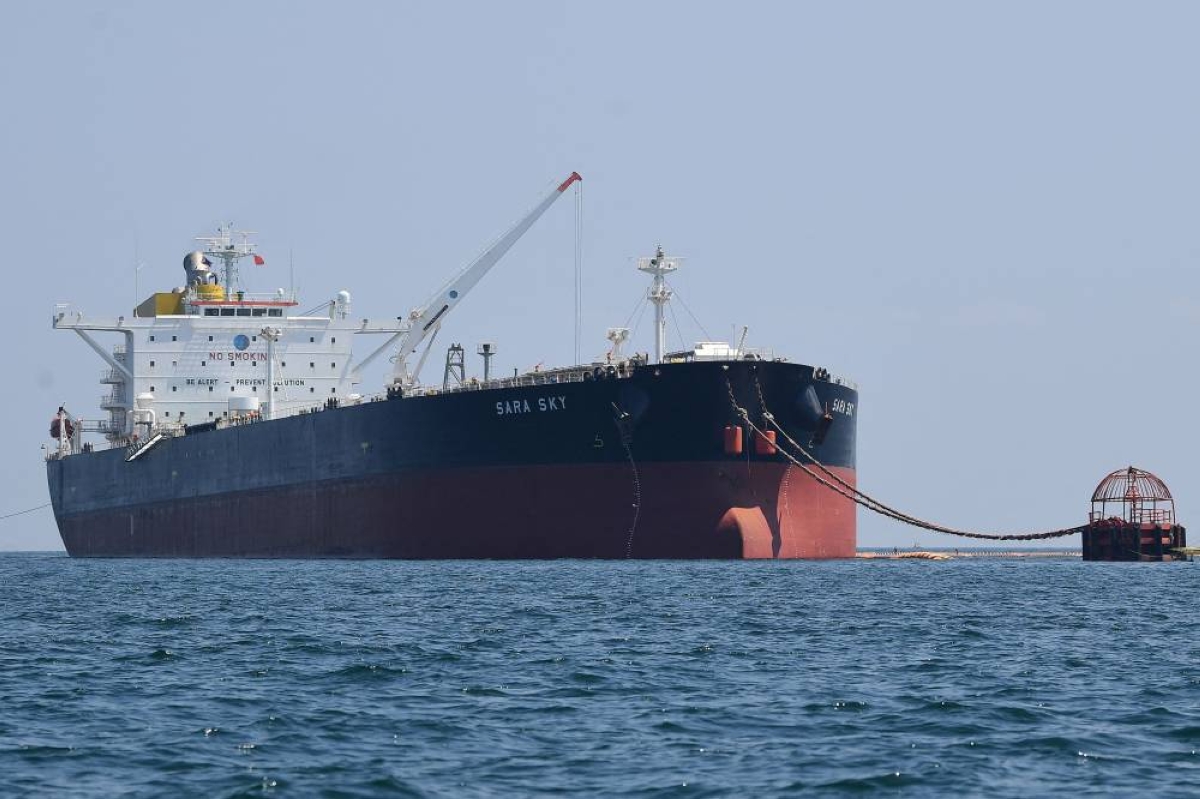
The Sierra Leone-flagged Sara Sky, which is carrying crude oil from Russia, is seen anchored at Limay port, Bataan province, Thursday. (AFP) A ship carrying more than 700,000 barrels of Russian crude oil has arrived in the Philippines, a source with knowledge of the matter told AFP Thursday, days after the country declared a national energy emergency over the Middle East war.The purchase, unthinkable before long-time treaty ally the US eased sanctions tied to Russia's war in Ukraine, comes as the import-dependent archipelago scrambles to expand its options in a suddenly volatile oil market.The Sierra Leone-flagged Sara Sky and its cargo from Russia's ESPO pipeline arrived Monday, with documents showing the consignee as Petron Corp, operator of the Philippines' sole oil refinery, said the source, who asked to remain anonymous as they were not authorised to speak to the press.The Philippines has seen the price of fuel hit historic highs since the US-Israeli war with Iran forced the partial closure of the Strait of Hormuz, with President Ferdinand Marcos saying the country's dwindling stocks could last about 45 more days.Presidential spokeswoman Claire Castro later confirmed the Russian oil purchase to reporters in a group chat on a messaging app.An AFP journalist Thursday saw the Sara Sky at anchor in Limay port just outside Manila, where the Petron refinery is located. It is believed to be the first shipment of Russian oil to the country in five years.Ramon Ang, CEO of Petron, told AFP last week the company was "in talks" to potentially purchase Russian oil. Ang declined Thursday to confirm the arrival of the shipment.President Marcos said on Wednesday that the Philippines was casting a wide net in its search for fuel."We have not only gone to our... traditional oil suppliers, we have tried to explore other sources that are not affected by the war that is ongoing in the Middle East," he said in a press briefing addressing the state of emergency."Nothing is off the table. We are looking at everything, everything that we can do."Asked about the Russian oil, the Philippines' foreign affairs department told AFP Thursday the country would co-operate with "all possible partners to contribute to regional and global stability, balanced with our duty to protect and secure Philippine national interests".The US this month eased some restrictions on sales of Russian crude, allowing countries to purchase oil that was already at sea until April 11.Ateneo de Manila University economist Ser Pena Reyes said buying the Russian crude — equivalent to about two days of national demand — was a pragmatic move that might help stabilise prices in the short term.Ongoing geopolitical volatility, however, made Moscow less attractive as a long-term partner, he told AFP."Russia can be a useful supplementary supplier... but the Philippines will likely benefit more from a balanced approach, maintaining strong ties with traditional partners while gradually investing in renewable energy and regional energy cooperation," Pena Reyes said.The Department of Energy on Thursday separately announced the arrival of 142,000 barrels of government-procured diesel, part of its target of "up to 2mn barrels of additional supply for the country", it said in a statement.Energy secretary Sharon Garin told AFP the shipment had come from Japan.Earlier in the day, Garin said the department had taken the "proactive step" of activating a 20bn-peso ($332mn) emergency fund aimed at securing fuel supplies.  Related Story

Opinion
Iran war speeds tie-up between tech start-ups and US military

Iran war speeds tie-up between tech start-ups and US military

The Mideast war has highlighted the newfound alliance between the tech sector and the US military after decades of strained relations, displaying a synergy that investors see as a potential gold mine. For the first time, the usual military-industrial pillars like Lockheed Martin and Boeing are being joined by rising tech giants Palantir, Anthropic and Anduril in helping to keep the US war machine ticking. Tech firms are increasingly involved in helping the military with everything from cloud computing to AI-powered drones. Maven, Palantir’s data analytics platform, has been used extensively in the offensive against Iran, as has Anthropic’s artificial intelligence. Anduril’s president, Matthew Steckman, said Monday that it was providing “one of the main defense systems” against Iran’s low-cost, long-range Shahed drones. The company recently announced a 10-year, $20bn contract with the US military. Palantir’s chief Alex Karp called the developments “a huge shift in Silicon Valley.” “When we started Palantir,” he said this month, “we couldn’t get funding” because the company was still too focused on civilian applications for its technology. Employee revolts at Microsoft, Amazon and Google in the late 2010s helped kept those giants out of the military market. Google ended up relinquishing the Maven contract in 2018, with Palantir getting onboard in 2024. But times have changed. Investors and tech companies have now “moved from being hostile to skeptical to neutral, from neutral to positive on the idea that Silicon Valley, like every other part of industry has to support the war fighter,” Karp said. In 2025, private equity invested a record $49bn in defence technology companies, nearly double the previous year’s $27bn, according to the specialized website PitchBook. That shift relates to Russia’s invasion of Ukraine and worries about China’s ambition to take over Taiwan, said Merritt Ogle, chief operating officer at the Silicon Valley Defense Group, which promotes closer ties between the two sectors. “When you start to think about protecting democracy and protecting freedom and protecting things that I think a lot of the countries that are allied with the US appreciate,” she said, the concept that “all defense is bad becomes a harder argument to make.” Generative AI technology has revived some concerns, however. Anthropic has refused to allow its systems to be used by the Pentagon for mass surveillance, prompting the Trump administration to brand the trailblazing company a “supply chain risk” -- even as Anthropic’s AI systems continue to be used for fighting in the Mideast. Behind the shift has been a wider recognition among military and political leaders that the United States “needs to tap into a broader innovation base for national security,” said Mark Valentine, head of defense strategy at Skydio, a maker of autonomous drones. Funding has never been an issue for the US military, which has the world’s largest defence budget by far, amounting to $962bn for the 2026 fiscal year. Almost all of that funding has historically gone to the usual major suppliers. For about a decade, under both Republican and Democratic administrations, the Pentagon has launched numerous initiatives to foster the development and adoption of new technologies. “There’s a broader understanding that maintaining a technological edge depends on integrating the best capabilities and doing it faster than we have in the past,” Valentine said. Several programs have been initiated to strengthen ties with the private sector, and “the government has seemingly shown a lot more appetite to support earlier stage companies,” said Drew Wandzilak, principal of the strategic tech fund at the private equity firm Alumni Ventures. The widespread use of drones and missiles in the Ukrainian conflict and the Mideast war has shown that having “the most expensive, most exquisite system was no longer a differentiator,” Wandzilak said. “It’s a volume game, and so there’s competition on volume, there’s competition on capacity. And I think ultimately it’s a mix of the two.”  

World
US jury finds Meta, Google liable in social media addiction trial

US jury finds Meta, Google liable in social media addiction trial

Meta spokesperson Ashly Nikkole Davis speaks to the media outside the court in Los Angeles, California, yesterday. (Reuters)  A Los Angeles jury found Alphabet’s Google ‌and Meta liable for $3mn in ‌damages yesterday in a landmark ‌social media addiction lawsuit that will influence thousands of similar cases against the tech companies. Punitive damages for the companies will be decided next. The jury may consider whether Google or Meta’s products caused the plaintiff physical harm or whether the companies disregarded the health of other users, Judge Carolyn Kuhl said in court. The case involves a 20-year-old woman who said she became addicted to Google’s YouTube and Meta’s Instagram at a young age because of their attention-grabbing design. The jury found Google and Meta were negligent in ​the design of both apps and failed to warn about their dangers.“Today’s verdict is a referendum — from a jury, to an entire industry — that accountability has arrived,” the plaintiff’s lead counsel said in ‌a statement. Shares of Meta were up 1% and Alphabet ​shares were up 0.2%, little changed after the verdict.Meta disagrees with the ​verdict and its lawyers are “evaluating our legal options,” a company spokesperson said. Google plans to appeal, said company spokesperson José Castañeda. The plaintiffs in the Los Angeles proceeding focused on platform design rather than content, making it harder for the companies to avert liability. Snap and TikTok were also defendants in the trial. Both settled with the plaintiff before it began. Terms of the agreements were not disclosed. Large technology companies in the US have faced mounting criticism in the last decade over child and teen safety. The debate has now shifted to courts and state governments. The US Congress ‌has declined to pass comprehensive legislation regulating ‌social media. At least 20 states enacted laws last year on social media usage and children, according to the nonpartisan National Conference of State Legislatures, an organisation that tracks state laws. The legislation includes bills that regulate the use of cellphones in schools and require users to verify their ages to open a social media account. NetChoice, a trade association backed by tech companies such as Meta and Google, is seeking to invalidate age verification requirements in court. A separate social media addiction case brought by several states and school districts ​against technology companies is expected to go to trial this summer in federal court in Oakland, California. Another state trial is slated to begin in Los Angeles in July, said Matthew Bergman, one of the attorneys leading the cases for the plaintiffs. It will involve Instagram, YouTube, TikTok and Snapchat. 

Sports
Rybakina outlasts Pegula to reach semis

Rybakina outlasts Pegula to reach semis

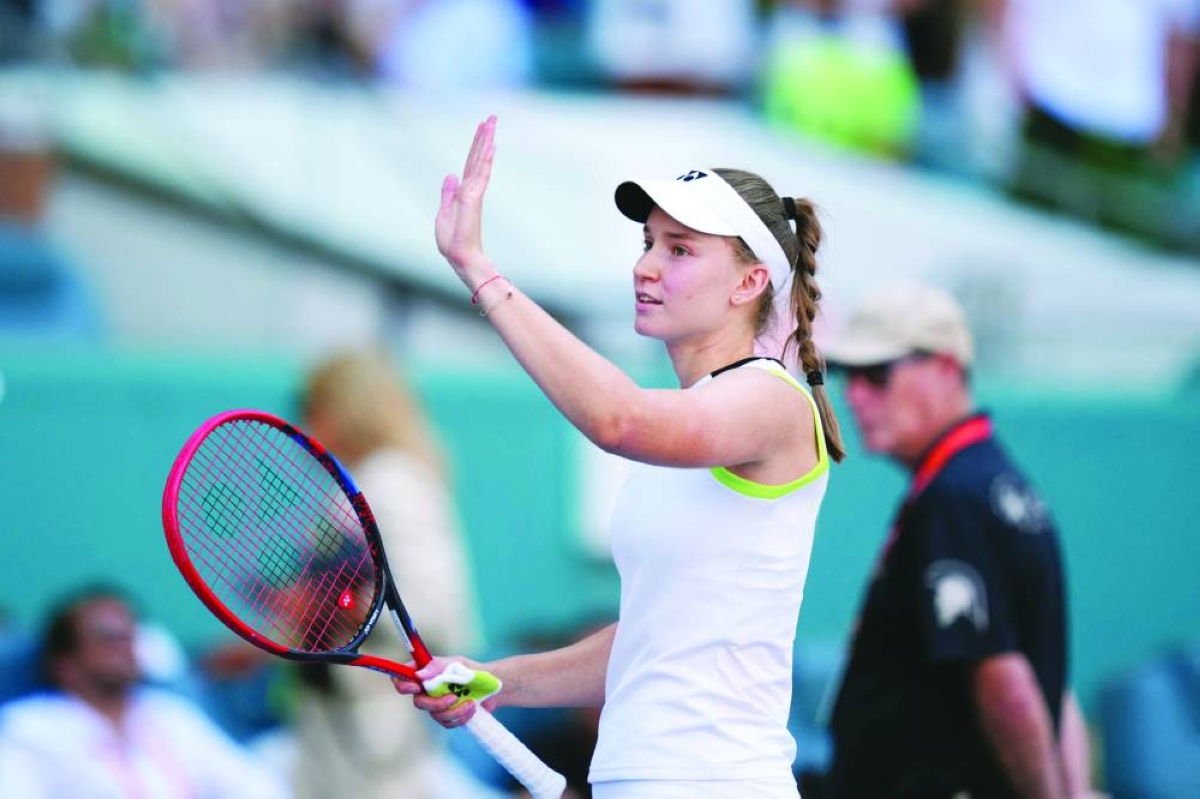
Elena Rybakina of Kazakhstan celebrates after defeating Jessica Pegula of the United States in their Miami Open quarter-final at Hard Rock Stadium Wednesday. (AFP) World number two Elena Rybakina rallied to overcome fifth-ranked Jessica Pegula 2-6, 6-3, 6-4 Wednesday to reach the WTA and ATP Miami Open semi-finals. Reigning Australian Open champion Rybakina, a 26-year-old from Kazakhstan, fired 12 aces in beating the American, last year’s Miami runner-up, for their fifth consecutive meeting. Rybakina next will play the winner of a later quarter-final between world number one Aryna Sabalenka, the defending champion from Belarus, and 45th-ranked American Hailey Baptiste, trying to reach her second WTA semi-final. Rybakina improved to 6-3 all-time against Pegula, including an Indian Wells quarter-final and semi-finals of the Australian Open and last year’s WTA Finals on the way to titles. Pegula, who won last month’s WTA title in Dubai, broke twice to begin the match with a 4-0 lead when Rybakina netted a forehand in the opening game and sent a forehand long in the third. Pegula held twice more to take the first set in 35 minutes when Rybakina netted a backhand, the American making only two unforced errors in the opening set. Rybakina missed three overhead smashes in the fifth game of the second set but held serve then broke when Pegula swatted a forehand long for a 4-2 edge on the way to forcing a third set. Rybakina broke Pegula to open the third set and stayed in command to advance after two hours and 15 minutes. Sabalenka, who will face Baptiste for the first time, has not lost to an unseeded opponent since she fell to Czech Marketa Vondrousova in last June’s Berlin semi-finals. Sabalenka won titles this year at Brisbane and Indian Wells. Her only 2026 loss was to Rybakina in the Australian Open final. It will be the 32nd career WTA quarter-final for Sabalenka. Baptiste, who lost to Rybakina in the second round at Indian Wells, has captured four straight matches, the longest win streak of her WTA career. Her best WTA finish was a run to the Abu Dhabi semi-finals. Earlie, Coco Gauff battled past Belinda Bencic to reach the semi-finals for the first time on Tuesday with a gruelling 6-3, 1-6, 6-3 victory. Fourth seed Gauff had considered skipping Miami after being forced to pull out during the fourth round at Indian Wells with a left-arm injury. But the 22-year-old from Florida, who lives in nearby Delray Beach, was determined to play in what she considers to be her hometown tournament where she had never previously gone further than the last 16. Gauff’s sense of determination was on full display at the Hard Rock Stadium’s main court on Tuesday as she weathered fluctuating form against the 12th-seeded Bencic to grind out victory. “I honestly didn’t think I would be in the semis so I’m really happy and proud of myself,” Gauff said. “I think I proved a lot to myself this week, and I feel like with each match I’m getting better. “Even though I’m still playing three sets, I feel like the level is getting better and better.” Gauff, the French Open champion, will now face the Czech 13th seed Karolina Muchova in the last four as she chases her first Miami final appearance. Gauff has won all five of her previous matches against Muchova. “You don’t think about the head-to-head,” Gauff said. “There’s so many matches that we play that could go either way. I don’t really think about it -- especially when I play here, because I know how good she is.” Muchova advanced to the last four earlier with a 7-5, 7-6 (7/5) defeat of Canadian 10th seed Victoria Mboko. The 29-year-old Muchova admitted she had everything to prove against Gauff. “I don’t have the best record against Coco, but I feel good,” Muchova said. “And you never know.” Despite giving away 10 years to the teenaged Mboko, Muchova said she did not feel any sense of disadvantage against her younger opponent. “I keep getting these questions this week like I’m really old or something,” Muchova said. “I don’t feel that old - I feel like I’m still pretty young. In my head, I could be 20.”  Related Story

Sports
Havertz eyes successful World Cup despite long injury absence

Havertz eyes successful World Cup despite long injury absence

Germany’s Kai Havertz attends a press conference Wednesday, ahead of the friendly against Switzerland in Herzogenaurach. (AFP) Germany forward Kai Havertz is close to his best form again after several injuries in the past 12 months, and a successful Arsenal run across three competitions ‌in the coming months will be the best preparation ​for the World Cup, ‌he said Wednesday. Havertz, who has been away from ‌the national team for more ‌than a year after missing ‌last year’s internationals through injury, is part of the Germany squad to face Switzerland on Friday and Ghana three days later. “I had a tough time. It was not easy for me,” Havertz told a press conference ahead of Germany’s friendly against hosts Switzerland. “I had my first injury in February last year, three and a half months out then comeback and then a setback ​with the knee injury,” he added. Havertz returned to action for the Premier League leaders Arsenal in January after being sidelined since August last year, but ‌the 26-year-old said he was ready for ​his club’s busy match schedule in the league, the FA ​Cup and the Champions League. “I now feel completely fit. I need the one or other game from the start to reach 100 percent but I feel fit to start lasting over 90 minutes,” he said. Havertz added that Arsenal’s busy schedule came just at the right time. “We have many matches in three competitions. I missed the first six months of the season and I will give it all for the club, and ‌to be able to go ‌with a lot of confidence to the World Cup. I want to be successful at this World Cup and lead the way,” he said. Germany have set their sights on winning the World Cup following shock group-stage exits in 2018 and 2022, determined to restore their reputation as a global football powerhouse. The tournament starts in June and is co-hosted by Mexico, the United States and ​Canada. The Germans, who have not reached a final in any major international tournament since winning their fourth World Cup in 2014 in Brazil, have been drawn in Group E with Ecuador, Curacao and Ivory Coast for the June 11-July 19 tournament. They play their opening World Cup match in Houston, Texas on June 14 against Curacao. Germany then travel to Toronto on June 20 to take on ‌Ivory Coast before ​their last group game against Ecuador in New York on June 25.  Related Story

World
UNHRC adopts resolution on Iran’s unprovoked attacks on GCC

UNHRC adopts resolution on Iran’s unprovoked attacks on GCC

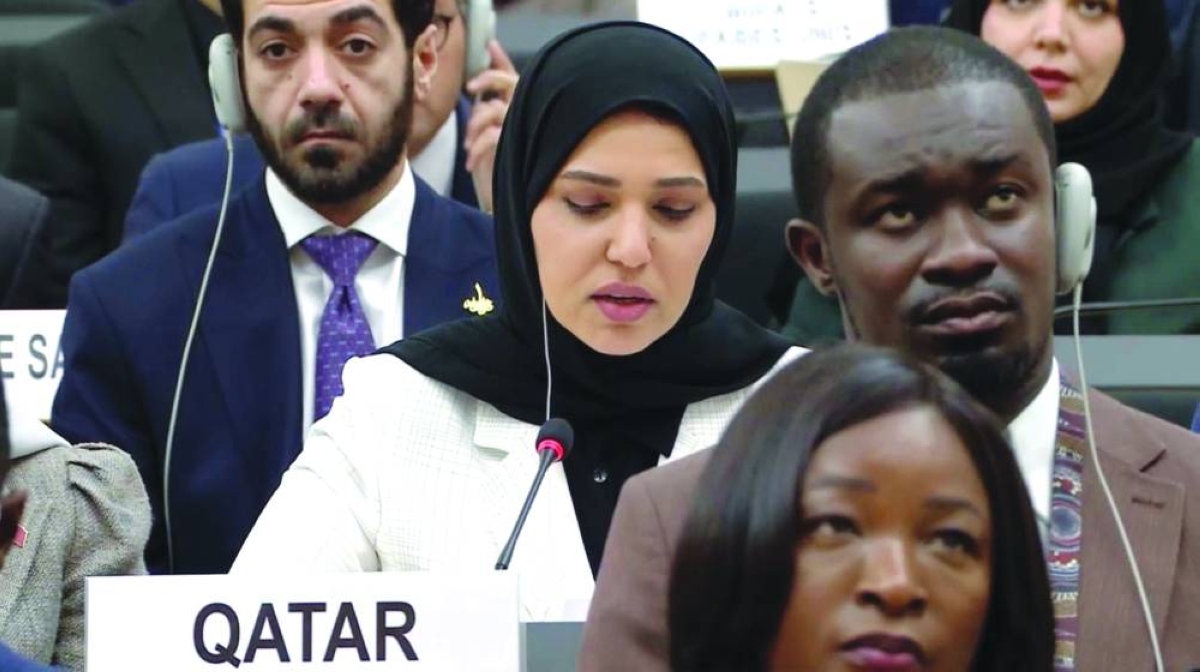
The UN Human Rights Council (UNHRC) has unanimously ratified a resolution condemning the human rights implications of Iran's missile and drone attacks on Qatar, the United Arab Emirates, Saudi Arabia, Bahrain, Oman, Kuwait, and Jordan. The resolution, adopted without a vote, was co-sponsored by more than 100 countries.The decision followed an urgent debate convened by the Council in Geneva on Wednesday, during which Qatar's Her Excellency Permanent Representative to the UN Office in Geneva, Dr Hind Abdulrahman al-Muftah, delivered a robust condemnation of the strikes on behalf of Doha.Qatar described the attacks as a flagrant violation of its national sovereignty and territorial integrity, and a direct breach of the UN Charter's prohibition on the threat or use of force. Al-Muftah told the Council the debate had been convened under "extremely perilous circumstances," warning that the ripple effects of Iran's offensive threatened not only regional stability but the full enjoyment of human rights across the affected nations.She stressed that the strikes — targeting civilians and civilian infrastructure — were in clear violation of international humanitarian and human rights law. Critical facilities struck included airports, ports, energy installations, and water desalination plants. Qatar itself sustained ballistic missile and drone strikes that caused civilian casualties, injuries, and widespread disruption to basic services including water and energy supplies — breaches, she said, of the rights to life, health, education, and safety.HE Al Muftah further warned that attacks on energy and desalination infrastructure carried grave environmental consequences, undermining the right to a clean and sustainable environment. She noted that the most vulnerable — women, children, the elderly, and persons with disabilities — were disproportionately affected, in contravention of international conventions designed to protect them.The Qatari representative also raised alarm over strikes targeting maritime shipping lanes, including the Strait of Hormuz, cautioning that disruption to one of the world's most critical waterways would have far-reaching consequences for global supply chains, energy security, and the socioeconomic rights of nations worldwide.HE Al-Muftah underscored that Qatar had played no part in the underlying conflict and had not permitted its territory or airspace to be used in any combat operations, making Iran's targeting of Qatari soil a particularly egregious violation of international law. Qatar, she noted, had consistently pursued dialogue and mediation as its preferred approach to regional disputes.She welcomed UN Security Council Resolution 2817 (2026), which formally condemned Iran's attacks and determined they constituted a serious threat to international peace and security, and called for effective remedies and full reparations for victims and affected states.Concluding her address, Al-Muftah urged an immediate halt to the escalation and called on all parties to prioritise diplomatic solutions. She appealed to Council member states to back the resolution and reaffirm the international community's commitment to upholding human rights, halting violations, and ensuring such attacks are never repeated.  Related Story

Entertainment
‘The Secret Lives of Mormon Wives’ Fate Is in Limbo

‘The Secret Lives of Mormon Wives’ Fate Is in Limbo

'The Secret Lives of Mormon Wives' Series Future Is Up in the Air!!! Published March 25, 2026 1:08 PM PDT "The Secret Lives of Mormon Wives" production has been shut down for weeks ... and

News
UAE advises residents to pray at home amid unstable weather

UAE advises residents to pray at home amid unstable weather

The General Authority of Islamic Affairs called on worshippers to perform prayers in their homes for their safety. The Authority stated that it directed mosque imams to alert people via loudspeakers immediately after the Azan

News
Ministry launches ‘UAE Traditional Crafts Award

Ministry launches ‘UAE Traditional Crafts Award

The Ministry of Culture has launched the UAE Traditional Crafts Award - Make it in the Emirates, in collaboration with the Ministry of Industry and Advanced Technology, to promote Emirati crafts and strengthen their role

Entertainment
Shannen Doherty’s Estate Reaches Deal With Her Ex Over $1 Million Mansion

Shannen Doherty’s Estate Reaches Deal With Her Ex Over $1 Million Mansion

Shannen Doherty’s Estate Works Out Deal With Her Ex ... Over $1M Texas Mansion Published March 25, 2026 11:49 AM PDT Shannen Doherty’s estate has worked out a deal with her ex-husband Kurt Iswarienko in