admin
admin 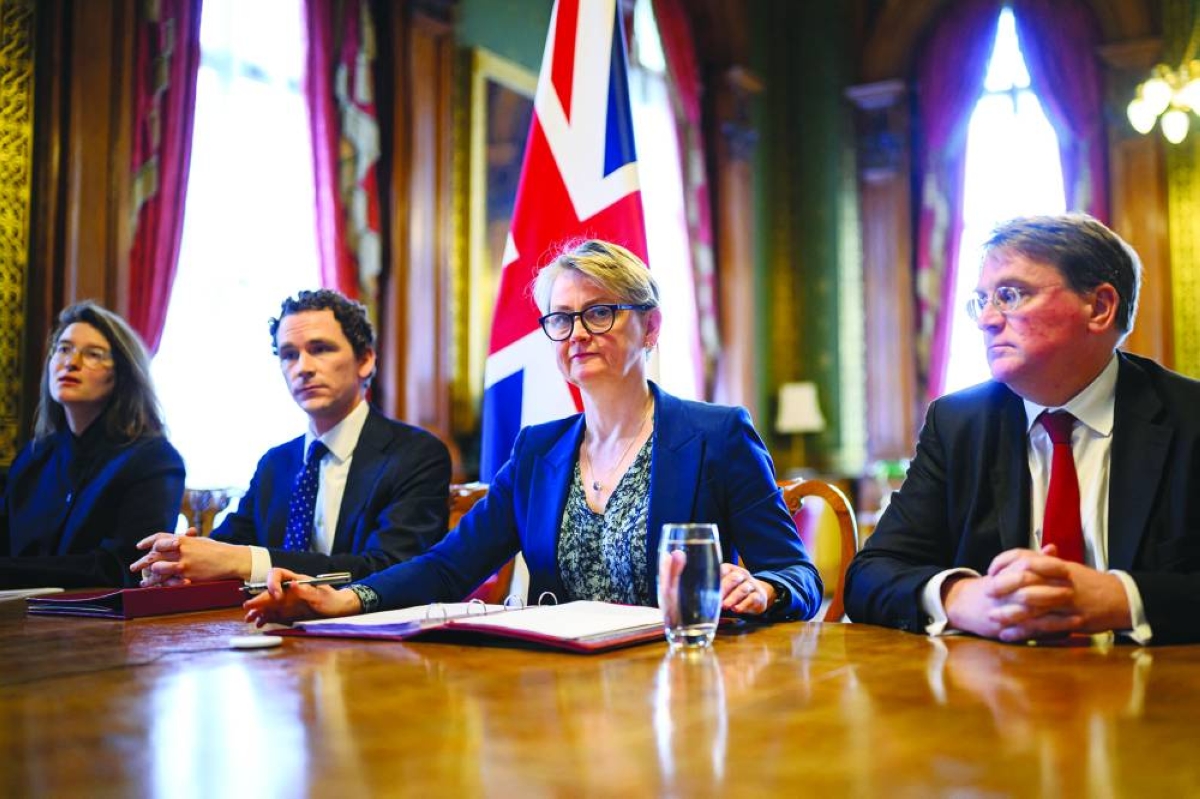
British Foreign Secretary Yvette Cooper prepares to speak during a virtual summit at the Foreign & Commonwealth Office in London, Thursday. (Reuters)
British foreign minister Yvette Cooper stressed Thursday the “urgent need” to reopen the Strait of Hormuz and slammed Iran’s “recklessness” as she convened a meeting of some 40 countries on the vital shipping route.
Cooper said Iran’s blockading of the waterway was “hitting our global economic security” as she kicked off the virtual meeting of international allies.
The strait has been virtually closed since the US-Israeli war against Iran started on February 28, impacting global supplies of important commodities including oil, liquid natural gas, and fertiliser.
That has led to a sharp rise in energy prices.
Cooper said foreign ministers and representatives from more than 40 countries had joined the call to discuss “the urgent need to restore freedom of navigation for international shipping, and the strength of our international determination to see the Strait reopen once more”.
A total of 37 countries have signed a statement, first published last month, expressing “readiness to contribute to appropriate efforts to ensure safe passage through” the shipping lane.
Britain, France, Germany, Italy, Japan and the Netherlands are among those to have signed it.
The US, China, and most Middle Eastern countries have not, according to a list provided by the UK government.
“We have seen Iran hijack an international shipping route to hold the global economy hostage,” Cooper added in her opening remarks, broadcast before the rest of the meeting took place behind closed doors.
Cooper said the discussions would focus on the “collective mobilisation of our full range of diplomatic and economic tools and pressures” to “enable a safe and sustained opening of the Strait”.
A spokesperson for the French foreign ministry said securing the Strait of Hormuz could “only take place once the intense phase of the bombing is over”.
French President Emmanuel Macron, speaking on a visit to South Korea, meanwhile, said a military operation to liberate the Strait of Hormuz was “unrealistic”, while lamenting Trump’s differing daily statements on the Iran war and Nato.
“There are those who advocate for the liberation of the Strait of Hormuz by force through a military operation, a position sometimes expressed by the US,” Macron said.
“I say sometimes because it has varied, it is never the option we have chosen and we consider it unrealistic,” he said.
The virtual meeting came after Trump urged oil-importing nations to show “courage” and seize the narrow strait.
“The countries of the world that… receive oil through the Hormuz Strait must take care of that passage,” Trump said in a prime-time address at the White House late Wednesday.
“Just take it, protect it, use it for yourselves,” he added.
Trump has said he would consider a ceasefire only when Hormuz is “free and clear”.
Western officials have insisted any operation to protect seafarers using the strait could only come after a ceasefire.
“We are also convening military planners to look at how we marshal our collective defensive military capabilities, including looking at issues such as de-mining or reassurance once the conflict eases,” Cooper told Thursday’s meeting.
Around a fifth of the world’s oil and liquefied natural gas passes through the strait in peacetime.
The channel normally sees around 120 daily transits, according to shipping industry intelligence site Lloyd’s List.
But since March 1, commodities carriers have made just 225 crossings, according to maritime intelligence firm Kpler, a 94-percent decrease on peacetime.
Related Story