admin
admin 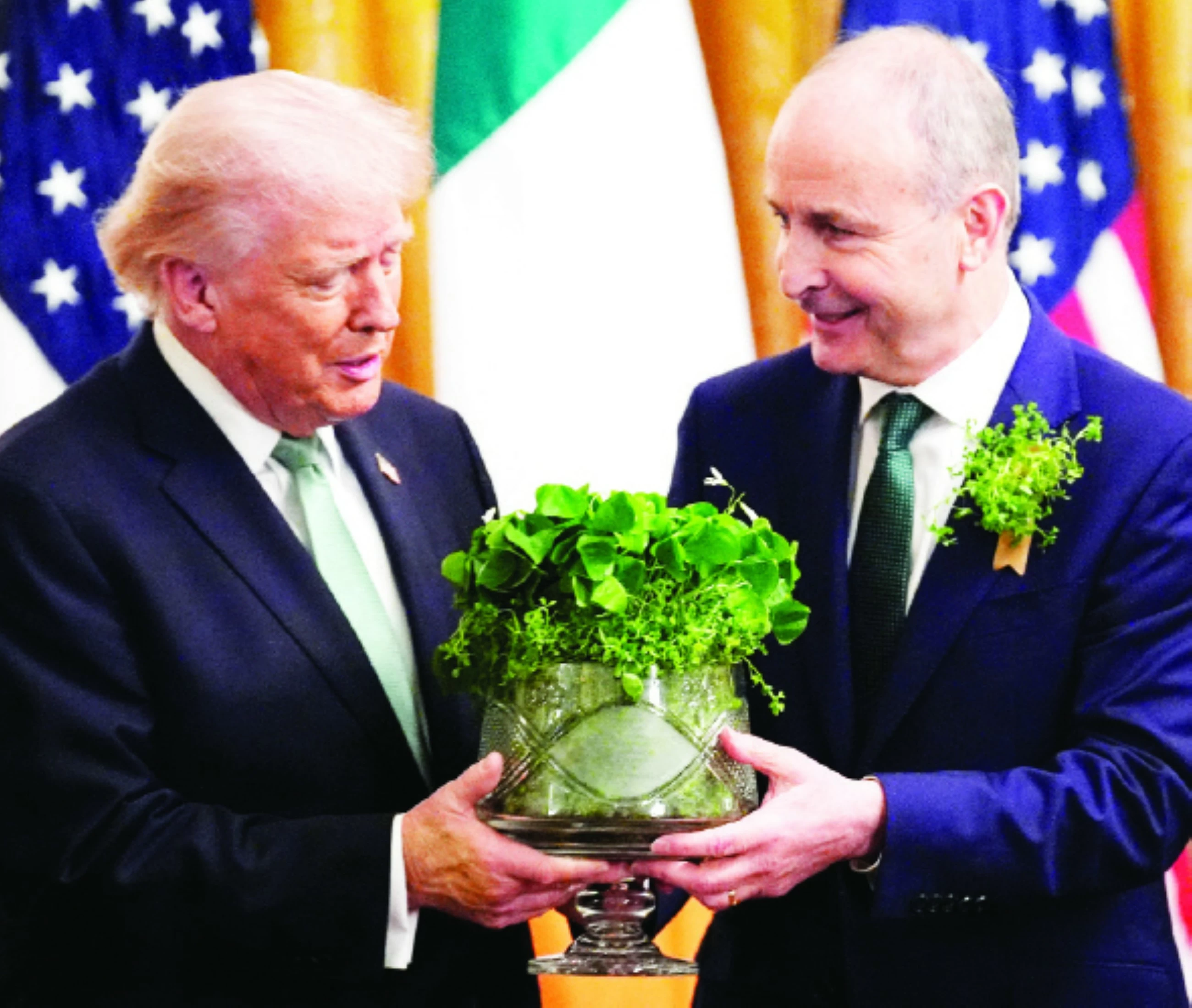
Irish Prime Minister Micheal Martin had an awkward hour with US President Donald Trump during the Irish leader’s annual St. Patrick’s Day visit to the White House last week. Although neutral Ireland is not a NATO member or allied to the US in any politico-military pact, Martin was treated to a scolding by Trump who argued that NATO was obliged to support the US in the war mounted with Israel on Iran. Trump said that the US had joined Europe when Ukraine was invaded by Russia, but Europe didn’t “help with Iran” and Iranian leaders, whom he called “the worst people going back to Hitler.”Trump criticised Irish President Catherine Connolly for stating that the US-Israel war against Iran was illegal under international law and for joining South Africa’s case before the International Court of Justice (ICJ) accusing Israel of committing genocide in Gaza. When Trump negatively commented on UK Prime Minister Kier Starmer’s refusal to join the US-Israeli war on Iran, Martin stated, “I do believe that he’s a very earnest, sound person. We think you have a capacity to get on with [him]; you’ve got on with him before.”Addressing the lack of Western allies in the war, Trump warned, “We will remember,” reminding those who rejected involvement that he holds grudges. When Trump gestured toward a bust of Winston Churchill in the Oval Office and said Starmer was “no Winston Churchill,” Martin reminded Trump of Churchill’s role during the Irish War of Independence (1919–1921). While Secretary of State for War, Churchill ordered the recruitment of the Loyalist “Black and Tans” to fight the Irish Republican Army. When Britain’s efforts failed to crush Ireland’s liberation struggle, Churchill – then colonial secretary – negotiated the treaty that led to the creation of the Irish Free State which became the indepen-dent Irish Republic in 1922.Ireland’s relationship with Palestine is based on their shared experience of colonialism. During Britain’s 800-year rule over Ireland, the Irish were subjected to land seizure, English settlers, discrimination, and poverty which drove millions to emigrate to the US and elsewhere. This experience mirrors the Zionist-Israeli colonisation of Palestine, uprooting of its native population, and bouts of Palestinian resistance which have been put down by brute force.Due to Israel’s violations of UN resolutions, Ireland only extended de jure recognition to Israel in 1963, 25 years after its establishment. The two countries opened diplomatic relations in 1975, when Ireland’s ambassador to Switzerland was also accredited to Israel.Following the 1967 Israeli occupation of East Jerusalem, the West Bank and Gaza, Ireland became increasingly critical of Israel’s occupation and displacement policies. In 1969, Irish Foreign Minister Frank Aiken declared that the conflict and Palestinian refugees had become a top foreign policy issue. In 1974, Ireland became one of the first Western European states to recognise the Palestine Liberation Organization (PLO) as the representative of the Palestinian people. In 1980 Irish Foreign Minister Brian Lenihan declared that the Palestinian people had the right to self-determination and supported the creation of an independent Palestinian state. In 1993, Lenihan met PLO chief Yasser Arafat in Tunis. Israel was finally permitted to open a residential embassy in Dublin, making Ireland the last European Union member to take this step. In 2000, Ireland established a Palestinian diplomatic office in Ramallah and a year later Ireland granted Palestine’s representative in Dublin full diplomatic status. In 2921, IIreland became the first European Union member to declare that Israeli settlement expansion in the West Bank amounts to de facto annexation. Photo: TNS