admin
admin The US-Israel war with Iran entered its third week on Saturday as a missile struck a helipad inside the US embassy compound in Baghdad.
Meanwhile, a US official said 2,500 more Marines and an amphibious assault ship are being sent to the Middle East, adding to the military’s largest buildup of warships and aircraft in the Middle East in decades.
On Saturday, Iran’s joint military command reiterated its threat to attack US-linked oil and energy facilities in the region if the Islamic Republic’s oil infrastructure is hit.
Ebrahim Zolfaghari, spokesperson for Khatam Al Anbiya Central Headquarters, warned they will target “all oil, economic and energy infrastructures belonging to oil companies across the region that have American shares or cooperate with America.”
Iran’s semiofficial Fars news agency said on Saturday the US strikes caused no damage to the island’s oil infrastructure. It said at least 15 explosions followed the strikes, which it said targeted an air defence facility, a naval base, the airport control tower and an offshore oil company’s helicopter hangar.
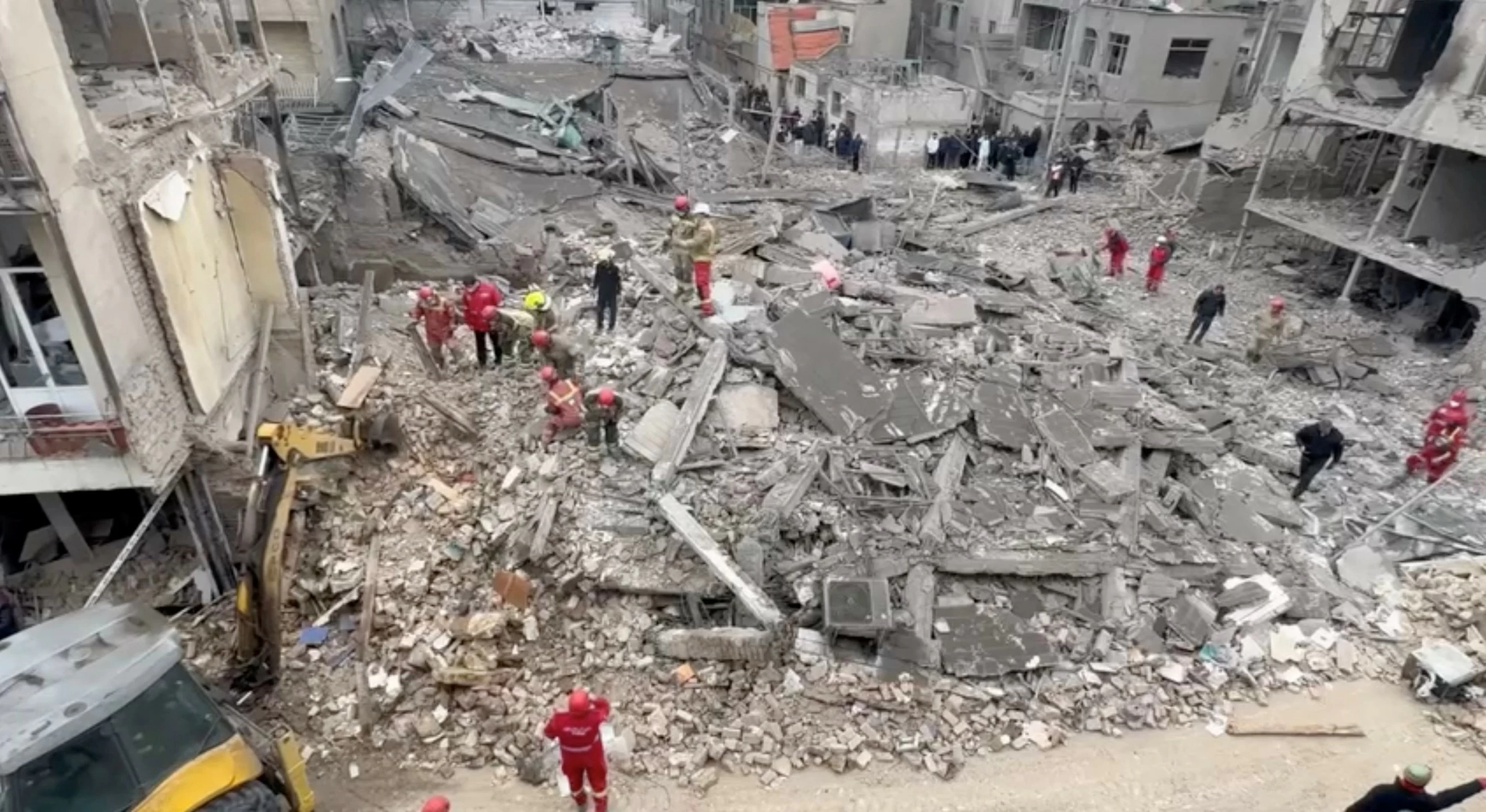
Iranian Red Crescent aid workers and firefighters work at a residential site damaged by strikes, in Javadiyeh district, Tehran, on Saturday. Reuters
At least 15 people were killed when an airstrike hit a refrigerator and heater factory in the central Iranian city of Isfahan, Fars news agency said on Saturday.
US Central Command released a video showing the strike and saying it destroyed naval mine storage facilities, missile storage bunkers and other military sites.
Iran’s foreign minister said that there was “no problem” with the Islamic republic’s new supreme leader Mojtaba Khamenei, who US officials say was wounded.
On Friday, US Secretary of Defence Pete Hegseth said he believed Khamenei, who took power after his father was killed in a strike at the start of the US-Israeli war on Iran, “is wounded and likely disfigured.”
Foreign Minister Abbas Araghchi told MS NOW’s Ayman Mohyeldin “there is no problem with the new supreme leader. He sent his message yesterday, and he will perform his duties.”
Iranian officials have previously confirmed reports that the new leader is wounded but have given no further detail.
Khamenei, 56, has not been seen in public since the airstrike that killed his father and predecessor as supreme leader, Ali Khamenei, and several key family members. But on Thursday, he issued a written statement, in which he said his wife, sister, her child and his brother-in-law were killed.
He vowed to avenge the deaths since the start of the war with the United States and Israel.
No one immediately claimed responsibility for the strike on the embassy’s helipad in Baghdad. The embassy complex, one of the largest US diplomatic facilities in the world, has been repeatedly targeted by rockets and drones fired by Iran-aligned militias.
There was no immediate comment from the embassy.
Later on Saturday, the embassy issued an updated security alert urging citizens to “leave now” but telling them not to come to the embassy in the capital or the consulate general in Erbil “in light of the ongoing risk of missiles, drones, and rockets in Iraqi airspace.”
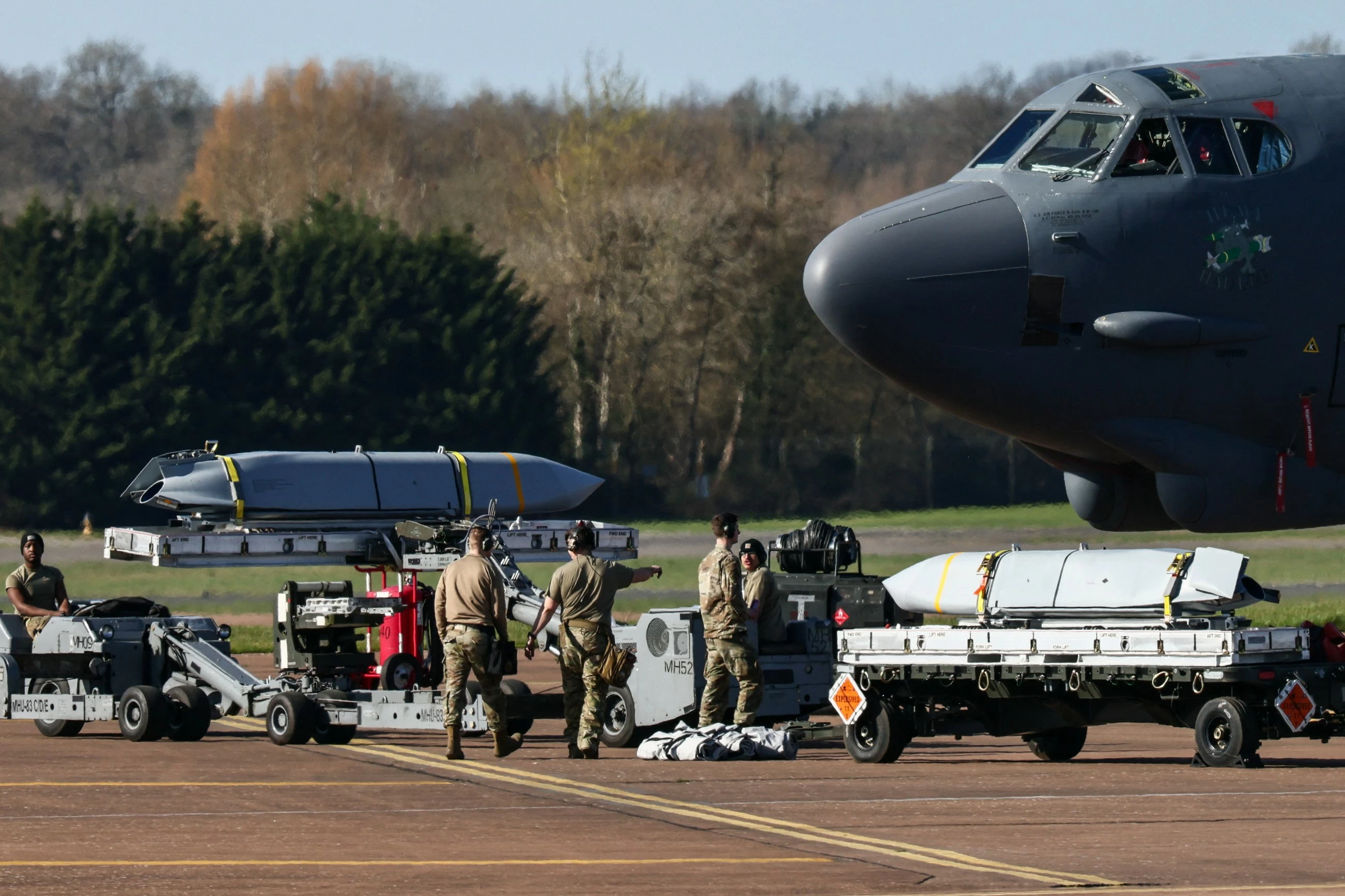
Members of a ground crew work to load cruise missiles into a US Air Force Boeing B-52 Stratofortress at RAF Fairford airbase, used by United States Air Force personnel in Gloucestershire, Britain, on Saturday. Reuters
“Iran aligned terrorist militias have repeatedly attacked the International Zone” in Baghdad, it said on X. “There have also been repeated attacks in the area around the Erbil International Airport and the Consulate General,” it added.
On Friday, it renewed its Level 4 security alert for Iraq, warning that Iran and Iran-aligned militia groups have previously carried out attacks against US citizens, interests and infrastructure and “may continue to target them.”
Israel earlier announced another wave of strikes in Iran targeting infrastructure, and said its air force had hit more than 200 targets in the last 24 hours, including missile launchers, defense systems and weapons production sites.
US Defence Secretary Pete Hegseth said over 15,000 enemy targets have been struck, more than 1,000 a day since the war began.
He sought to address concerns about the bottling of the Strait of Hormuz, telling reporters: “We have been dealing with it and don’t need to worry about it.”
Turkey’s top diplomat said Saturday that Iran was denying responsiblity for firing ballistic missiles towards Turkey despite evidence from technical data.
Turkish Foreign Minister Hakan Fidan said he had spoken with his Iranian counterpart Abbas Araghchi after Nato defence systems on Friday shot down another ballistic missile from Iran — the third in nine days.
“Once again, they are not taking responsibility for this incident. They claim they did not order any such attack, nor are they linked to it,” Fidan said.
“Of course, there is technical data available… and we are discussing the discrepancy between their statements and the reality with them,” he said, adding it was being discussed at a diplomatic and military level. Turkey would resist all provocations, but as a nation its deterrence capacities were “extremely strong,” he warned, saying: “We always know exactly where and when to use our strength.” Nato shot down a first ballistic missile from Iran on March 4, with a second intercepted on Monday, March 9.
Iran denied involvement in both. US troops are stationed at two Turkish bases which are key Nato facilities: Incirlik near the southern city of Adana, and Kurecik in central Turkey where they man an early-warning radar system that can detect Iranian missile launches.
Agencies