admin
admin Top diplomats from key regional powers gathered in Pakistan on Sunday to discuss how to end the fighting in the Middle East.
The US and Israel were not participating in the Islamabad talks.
The four-way meeting between the top diplomats of the Muslim nations convened “to review the evolving regional situation and discuss issues of mutual interest,” Pakistan’s Foreign Office (FO) said in a brief statement.
Convened at the invitation of Deputy Prime Minister and Foreign Minister Ishaq Dar, the participants of the meeting discussed issues of mutual interest, the FO said.
The quadrilateral mechanism is being viewed as a key diplomatic track feeding into wider efforts to end the conflict, with a focus on consolidating regional backing for de-escalation, aligning positions ahead of any possible US-Iran talks, and facilitating dialogue.
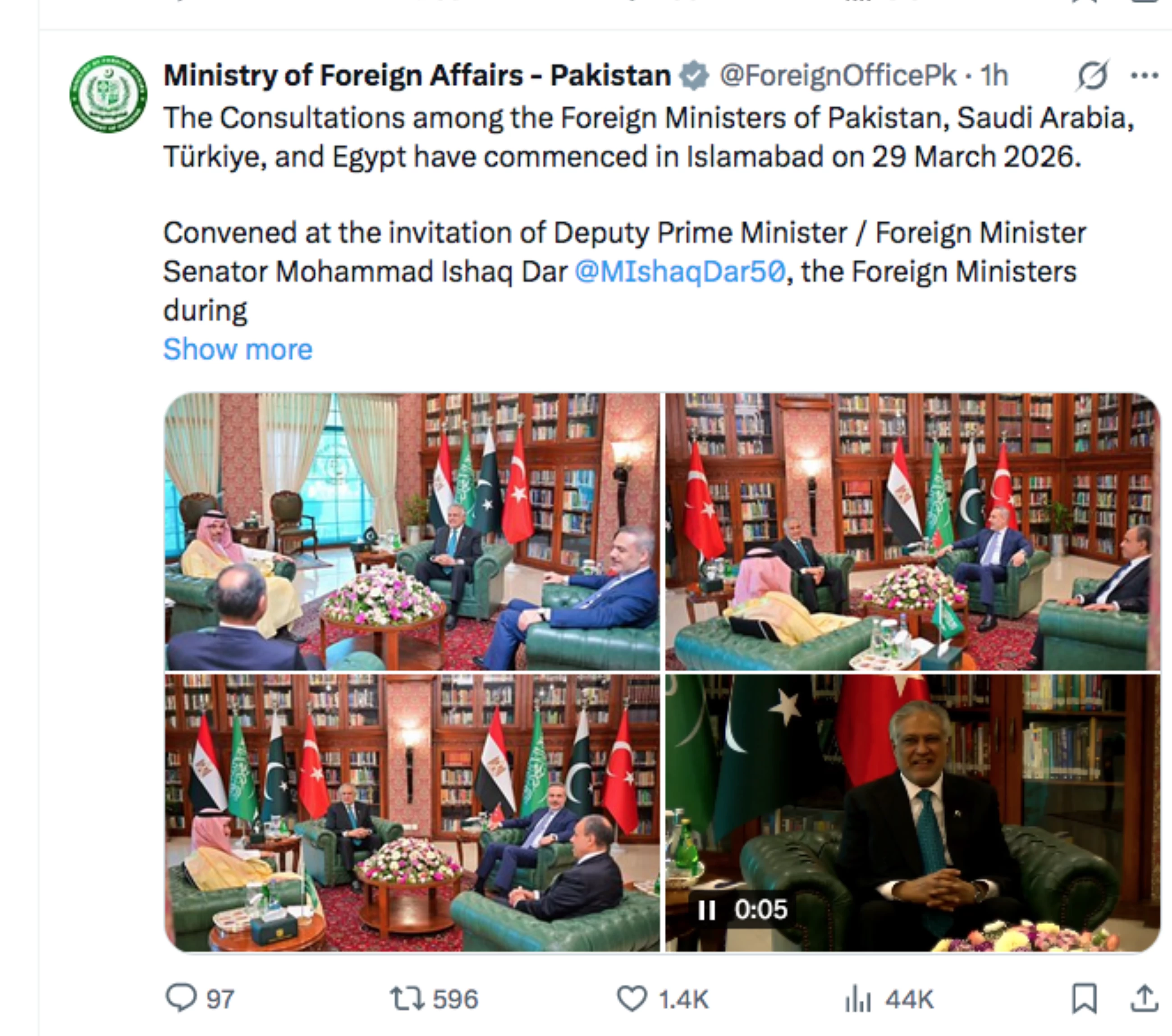
Egypt’s Badr Abdelatty and Hakan Fidan from Turkey arrived in Islamabad on Saturday night while their Saudi counterpart Faisal Bin Farhan touched down on Sunday afternoon.
Several roads leading to Islamabad’s Red Zone — where key government buildings and diplomatic missions are based — were sealed off, AFP reporters said. Security was tight and the driveway of the foreign ministry was decorated with the flags of all four countries.
Before the meeting, Pakistan’s Foreign Minister Ishaq Dar held separate bilateral talks with his visiting counterparts.
Fidan and Abdelatty also jointly met Pakistan’s army chief, Field Marshal Asim Munir.
Egypt’s Abdelatty said the meetings were aimed at opening a “direct dialogue” between the US and Iran, which have largely communicated through mediators during the war.
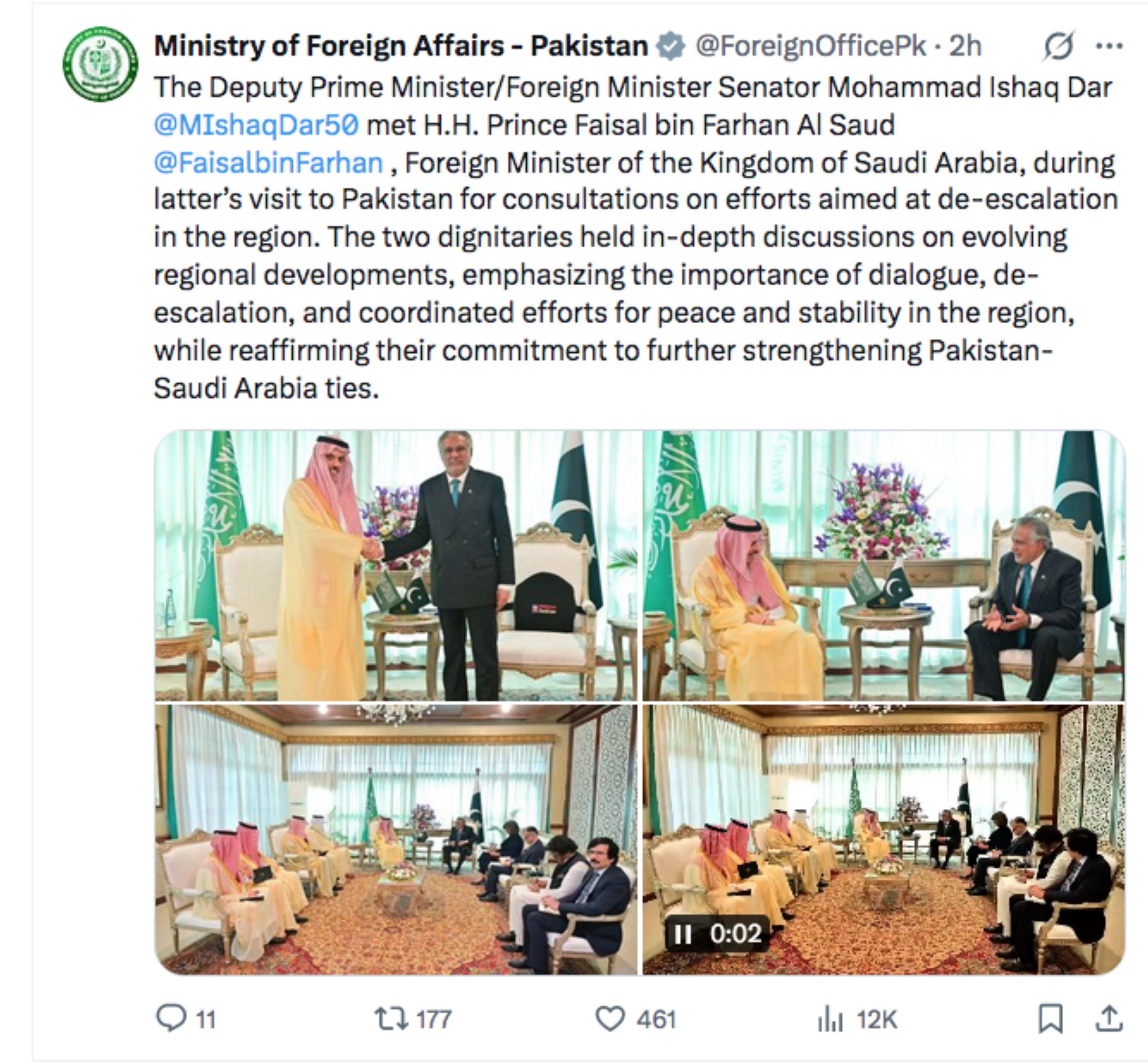
The government in Pakistan has emerged as a key facilitator between Iran and the United States as their war drags on, serving as an intermediary for messages between the two sides.
Islamabad has longstanding links with Tehran and close contacts in the Gulf, while Prime Minister Shahbaz Sharif and Munir have struck up a personal rapport with US President Donald Trump.
Tehran has refused to admit to holding official talks with Washington but has passed a response to Trump’s 15-point plan to end the war via Islamabad, according to an anonymous source cited by the Iranian Tasnim news agency.
Shahbaz on Saturday said he had a detailed telephone conversation with Iranian President Masoud Pezeshkian lasting over one hour, detailing his country’s “ongoing diplomatic outreach.”
Pezeshkian thanked Islamabad “for its mediation efforts to stop the aggression.”
Late on Saturday, Dar, who is also the country’s deputy prime minister, said Iran had allowed 20 more Pakistani-flagged vessels — or two ships daily — to pass through the Strait of Hormuz.
In a post on X, he said two ships will cross the Strait daily.
“This is a welcome and constructive gesture by Iran and deserves appreciation. It is a harbinger of peace and will help usher stability in the region,” he said. “This positive announcement marks a meaningful step toward peace and will strengthen our collective efforts in that direction,” Dar said.
“Dialogue, diplomacy, and such confidence-building measures are the only way forward,” he said and tagged US Vice President JD Vance, US Secretary of State Marco Rubio, Iranian Foreign Minister Abbas Araghchi and US special envoy Steve Witkoff in the post.
The world has been facing a global fuel crunch in the aftermath of a US-Israeli war on Iran, which has been going on for nearly a month.
The fuel crisis has resulted from the disruption of traffic in the Strait of Hormuz – a corridor that carries 20 per cent of global liquified natural gas and a quarter of seaborne oil.
Earlier, Iran had permitted two Pakistani cargo ships to transit through the Strait of Hormuz.
Meanwhile, a Pakistani oil tanker had also transited through the Strait on March 16 – the first such voyage by a non-Iranian tanker since the start of the war.
The development came hours after Prime Minister Shahbaz Sharif spoke to Iranian President Masoud Pezeshkian and apprised him of Pakistan’s diplomatic outreach efforts to organise peace talks between Washington and Tehran, in a phone call that lasted over an hour.