admin
admin 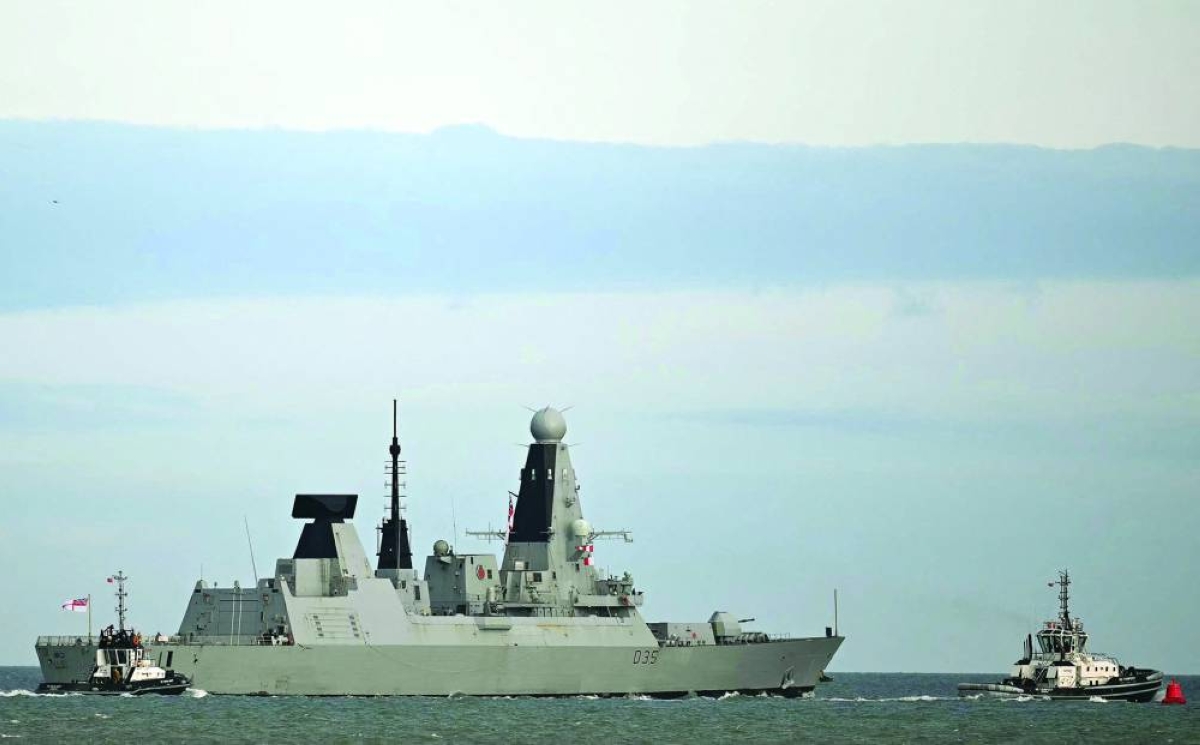
HMS Dragon, a Royal Navy Type 45 Daring-class air-defence destroyer warship, is guided by tug boats, as it departs from HM Naval Base Portsmouth, on the south coast of England. (AFP/File Photo)
A single destroyer sent to the Mediterranean and Germany stepping in to command a Nato maritime mission: the Iran war is exposing the limits of Britain’s navy, seen by observers as an embarrassment for a once proud maritime power.
The conflict, launched on February 28 with US-Israeli strikes on Iran, is highlighting the effects of years of under-investment and industrial delays, leaving the Royal Navy virtually absent from the Middle East.
Controversy about Britain’s naval capabilities first erupted over the slow deployment of HMS Dragon to protect British bases in Cyprus, one of which was hit by an Iranian drone on March 1.
The destroyer has only just arrived.
In the meantime, France deployed its Charles de Gaulle aircraft carrier, while Italy and Greece sent ships to reassure Cyprus. Right-wing newspaper the Daily Telegraph called the comparisons “embarrassing”.
This week Germany announced it will assume command in April of a Nato maritime mission in the North Atlantic in place of Britain, which was due to assign HMS Dragon to the role but is not able to deploy another vessel.
“This is what good allies do,” Defence Secretary John Healey said Thursday, while admitting he was “not happy with the situation we have with British warships”.
“I have to make decisions based on what we’ve got,” he added, noting the UK now has 17 frigates and destroyers, compared with 23 when Labour was last in power in 2010.
The vessels include six Type 45 destroyers and 11 Type 23 frigates, but most are currently unavailable, in maintenance or being decommissioned.
The next generation of warships — eight Type 26 anti-submarine frigates and five Type 31s — are not due to be ready before 2028-2029 due to delays, prompting some experts to warn of a capability dip in the coming years.
The Strategic Defence Review published last year lamented that maintenance costs are being driven up by the ageing fleet — a blow for the Royal Navy, which for centuries extended Britain’s empire around the world, once dominating the oceans and turning the island into a global power.
It took eight years to complete upgrades on the destroyer HMS Daring.
Britain’s two aircraft carriers — HMS Prince of Wales and HMS Queen Elizabeth — are also docked. The former is expected to take part in a North Atlantic mission soon.
They were labelled “toys” by US President Donald Trump on Thursday, who has criticised London for its limited response to the US-Israel war against Iran.
Prime Minister Keir Starmer has said the UK will not be drawn into a broader war, and refused to join the US and Israel’s bombing of Iran.
But the UK government has allowed US planes to take off from two UK bases to target Iran’s missile sites.
And Britain has deployed fighter jets and air-defence systems to the Gulf to protect British interests and allies, shooting down numerous drones.
Russia’s war in Ukraine, the expansion of Nato missions, and the conflict in the Middle East means it is “a particularly challenging period for the Navy”, Nick Childs of the International Institute for Strategic Studies told reporters including AFP recently.
“It is struggling to make capabilities match commitments in particular, but also is struggling to maintain force levels,” he said.
Mark Sedwill, formerly Britain’s most senior civil servant, told the BBC recently that under successive governments “there’s been an erosion of the basics, the maintenance, the training, the ordinance supplies and so on that keep an effective force ready to deploy”.
— ‘Russia main threat’ —
Starmer’s Labour government, elected in July 2024 following 14 years of Conservative rule, has pledged to significantly ramp up defence spending, with priority given to Nato commitments.
But the publication of its defence investment plan, first expected back in late 2025, continues to be pushed back — to the frustration of industry.
Within the Navy, priority is to go to nuclear deterrence and the shift toward a so-called hybrid force combining traditional crewed warships with autonomous maritime drones.
“For good reason, the UK has decided that the main threat faced by the UK is Russia,” Kevin Rowlands of the RUSI think-tank told AFP.
“And the main theatre of operations where we need to confront Russia will be in Northern Europe, the North Atlantic and the High North.
“So it’s almost inevitable, if something happens in a different part of the world, then we won’t necessarily be there.”