admin
admin 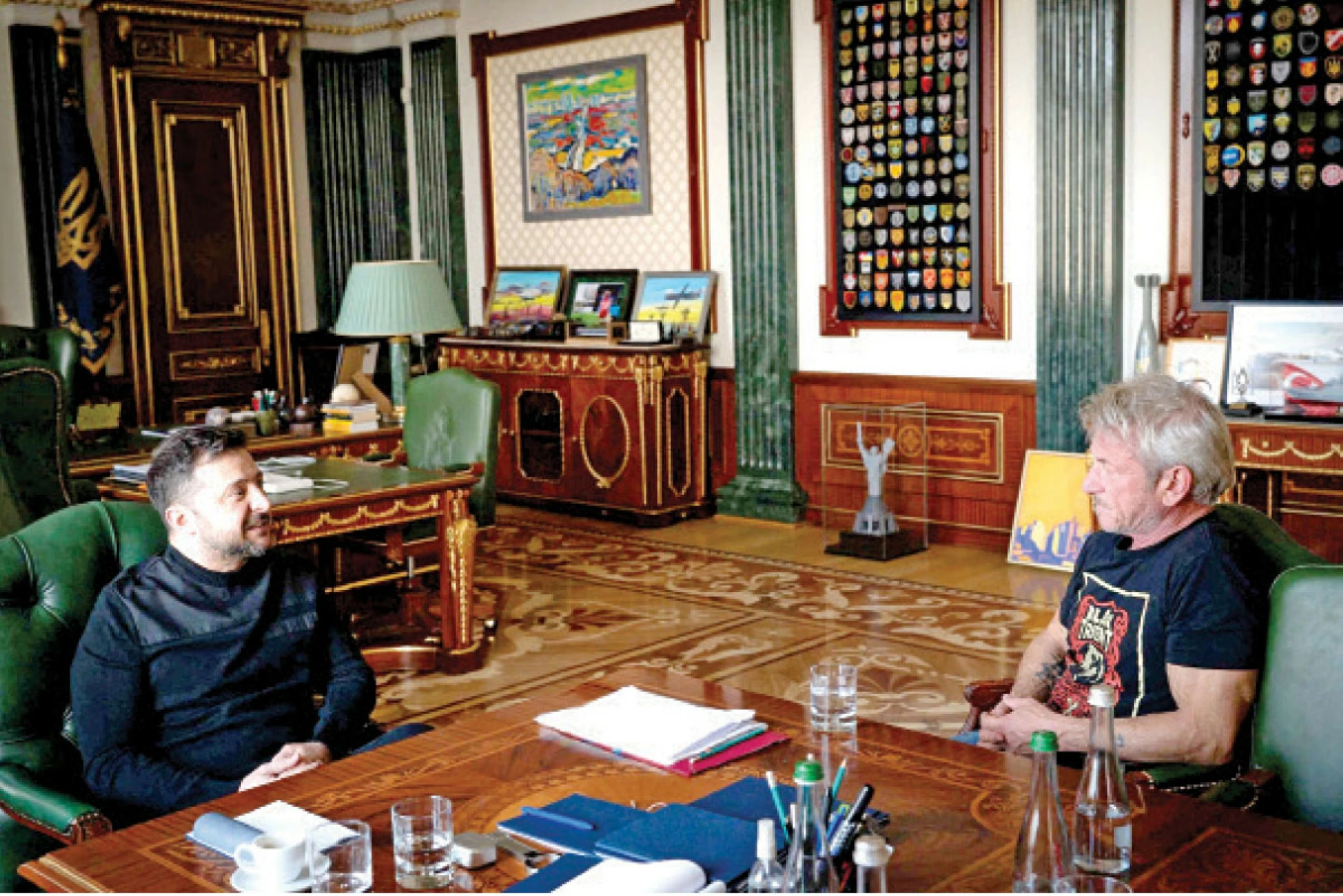
Katie Rosseinsky, The Independent
At the 2026 Oscars ceremony, actor Sean Penn joined a small coterie of male performers who have three Academy Awards to their name. But the 65-year-old, who was named Best Supporting Actor for his brilliant portrayal of a racist military officer in Paul Thomas Anderson’s One Battle After Another, wasn’t among the stars gathered at Los Angeles’ Dolby Theatre on Sunday night.
“Sean Penn couldn’t be here this evening, or didn’t want to, so I’ll be accepting the award on his behalf,” Succession star – and last year’s Best Supporting Actor winner – Kieran Culkin quipped after opening the golden envelope.
So where was Penn on one of the biggest nights of his acting career? According to a report from the New York Times, the actor, who previously earned Oscars for Mystic River in 2004 and for Milk in 2009, chose to skip the ceremony in order to head to Europe.
His plan “as of late last week”, anonymous sources told the paper, was to visit Ukraine, although they “did not specify what he would be doing there or where precisely within the country he would be going”. On Monday, an AFP reporter spotted Penn leaving a car in Kyiv, and he has since been photographed in a meeting with president Volodymyr Zelensky.
Swapping a glitzy Hollywood party to spend time in a country torn apart by war – it’s not exactly your usual A-list behaviour, but it is certainly quite typical of the unusual turn that Penn’s life and work has taken in recent years.
This is, after all, the man who lent one of his Oscar statuettes to Zelensky, promising that it should remain in the capital city of Kyiv until Ukraine wins the war against Russia – and who previously debated melting down his two little gold men to make “bullets they can shoot at the Russians”.
So how did Penn, the star who was once best known for his tumultuous marriage to Madonna in the late Eighties, become such a passionate supporter of Zelensky? It’s worth noting that this is not the first cause that Penn has taken up. Far from it.
His activism has roots in his family’s liberal politics. His father, the actor and director Leo Penn, was blacklisted from Hollywood in the Fifties after refusing to testify before the House Un-American Activities Committee (HUAC), the organisation designed to root out alleged Communist sympathisers.
Penn Jr, meanwhile, emerged as one of the film industry’s most outspoken activists in the early Noughties, when George W. Bush went to war in Iraq in the wake of the September 11 attacks. Penn, sceptical of the existence of “weapons of mass destruction”, took out an ad in The Washington Post in 2002, in which he called on the then-president to change his mind.
Months later, he travelled to Baghdad “to personally record the human face of the Iraqi people so that their blood – along with that of American soldiers – would not be invisible on my own hands”, as he put it in a powerful statement to the press.
A few years on, he operated a rescue boat during the aftermath of Hurricane Katrina in New Orleans, managing to pick up survivors who had been trapped in their homes. Then, in 2010, following the devastating earthquake in Haiti, he set up and ran what would become one of the country’s biggest refugee camps. It was an endeavour that, unlike many celebrity brushes with humanitarianism, won praise from experienced aid workers for making a tangible difference, and Penn was later named as an ambassador-at-large for Haiti to recognise his hands-on work. His involvement in Ukraine initially began when he was searching for a lighter directing project to pursue, after planned documentaries about the exiled Bashar al-Assad and the assassination of Saudi journalist Jamal Khashoggi didn’t pan out.
Good material for a film
The story of Zelensky – an actor and comedian who had starred in a TV series about an ordinary bloke who ends up as president after his rant about government corruption goes viral, and had then himself successfully won a presidential election on an anti-corruption platform – seemed like good material for a film.
“We thought we’d follow this kind of interesting story that would have been a light-hearted take,” Penn said at the time.
The Covid pandemic meant that filming ended up being delayed, and it wasn’t until late 2021 that Penn finally headed to Ukraine. He and Zelensky eventually met on 23 February 2022; their initial encounter wasn’t filmed, the actor has said, so that the politician could figure out whether he could trust him or not.
What neither of them could have predicted was that on that night, Russia would invade Ukraine. The following day, which the pair had agreed would mark the start of filming, would be the first day of the war.
Inevitably, the project moved in an entirely different direction. What had been intended as a lightly comic portrait of a celebrity-turned-politician would morph into a depiction of a nation thrown into conflict. Zelensky, though, kept his planned appointment with Penn on 24 February. It seems as if this second meeting stoked an abiding admiration on the American’s side. “I saw a very big change in him from one day to the next,” Penn recalled. “At that moment, he was the significant target. But he wasn’t going anywhere. That day, he found out that he was born for this.”
The fact that Zelensky chose to stay in the capital city, rather than accepting offers to leave his country for his own safety, seemed to especially impress Penn. “President Zelensky and the Ukrainian people have risen as historic symbols of courage and principle,” he said in a statement released a few weeks later. “Ukraine is the tip of the spear for the democratic embrace of dreams. If we allow it to fight alone, our soul as America is lost.”
Penn’s documentary Superpower premiered at the Berlin Film Festival the following year. The unabashedly pro-Zelensky movie – “If it’s propaganda, I’m proud,” he told one audience – shows the star traipsing through the rubble and meeting with civilians who have had their lives turned upside down.
Penn, perhaps to his credit, kept up his friendship with Zelensky long after the cameras stopped rolling. In late 2022, he made headlines for handing over his Oscar statuette to the president, telling him to bring it “back to Malibu” after a Ukrainian victory. “It’s just a symbolic silly thing, but if I know this is here with you then I’ll feel better and stronger for the fight,” the actor said. Zelensky, in response, presented him with a very different accolade: Ukraine’s Order of Merit.
Then in 2025, following a tense moment between president Donald Trump and Zelensky during a White House meeting, Penn doubled down on his praise for his friend, hailing him as “constantly, extemporaneously genuine” in his desire to secure freedom for Ukraine.
With his latest visit to Kyiv, the latest member of the Oscars’ three-timers club shows no erosion of his own unique form of activism. Where other actors might have opted to pledge support for Zelensky in their winner’s speech (and be praised for their “powerful” words on social media), Penn clearly prefers a more hands-on approach.
“It’s his personal visit, that’s how he sees it, that he needs to be in Ukraine,” a senior Ukrainian official told AFP on Monday. “He just wants to support Ukraine.” Whether he offers up his latest trophy to Zelensky remains to be seen.