admin
admin B’Tselm, the Israel human rights organisation in the occupied Palestinian territories has reported that Israeli troops, and border police, armed with guns and diggers, demolished all Palestinian homes and other structures in Khirbet a-Taban in the Masafer Yatta area in the South Hebron Hills. The community was given no warning and were not allowed to rescue their property. Twelve families, with 70 members, including 28 children, lived in cinder-block shelters with sheet metal roofs. They were farmers whose livelihood depended on 600 livestock.
During the first five months of 2026, B’Tselem also documented 17 incidents of sheep theft from Palestinians. While such thefts have occurred in previous years, some recent incidents appeared to be more organised, and in eight, soldiers guarded settlers while they stole the sheep.
In the early 1980s, the Israeli military had declared an area of about 30,000 dunams (3,000 hectares), including the south Hebron community’s land, a restricted military zone, and dubbed it “Firing Zone 918.” In the fall of 1999, the military expelled all 700 residents of 12 villages in the area on the pretext they were “illegally living in a firing zone”. This with the full knowledge of Israeli authorities who conveniently forgot that these families had been living in the area for many years, since before and after Israel occupied the West Bank in 1967.
Following their expulsion, the Association for Civil Rights in Israel (ACRI) and Attorney Shlomo Lecker filed petitions to the High Court of Justice (HCJ) on behalf of some 200 families from the villages. In March 2000, the HCJ issued an interim injunction permitting the villagers to return to their homes and graze their livestock in their fields, pending a ruling in the case. Eventually, the court rejected the residents’ petition. In May 2022, it also rejected additional petitions filed by residents of the area, demonstrating there was “no crime it would not find a way to sanction.” The court argued the petitions must be rejected on three grounds. First, they were filed many years after the firing zone was declared and the petitioners had built structures without permits over the years.
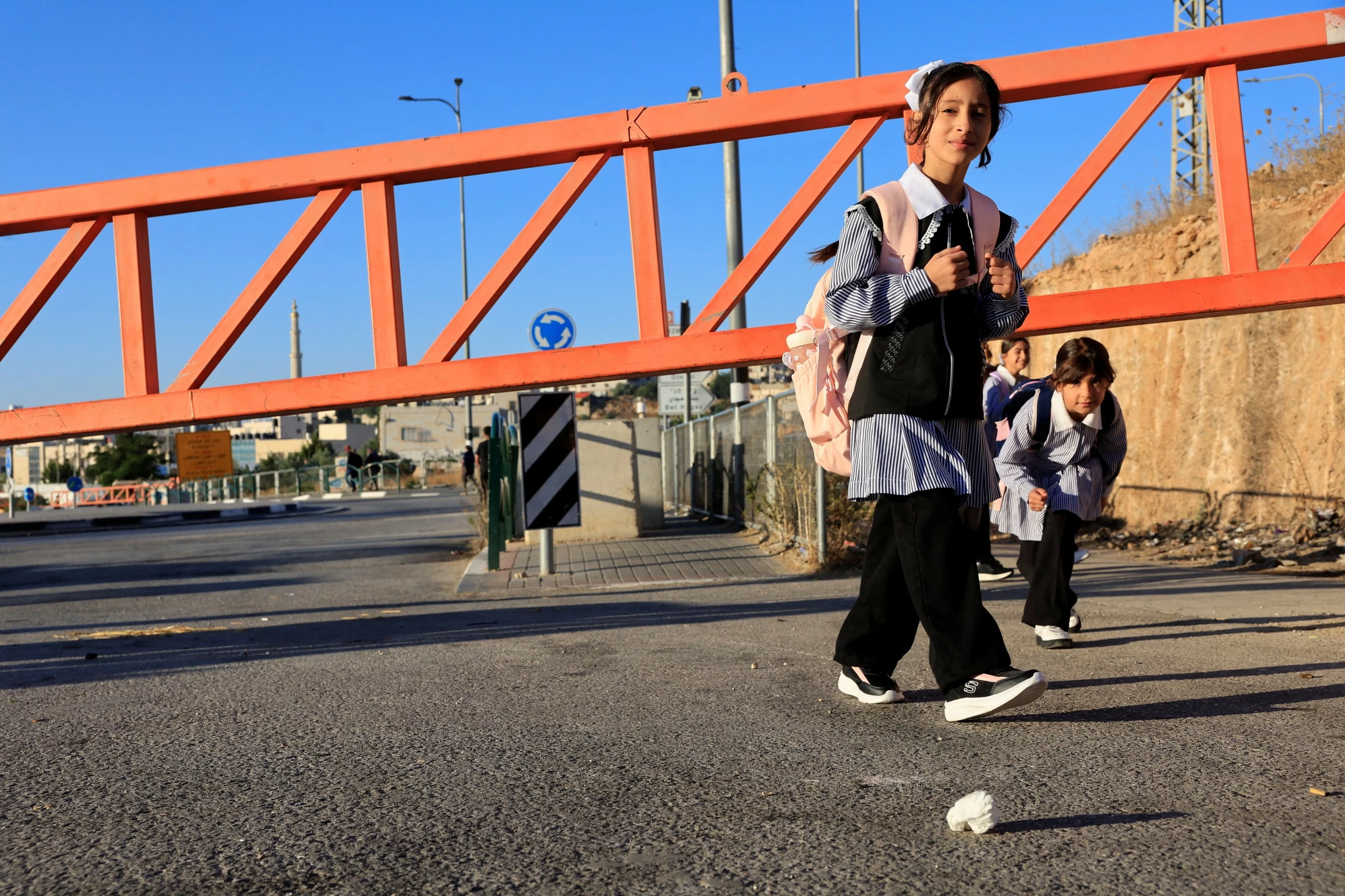
Palestinian students cross an Israeli checkpoint as they return to school for the new academic year, near Hebron in the Israeli-occupied West Bank, on Sunday. Photos: Reuters
However the Israeli militarised Civilian Authority denies the vast majority of Palestinian petitions against house demolitions or land appropriations. Second, the justices argued the military commander has the power to declare closed military zones in the occupied territory in defiance of international law which prohibits the annexation of occupied territory and its settlement with citizens of the occupier. Third, the justices ruled that the petitioners were not “permanent residents” of the area before it was declared a firing zone and rejected the petition, allowing the state to expel them and destroy their communities.
The timing could be significant. Due to the October 7th, 2023, raid into southern Israel by Palestinians from Gaza which killed about 1,200, the Israeli public has adopted a hostile attitude towards Palestinians. This has been exploited by Prime Minister Binyamin Netanyahu to keep him in power after the October Knesset election. In this climate of opinion Israeli settler attacks on Palestinians in the West Bank have spiked while the Israeli army either does nothing to stop them and some troops take part.
The Israeli human rights organisation Yesh Din has issued a report dubbed “The Next Frontier,” which described settler violence and pressures by the Israeli government targeting Palestinians in areas which under the 1993 Oslo Agreement should be included in a future Palestinian state. Israeli governments, driven by the settler movement, have pursued a long-term policy of undermining international agreements for the emergence of a Palestinian state and Palestinian claims.
UN deputy special coordinator for the Middle East peace process Ramiz Alakbarov and the UN had documented 1,430 West Bank settler attacks affecting 260 Palestinian communities this year. He warned that violence had reached unprecedented levels and argued that the illegally occupied territory had “reached a breaking point.” He added that 76 West Bank Palestinians had been killed by Israeli soldiers or settlers as of 10 August. The UN pointed out that some 3,800 Palestinians had been displaced since the beginning of the year because of settler violence, demolitions, and evictions.
Critics and analysts argue Netanyahu is determined to maintain his fragile coalition which includes right-wing pro-settler parties. As long has he remains in power he escapes the consequences of his off-and-on-again corruption trial. This depends on the October 27th Knesset election, but opinion polls show his rivals have nearly enough support to defeat his coalition.
As the October 7th, 2023, attack took place while he was in charge, Netanyahu has come under fire for Israel’s failure to pre-empt and prevent the incident. He has attempted to deflect criticism by adopting aggressive anti-Palestinian policies in the West Bank, tolerating settler and army violence in the West Bank and stepping up attacks on Gaza despite the ceasefire.