admin
admin 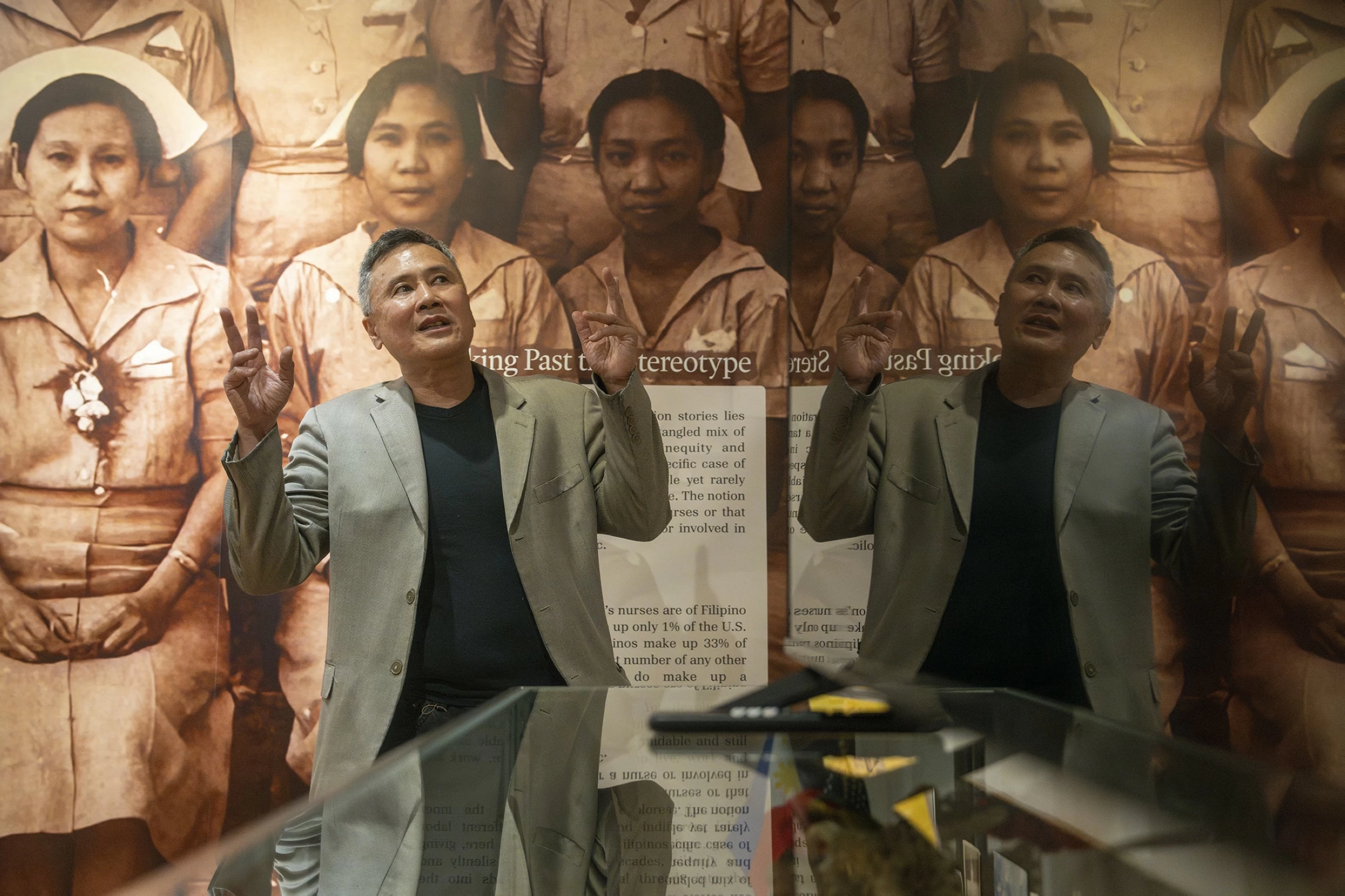
In a small room in a museum downtown, a medium-size leather suitcase sits on the floor. It’s empty now, but nearly 50 years ago — as it crossed the Pacific Ocean from the Philippines to Chicago — it held textbooks, clothes, a prayer book and hopes for the future as a nurse in Illinois. “Whenever I look at that, it comes back to me very clearly, what happened to me when I left the Philippines and came over here,” said Brenda Vins, the owner of the suitcase, and a retired nurse who now lives in La Grange. “It’s just that everything was in there for me — the reason I came.”
The suitcase is one of dozens of items on display at the International Museum of Surgical Science in the Gold Coast neighbourhood, as part of an exhibit called “Unheard Voices of Care: Filipino Nurses in America.” Filipino nurses have long had a sizable presence in American healthcare but the reasons behind that and their experiences have not often been discussed. The exhibit, which runs till Aug. 2, aims to tell their story, including their contributions in the Chicago area.
“We want to tell the narrative of what could be considered the story of a Filipino nurse,” said Angel Abcede, a freelance writer who co-coordinated the exhibit after writing a book about his mother and her two sisters who came from the Philippines to work as nurses in the US. Even some Filipino nurses might not think much about “what brought them here and why so many in their families are nurses,” Abcede said. The exhibit grew partly out of that book, thanks to the backing and coordination of the Filipino American Historical Society of Chicago.
“Our mission has always been to… show the history and culture of Filipinos in the Chicago area,” said Ruben Salazar, president of the society. “The story of the nurses is a big part of the history of Filipinos in Chicago.” Filipino immigrant nurses make up an estimated 4% of all nurses in the US, according to an American Immigration Council analysis of data from the 2024 American Community Survey. More nurses came from the Philippines to the US than from any other country, according to the analysis — more than four times as many nurses as the next leading nation. Many other nurses of Filipino descent are second- and third-generation Americans who followed in their mothers’ and grandmothers’ footsteps.
“What happens is that US-born, young Filipino Americans realise in their community that nursing is a profession that offers socioeconomic mobility, that offers steady work and income,” said Catherine Ceniza Choy, a professor of ethnic studies at the University of California at Berkeley. Choy herself grew up on the Lower East Side of Manhattan in New York surrounded by family friends and neighbours who were nurses. She saw that they were respected as professionals and immigrants.
Though Choy didn’t become a nurse, she decided to study the history of Filipino nurses in the US, writing her dissertation on the topic and later a book about it titled “Empire of Care.” In her research, Choy found that reasons behind the migration of Filipino nurses to the US could be traced all the way back to as early as 1898, when the US won the Spanish-American War. Shortly after the war, Spain ceded the Philippines to the US and it became an American colony.
At the time, the US had a policy of “benevolent assimilation,” Choy said, meaning it sought to impose the English language and American values in the Philippines. That included setting up an American-style education system and eventually nursing schools, as that was seen, at the time, as one of the few acceptable professions for women. Small numbers of nurses then began coming to the US in the early 1900s through a “pensionado” programme that allowed them to advance their education in the US and then return to the Philippines.
More Filipino nurses arrived in the late 1950s and early 1960s, through a Cold War-era exchange programme in which people could come to the US on visas for two years and then return to their home countries. The intent of the programme was to spread positive feelings about the US throughout the world, but it ended up having a dual purpose: many Filipino nurses ended up serving in inner cities, including in Chicago, and rural areas where it could otherwise be difficult to find nurses, Choy said. The greatest influx of Filipino nurses, however, began more than 50 years ago with the Immigration and Nationality Act of 1965. That law ended previous quotas that had heavily restricted immigration from Asian and African countries. It also gave preference to immigrants who had needed skills — such as nurses.
“The Philippines came to dominate that particular stream in large part because of this foundation already of Americanised nursing education in the Philippines,” Choy said. “They were trained under Americans. They were proficient in English.” At the time, Filipino nurses could earn about seven times as much money working in the US as they could in the Philippines, Choy said.
Also, a number of Filipino nurses had already worked in the US for two years and then returned home under the exchange programme — making them especially desirable for US hospitals.
Lisa Schencker, Tribune News Service