admin
admin Shares fell sharply on Friday after a blowout jobs report fueled bets of a rate hike by the US Federal Reserve and as investors turned defensive ahead of the weekend, wary of the flare-up in Middle East hostilities.
Iran reaffirmed support for the Lebanese group Hizbollah and demanded Israel withdraw from southern Lebanon, complicating efforts to end the broader conflict between the US and Iran. Israel has said it would not withdraw troops from Lebanon.
On Wall Street, all three indexes ended lower, led by a selloff in technology shares, including AI chipmaker Nvidia . Shares in Broadcom fell nearly 8%, continuing losses since the semiconductor company reported underwhelming results on Wednesday.
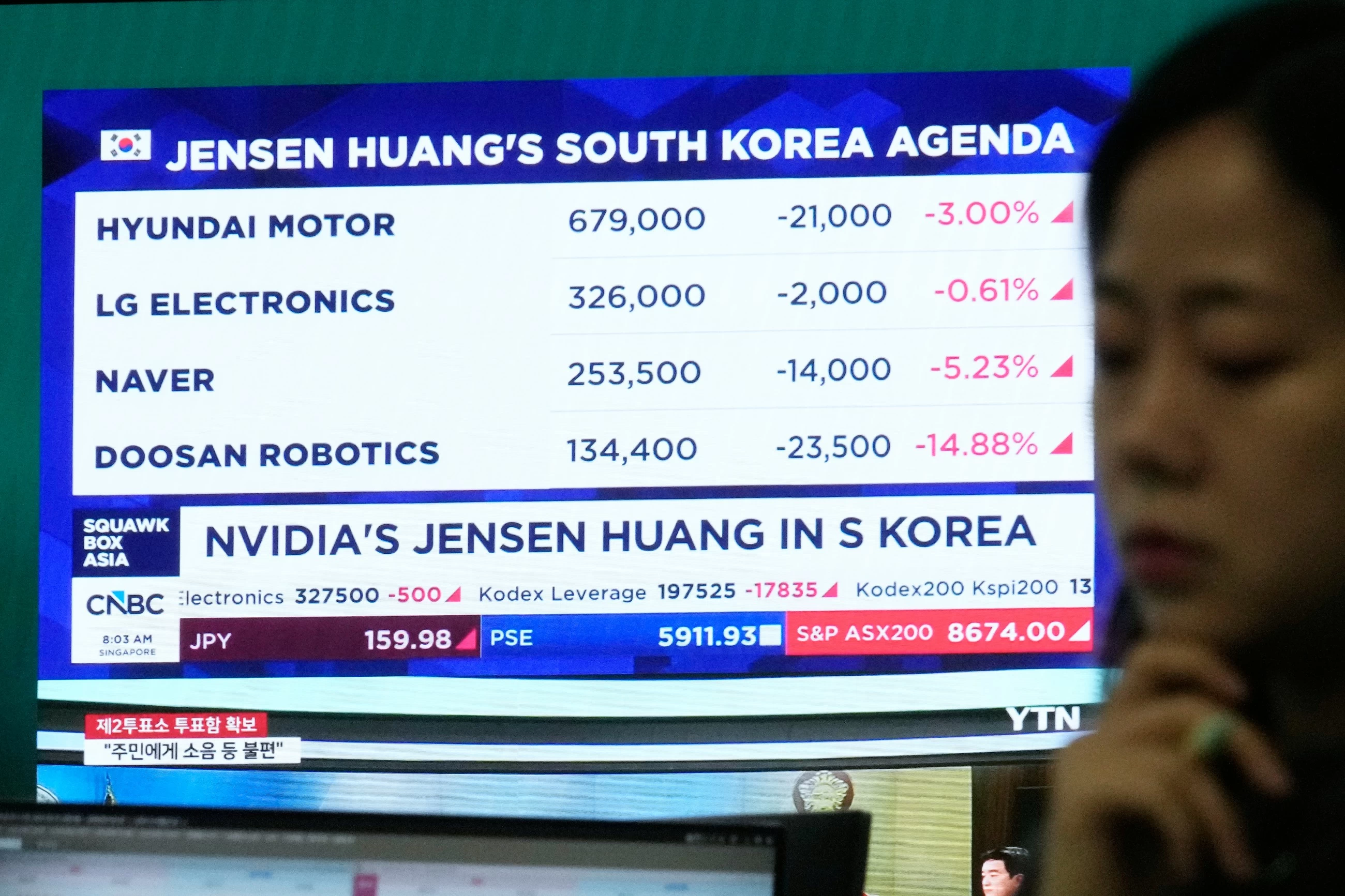
A screen shows South Korean companies’s stock prices related to Nvidia CEO Jensen Huang, who is scheduled to visit South Korea at the foreign exchange dealing room of the Hana Bank headquarters in Seoul, South Korea, on Friday. AP
The Dow Jones Industrial Average fell 1.4%, the S&P 500 lost 2.64% and the Nasdaq Composite dipped 4.2%.
Data showed US employers added far more jobs than expected in May, bolstering bets that the Fed could raise rates late this year.
US Treasury yields surged following the report, with the yield on the 2-year note, which typically moves in step with Fed rate expectations, hitting a 15-month high. It was last at 4.147%.
“We’re talking about a strong economy,” said Gary Schlossberg, market strategist at Wells Fargo Investment Institute.
“That just adds to inflation risk coming from the Gulf. It makes it difficult for the Fed to even think about rate cuts and might even increase the chances – although we’re still not forecasting that yet – of a rate hike by the Fed before the end of the year against the backdrop of inflation.”
The pan-European STOXX 600 index eased 0.29%. MSCI’s gauge of stocks across the globe fell 2.27%.
“There are some near-term pressures on the short end of the curve and it’s largely because of the geopolitical impact on the price of oil and headline inflation, but looking through that, we also understand that these pressures tend to be temporary and calm back down,” said Talley Leger, chief market strategist at the Wealth Consulting Group.
Oil set for weekly gain
Oil prices slipped after Oman said operations at Mina al Fahal port were proceeding normally following a Reuters report that oil loadings had been suspended after an explosion.
Brent crude futures fell 2% to settle at $93.09 a barrel and U.S. crude dipped 2.69% to $90.54 per barrel, with both contracts set to post their first weekly gains in three weeks.

A drone view shows an offshore oil platform in Guanabara Bay in Niteroi, Rio de Janeiro state, Brazil. File/Reuters
In currencies, the yen settled around the 160 per dollar level and was last down 0.11% at 160.19, as Japanese officials ramped up warnings about the ailing currency, keeping traders on alert for further intervention from Tokyo.
Data on Friday showed Japan’s foreign reserves fell by $77 billion in May.
The euro was down 0.73% at $1.1524. Sterling weakened 0.63% to $1.3336.
The dollar index was on track to gain 0.62%, supported by the Middle East conflict. Cryptocurrencies extended recent declines, with bitcoin shedding 3.88% to $61,156.75 and heading for a weekly decline of nearly 18%, its biggest since the week FTX collapsed in November 2022, while ether declined 9.85% to $1,598.01.
Spot gold fell 3.38% to $4,322.85 an ounce.
Reuters