admin
admin 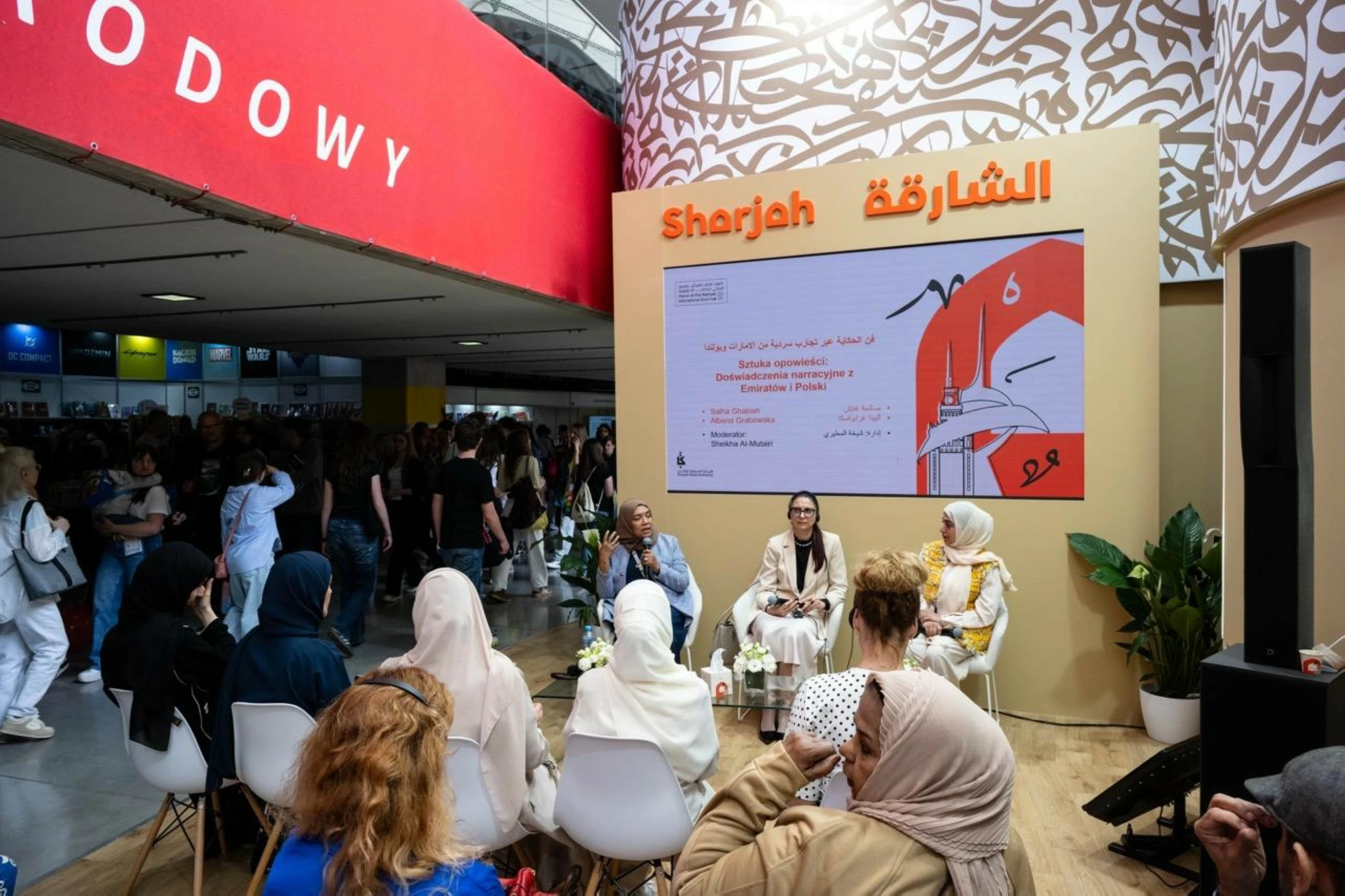
Sharjah’s Guest of Honour programme at the Warsaw International Book Fair 2026 turned attention to the power of storytelling to connect cultures during a discussion featuring Emirati writer Saleha Ghabesh and Polish novelist Albena Grabowska. The conversation explored how memory, history, and translation enable stories rooted in local experience to resonate with readers around the world.
The session, “The Art of Storytelling through Narrative Experiences from the UAE and Poland”, brought together the two authors to reflect on the relationship between storytelling, memory, history, and place, and how literature can cross cultural and geographical boundaries while remaining deeply connected to its origins.
Drawing on her experience writing The Scent of Ginger, Ghabesh said stories often begin with fleeting moments that remain in memory for years before finding their way onto the page. She recalled a childhood incident in which a lesson was abruptly interrupted and pupils were sent home as teachers gathered outside in tears, a memory that resurfaced years later and became part of the novel’s narrative.
While memory remains central to fiction, Ghabesh said it is ultimately shaped by the writer through language, culture, and craft.
“The most local stories are often the ones that travel the furthest,” Ghabesh said, arguing that literature resonates across cultures when it remains faithful to the details of place while exploring emotions and experiences shared by people everywhere.
Discussing The Scent of Ginger, she explained that the novel is set in the UAE during the 1950s and 1960s and follows its protagonist’s evolving relationship with family, society, work, and self. Despite its distinctly Emirati setting, she noted that the novel connected strongly with Polish readers. She pointed to the translator’s engagement with place names such as Wadi Al Helo and Khorfakkan as evidence that literature can carry the character of a place across linguistic and cultural boundaries.
Ghabesh also highlighted the role of history in shaping fiction, noting that the early conception of The Scent of Ginger was influenced by My Early Life (Sard Al That) by His Highness Sheikh Dr. Sultan bin Mohammed Al Qasimi, Supreme Council Member and Ruler of Sharjah. She said the book’s documentation of place and its account of social transformation in Sharjah and the UAE provided important reference points during the novel’s development.
Concluding her remarks, Ghabesh stressed the ethical responsibility that accompanies writing, arguing that fiction should reflect society while remaining respectful of people, events, and readers. Literature, she said, should be guided by human and cultural values rather than a desire to offend or condemn.
For her part, Grabowska described storytelling as an extension of the memory of women, families, and small communities. She said much of Polish literature is rooted in what she called “small homelands”, the places where people grow up and the memories passed down through generations.
Personal stories transmitted from one generation to the next often become part of a wider cultural memory, she said, adding that Polish literature frequently explores the relationship between past and present and the ways in which history continues to shape contemporary life.
Grabowska also addressed the challenges of bringing literature from one culture to another, arguing that translation involves far more than transferring words between languages. It requires preserving a work’s cultural nuances and deeper meanings while making it accessible to new readers.
Writers, she added, are not concerned with presenting idealised or stereotypical images of their countries, but with telling honest stories rooted in local realities that can still resonate with readers from different cultural backgrounds.
Discussing her work in historical fiction, Grabowska said history remains central to her writing. Her aim, she explained, is to present historical subjects through engaging narratives without sacrificing accuracy or depth.
She concluded by noting that literature, particularly historical fiction, has the ability to bring cultures closer together by allowing readers to experience the lives of others through stories and characters rather than through facts alone.