admin
admin President Donald Trump will meet with his Cabinet on Wednesday at a precarious moment for talks aimed at ending the war with Iran, just days after insisting that his administration and Tehran had “largely negotiated” a settlement but with the negotiations still in a state of flux.
As he prepares to huddle with his top aides, Trump is projecting confidence that he’s closing in on a deal that will reopen the Strait of Hormuz and provide him a credible argument that Iran’s nuclear capability has been diminished enough to declare victory, winding down a conflict that’s been politically unpopular for Republicans.
But as things stand, Trump also risks finding closure to his war of choice comes with an unsatisfactory ending.
The emerging deal puts off many critical issues to be resolved later and has already exposed the president to fierce criticism – even from some of his own supporters – that Iran’s hardline leaders will emerge from the conflict battered but emboldened. It all comes to a head just as the midterm elections to determine control of Congress come into focus and as Republicans worry that rising costs and fuel prices are darkening the American electorate’s mood.
Talks were further complicated after US forces carried out what the Pentagon called “defensive” strikes on missile launch sites and mine-laying boats in southern Iran on Monday. The U.S. said it acted with “restraint” in light of the weekslong ceasefire, while Iran decried the action as a sign of “bad faith and unreliability.”
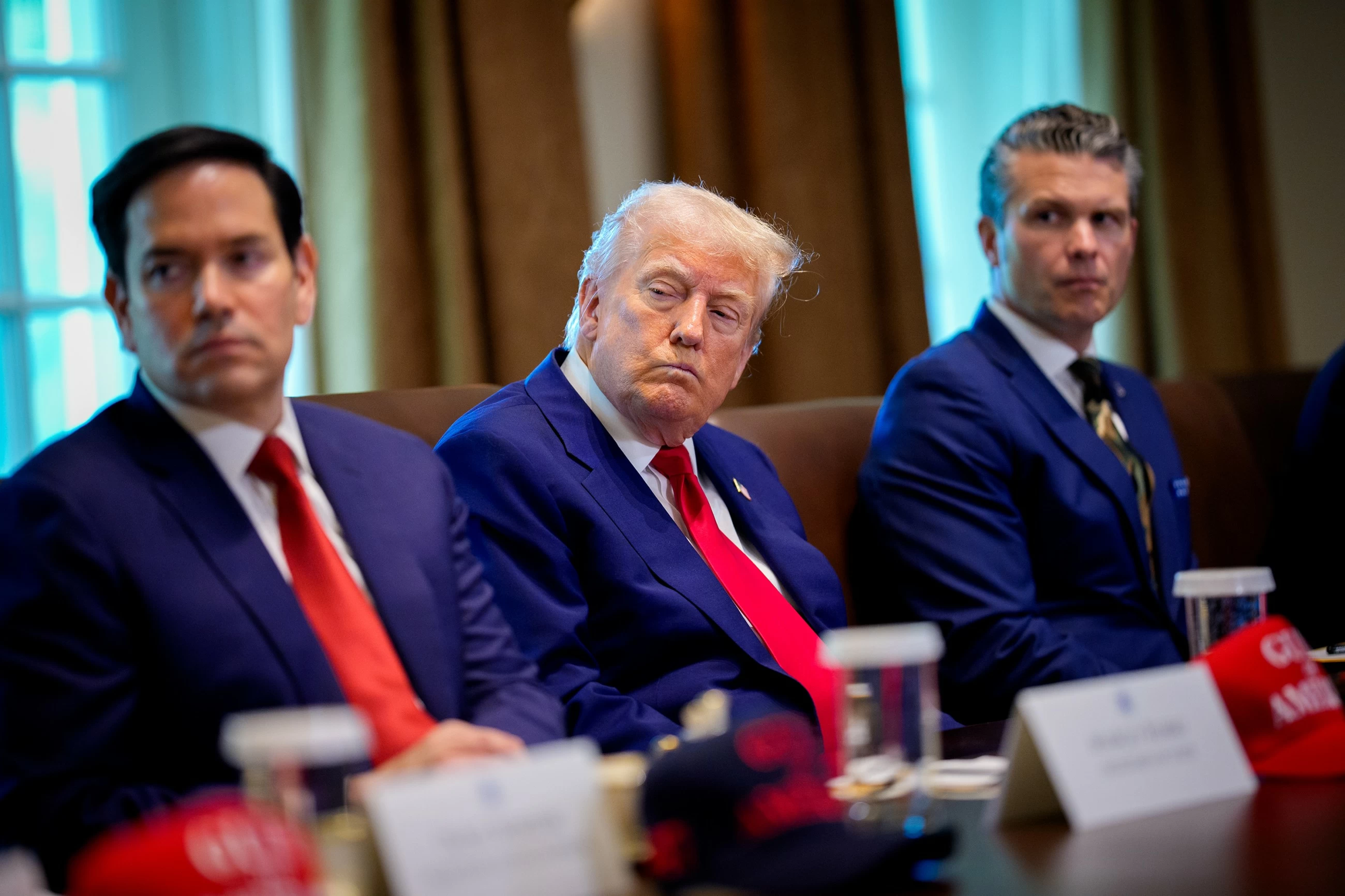
Marco Rubio (left), President Donald Trump and Pete Hegseth attend a Cabinet meeting at the White House in Washington. Tribune News Service
Secretary of State Marco Rubio said Tuesday that talks with Iran on reopening the strait and extending the ceasefire – a period that the administration says could be used to hash out the finer details of a nuclear agreement – will take several more days. “He’s either going to make a good deal or no deal,” Rubio told reporters.
Trump for his part took to social media on Tuesday to grumble that even if Tehran were to offer a complete surrender, the media would paint the end of the conflict as Iran scoring “a Masterful and Brilliant Victory.”
While Trump insists a deal is within reach, there appears to be daylight between the US and Iran on several key issues. The president is also facing scrutiny from Republican allies, including Sens. Roger Wicker of Mississippi, Lindsey Graham of South Carolina and Ted Cruz of Texas, who have said the terms seem too favorable to Tehran.
They’re balking at aspects of the deal that have emerged publicly that they say too closely resemble the nuclear agreement reached with Iran by former President Barack Obama, which Trump scrapped during his first term.
Under the potential deal, Tehran would agree to give up its stockpile of highly enriched uranium – a key Trump demand – in return for sanctions relief. That’s according to two regional officials and one senior Trump administration official, all of whom spoke on condition of anonymity to discuss the sensitive negotiations.
One regional official, with direct knowledge of the negotiations, said how Iran would give up the uranium would be subject to further talks during a 60-day period. Some would likely be diluted, while the rest would be transferred to a third country, the official said.
Iran has 440.9 kilogrammes (972 pounds) of uranium that is enriched up to 60% purity, a short, technical step from weapons-grade levels of 90%, according to the International Atomic Energy Agency. Iran has not publicly committed to giving up its uranium.
Trump on Monday said in a Truth Social post that the uranium, which is believed to be buried under nuclear sites battered by US air strikes last year, would either be turned over to the US or “destroyed in place or, at another acceptable location, with the
Atomic Energy Commission, or its equivalent, being witness to this process and event.” The comment signals a softening of Trump’s previous insistence that the US take control of Iran’s uranium stockpile.
Associated Press