admin
admin 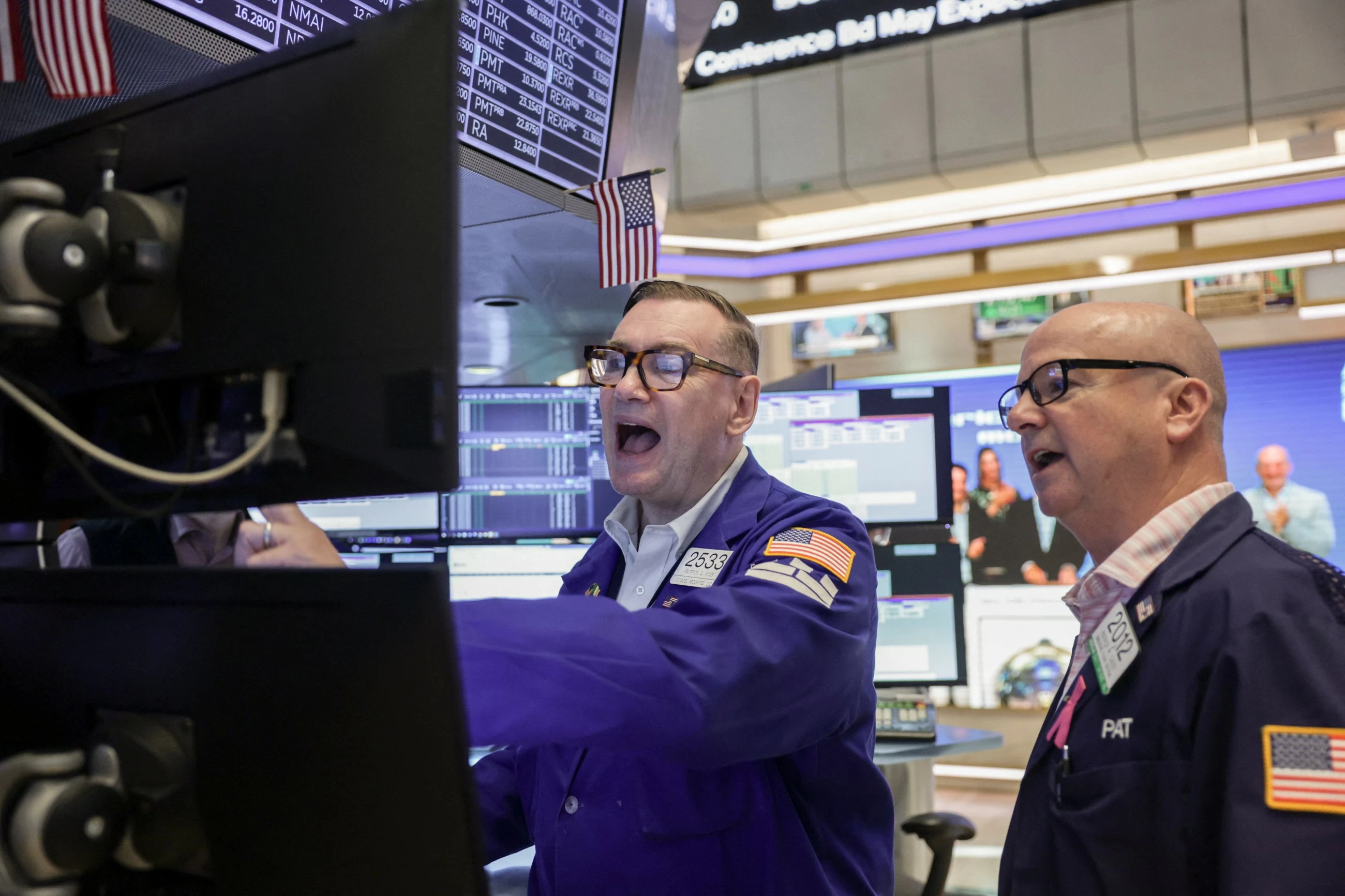
Wall Street stocks showed little conviction Wednesday, drifting along near record highs, while crude oil prices retreated as investors eyed possible progress in US-Iran peace negotiations.
All three major US stock indexes wavered in early trading with a pullback in chip stocks weighing on the Nasdaq, while Treasury yields eased on hopes that the months-long blockade of the Strait of Hormuz could soon be lifted, easing fears that the resulting energy price squeeze could metastasize into higher inflation, and in turn, tighter monetary policy.
Iran’s state TV said it obtained a draft of an unofficial framework of an initial understanding between Washington and Tehran toward ending the conflict, which would entail Iran restoring shipments through the crucial waterway to pre-war levels within a month. The White House said the report was false.
“Regarding news reports that Iran may reopen the strait in a month, I’m not sure that’s something anybody’s going to get excited over,” said Oliver Pursche, senior vice president at Wealthspire Advisors, in New York. “As we’ve seen, a lot can happen in a month.” This follows claims from Iran on Tuesday that the United States violated the ceasefire, potentially complicating peace efforts. For its part, Washington insisted its recent strikes were defensive in nature.
As of Wednesday, however, the fragile truce remained intact, offering hope that a deal could be imminent.
Financial markets are currently pricing in a 38.1% likelihood that the US Federal Reserve will raise interest rates in December according to CME’s FedWatch tool, which showed zero possibility of a December rate hike one month ago.
The Dow Jones Industrial Average rose 365.54 points, or 0.72%, to 50,827.22, the S&P 500 rose 0.02 points, or 0.01%, to 7,519.79 and the Nasdaq Composite fell 75.16 points, or 0.27%, to 26,585.03.
European shares, enjoying a boost from auto and chemical stocks, hovered near all-time highs even as market participants kept a wary eye on Middle East tensions.
MSCI’s gauge of stocks across the globe rose 1.32 points, or 0.12%, to 1,122.74.
The pan-European STOXX 600 index slipped 0.05%, while Europe’s broad FTSEurofirst 300 index lost 0.73 points, or 0.03%.
Emerging market stocks rose 20.17 points, or 1.17%, to 1,740.58.
Crude oil prices dropped on signs of progress in U.S.-Iran peace talks.
“Oil is off its high at this point, I think oil is getting closer to where it ought to be, given that it doesn’t appear that (the war) is going to escalate from here and that everybody’s looking for an off-ramp,” Pursche added.
US crude fell 4.61% to $89.56 a barrel and Brent fell to $95.54 per barrel, down 4.06% on the day. US Treasury yields edged lower on continued signs of progress in Middle East peace talks.
The yield on benchmark US 10-year notes fell 2 basis points to 4.471%, from 4.491% late on Tuesday.
The 30-year bond yield fell 1.8 basis points to 5.0059% from 5.025% late on Tuesday.
The 2-year note yield, which typically moves in step with interest rate expectations for the Federal Reserve, fell 1.5 basis points to 4.035%, from 4.05% late on Tuesday.
The dollar held steady after Tuesday’s uptick, while the yen slid to its weakest against the greenback since late April, brushing against levels that triggered an official Japanese intervention last month as investors eyed a potential flare-up of turmoil in the Middle East.
The dollar index, which measures the greenback against a basket of currencies including the yen and the euro, fell 0.07% to 99.04, with the euro up 0.19% at $1.165. Against the Japanese yen, the dollar strengthened 0.06% to 159.38.
In cryptocurrencies, bitcoin fell 1.48% to $74,892.70. Ethereum declined 0.82% to $2,058.86.
Gold prices declined to a two-month low as war-related inflation increased the odds that the Fed could hike interest rates this year.
Spot gold fell 1.31% to $4,447.05 an ounce. US gold futures fell 1.35% to $4,439.70 an ounce.
Separately, the market value of South Korean memory chipmaker SK hynix soared past $1 trillion on Wednesday, fueled by frenzied global demand for the computing hardware that powers artificial intelligence tools — a surge that also carried US-based Micron across the threshold.
SK hynix’s new benchmark comes on the heels of rival Samsung Electronics, whose market capitalization also topped $1 trillion this month — fanning frustration among its workers, who have since struck a deal with management securing massive bonuses and averting a strike.
Shares in SK hynix, which supplies Silicon Valley AI chip titan Nvidia with advanced high-bandwidth memory, were up more than 11 percent in early afternoon trade.
Its new valuation makes the company one of just three $1 trillion firms in Asia, along with Samsung and Taiwanese contract chipmaker TSMC, according to Bloomberg.
Idaho-based Micron also crossed the $1 trillion barrier on Tuesday and jumped another five percent at the opening of trade on Wall Street on Wednesday.
Governments and tech firms worldwide are pouring hundreds of billions of dollars into AI data centers that can train and run tools such as chatbots, image generators and agents.
That has caused a dizzying boom in business for companies that make the silicon microchips used to crunch vast amounts of data in these facilities.
Agencies