admin
admin 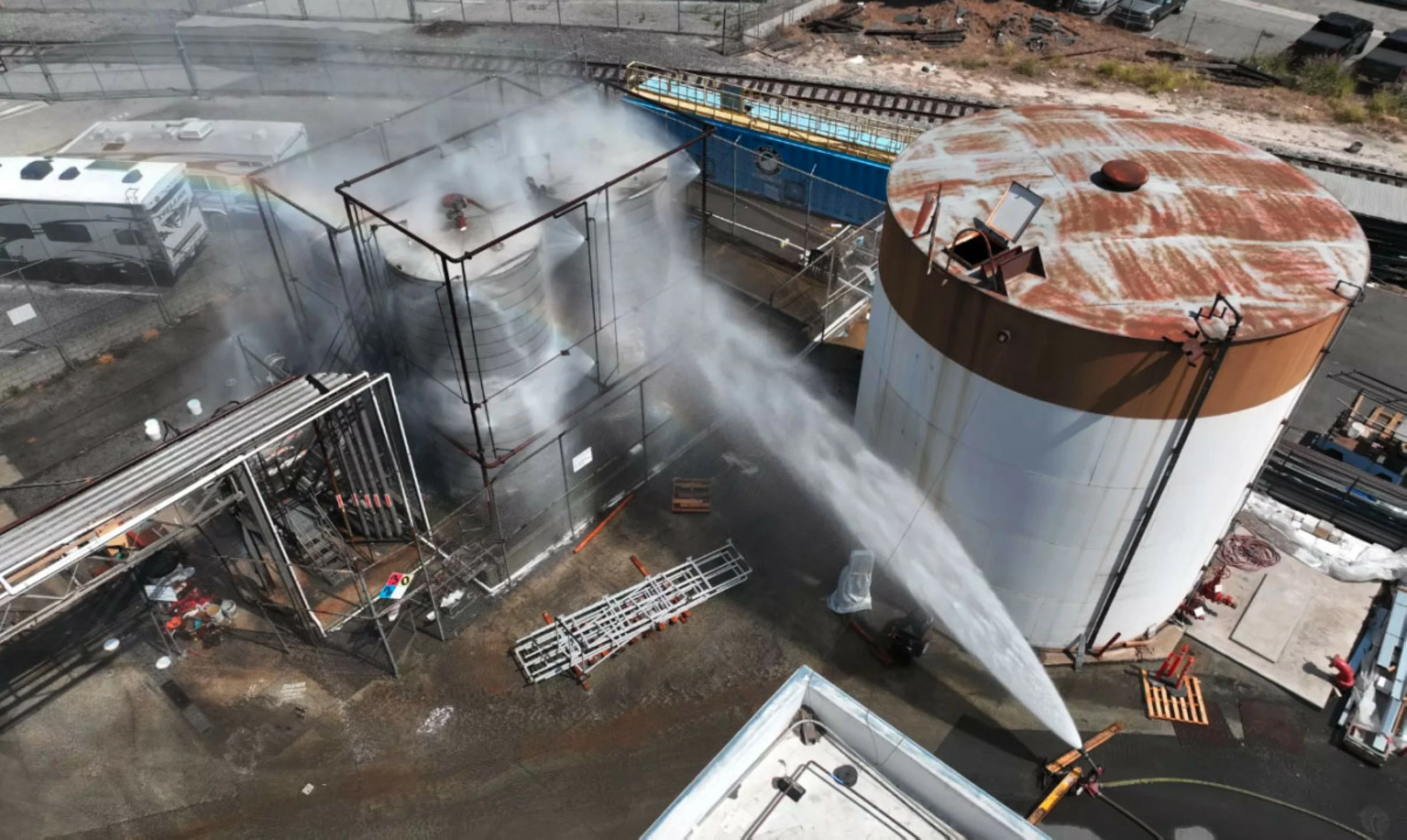
An “unprecedented” situation was taking hold in Orange County on Friday, as a tank at an aerospace firm was at risk of exploding and releasing a highly toxic chemical that can cause severe respiratory distress and lead to hospitalidation, officials said. An estimated 40,000 residents have been asked to evacuate, affecting portions of the cities of Garden Grove, Anaheim, Buena Park, Cypress, Stanton and Westminster. Disneyland is outside of the evacuation zone.
“This is highly volatile, it’s highly toxic, it’s highly flammable,” said Craig Covey, a division chief with the Orange County Fire Authority and the incident commander. Officials said they can’t recall a similar situation happening before. So what’s the science of the leak and why do officials say it is so dangerous?
What’s happening? There are three large tanks with a highly toxic chemical called methyl methacrylate, or MMA, used to make plastic, around the 12000 block of Western Avenue in Garden Grove. One tank that is the most compromised and in crisis has about 7,000 gallons of the chemical left in it, Covey said. There are two options with what will happen to the tank, Covey said, which started experiencing a rise in temperatures Thursday.
“One, it fails and cracks, and all the product leaks out onto the ground,” Covey said, and efforts are underway to try to prevent the liquid from “getting into the storm drains and the river channels and into our oceans.”
Chemical leak at GKN Aerospace: That’s the best-case scenario, because once it leaks, it’s no longer at risk of exploding. From there, teams in hazardous material suits can go in and “neutralise and mitigate the vapors that will be coming off of that.” The worst-case scenario is an uncontrolled explosion. “If you’ve ever seen videos of tank cars on a railroad track blowing up, and that fireball it puts out, and it blows half the tank car a half a mile down the train track, that’s the incident potential we are dealing with if this suffers a catastrophic failure,” Covey said.
Those were the options: “a leaking tank or a tank that blows up,” Covey said at a briefing Friday afternoon. “This is going to happen unless some guy behind me here figures out how we can mitigate this incident. This thing is going to fail. We don’t know when.”
The incident took place at GKN Aerospace, which builds engine structures, landing gear and other products for commercial and military aircraft.
What are the health risks of an explosion? MMA is very toxic. Short-term exposure involving inhaling the chemical’s vapors “can cause significant irritation in the lungs, the nasal passages, and it can also cause nausea and it can also cause dizziness,” said Dr. Regina Chinsio-Kwong, Orange County’s health officer.
At very high levels of exposure, “it can really cause severe respiratory distress and hospitalisation,” Chinsio-Kwong said. The evacuation is large in part because of the potential of a plume of toxic vapors. Officials said the chemical is heavier than air, so it would settle and sink into the lower areas around that facility if there’s an explosion. Officials are planning for the risk of the chemical blowing into other areas.
Methyl methacrylate can easily evaporate and linger near the ground as a dangerous vapor, according to the US Environmental Protection Agency. If inhaled at high levels, these fumes can aggravate a person’s lungs, causing coughing, wheezing and chest tightness. It can also cause nausea, dizziness and skin irritation. Although the EPA has classified the chemical as “not likely” carcinogenic to humans, long-term exposure has been linked to serious organ damage.
Why can’t officials take the toxic chemical safely out of the tank, without a leak or explosion? Of the three tanks with the toxic chemical, crews were able to add a chemical to one tank to neutralise its volatility, Covey said. They haven’t been able to do that with a second tank, but it is not in crisis. But the tank that is most in crisis has valves that are broken and “gummed up,” and so the stabilising chemical can’t be added to the explosive chemical, Covey said. The broken valves also mean that crews can’t drain the tank of the explosive chemical, according to Orange County Fire Authority division chief Nick Freeman.
“We are unable to get anything out, and we were unable to get anything in to stabilise these things,” Freeman said.
Officials are trying to see if there are other ways they can resolve the situation without a spill or explosion.
Tribune News Service