admin
admin 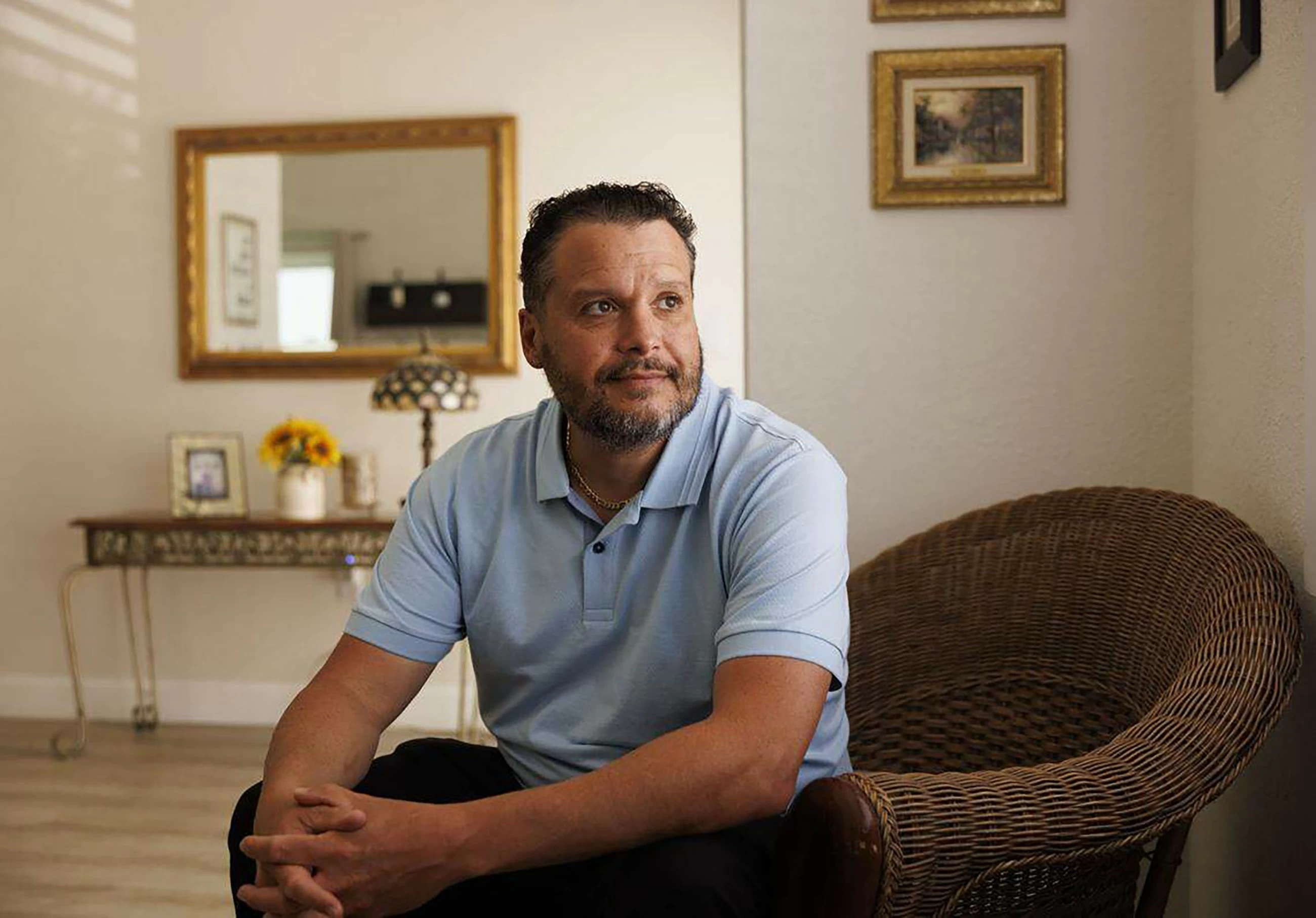
Michelle Marchante, Tribune News Service
Ozzie Echemendia’s “second chance of life” came in the form of a wire that runs from his brain all the way to his upper chest. Echemendia is in a battle with Parkinson’s disease, a movement disorder that affects the nervous system and usually worsens over time, causing tremors and making it difficult to walk and speak. It wasn’t long ago that the 54-year-old father of two found himself on the couch, unable to work or even walk without help. He had frequent tremors. He could barely speak. He was taking 60 pills a day, on average.
“Parkinson’s steals. It doesn’t care what you owe to the bank. It doesn’t care about keeping the lights on or feeding your kids,” Echemendia, who lives in the Redland area of South Miami-Dade, told the Miami Herald during a recent video interview. “The fact that I’m here sitting with you, it’s a miracle.”
In May 2025, he underwent a minimally invasive brain surgery to implant a device in the area of the brain that largely controls movement and is connected to a battery implanted in his upper chest. Shortly after recovery, the “programming” started. Doctors began to touch and slide buttons on an iPad.
At first, there was no change. By the third try, Echemendia began to move. “They hit the bull’s-eye,” Echemendia said. Within a few days, he was able to walk to the bathroom by himself for the first time in years.
He’s still undergoing treatment for Parkinson’s, a disorder that currently has no cure. But he’s working again. Dancing. Walking.
“I can’t describe — words can’t describe now the change,” Echemendia said, tearing up. It “was a game changer for me, a life changer.” What sounds like a miracle is the effects of a deep brain stimulation procedure Echemendia underwent at Memorial Regional Hospital in Hollywood. The procedure, most commonly known as DBS, implants thin wires into a specific area of the brain that controls movement to “control the symptoms of Parkinson’s” and other movement-related disorders without medication, according to Dr. Christopher DeMassi, chief of the Memorial Neuroscience Institute. A small battery, similar to a pacemaker, is implanted in the chest.
“It’s almost like a light switch. You turn the device on, and they’re moving totally normal,” DeMassi said. “They’re able to walk. They get rid of their walker. They start eating. It’s a huge change in life.”
The tech has been around for decades but has been honed over time to no longer require patients to stay awake as doctors poke around in their brains. The robot-assisted surgery takes less than an hour to do compared to traditional DBS surgery, which can sometimes take up to 10 hours to complete, according to the hospital. And unlike traditional brain surgery, no head shaving is needed.
Those were key selling points for Ivonne Gonzalez, who underwent the procedure in late December after she was connected to Echemendia by his wife, her former co-worker. Gonzalez, who was diagnosed with Parkinson’s in 2022, said she realized something was wrong when her handwriting began to change. She struggled to walk. Her speech began to slur. It became difficult to play with her grandchildren.
Now, she’s walking without her walker. And her speech has improved, though she’s still in her own programming process. “People have to be their own advocates,” Gonzalez told the Herald, stressing how important it is to find a doctor who listens and pays attention to symptoms and other changes that patients notice in their life.
The robot-assisted DBS surgery is just one of the innovative technologies being used at South Florida hospitals to combat the difficult symptoms of a life-changing disorder that affects nearly 1 million people in the country.
At Baptist Hospital, a similar — and newer — technology is being used to lessen Parkinson’s unbearable tremors, without the need for anesthesia. The MRI-guided procedure uses high-intensity focused ultrasounds to burn and kill the tremor-causing cells, according to Dr. Justin Sporrer, the director of functional neurosurgery at Baptist Health’s Miami Neuroscience Institute.
There are no stitches. No implanted devices. Patients go home the same day. And the effects are instantaneous. “It was a miracle. I literally started crying,” said Timothy Sick of Fort Lauderdale, who for six years and two months lived with tremors. “I came out of the machine. My hand didn’t quiver at all, and (the doctor) high-fived me.”
No two Parkinson’s patients are the same. The disease affects every patient’s body differently, similar to cancer. It’s why treatment is so difficult. In Sick’s case, his “tremor dominant” Parkinson’s wasn’t responding well to medication, making it difficult to work. He and his partner Sal Zambito went everywhere — 48 different specialists from London to Boston to Miami — looking for a treatment that could bring some sense of normalcy back.
They found it at Baptist. Just like DBS, the high-intensity focused ultrasound procedure commonly referred to as HIFU is approved by federal regulators to treat patients with essential tremors and Parkinson’s and is often covered by insurance.
“A year ago, I couldn’t even get out of bed, and we had medicine, adjustments, more physical therapy,” the 66-year-old Sick said. “And then when the procedure came, I like, hopped out of bed.”