admin
admin 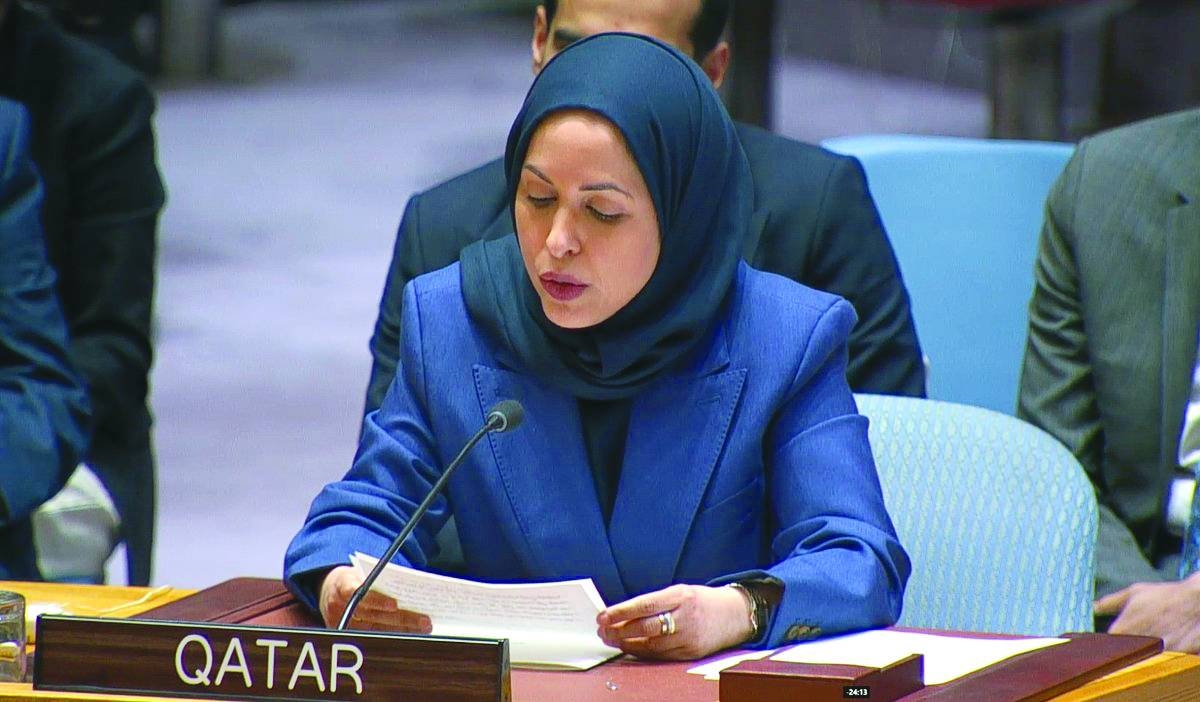
Qatar has affirmed that serious dialogue and adherence to the principles of international law and good neighbourliness are the fundamental pillars for resolving crises and avoiding their dangerous repercussions.
This came in a statement delivered by HE Permanent Representative of the State of Qatar to the United Nations, Sheikha Alya Ahmed bin Saif al-Thani, before the United Nations Security Council’s quarterly open debate on the situation in the Middle East, including the Palestinian question at the UN headquarters in New York.
HE Sheikha Alya noted that the Council meeting is being held amidst the current situation in the Arabian Gulf region, since Feb 28, and the subsequent serious and multifaceted repercussions for it has on international peace and security. She reaffirmed Qatar’s condemnation of attacks by the Islamic Republic of Iran against Qatar and Gulf states, as well as all violations targeting the national sovereignty of Qatar and the countries of the region, including attacks on residential areas, vital infrastructure, and energy facilities, which resulted in civilian casualties and material losses, constituting violations of international law and international humanitarian law.
The UN Security Council Resolution 2817, submitted by the Kingdom of Bahrain on behalf of the Gulf Cooperation Council (GCC) states and Jordan and backed by 136 countries, underscored strong support for the territorial integrity, sovereignty, and political independence of these states, she said, adding that it also emphasized respect for navigational rights and freedoms in accordance with international law, particularly concerning vital maritime routes.
Regarding developments in the Strait of Hormuz, HE the Permanent Representative of Qatar to the UN stressed the importance of ensuring security of maritime routes, freedom of navigation and international trade in line with international law. The strait’s security is linked to global energy security and supply chains, calling for concerted efforts to guarantee freedom of navigation and the opening of maritime routes, as it has regional and international implications.
She noted that Qatar welcomed the US-Iran ceasefire announcement on April 8, expressing appreciation for mediation efforts by Pakistan and other parties, and stressed the importance of full commitment to consolidating de-escalation and creating suitable conditions for dialogue.
Regarding the occupied Palestinian territories, Qatar condemned the illegal Israeli occupation’s measures in the West Bank, including reclassifying Palestinian land as so-called Israeli “state land,” accelerating settlement activity, approving legislation allowing the death penalty, and restricting freedom of worship in occupied Jerusalem. It reaffirmed its support for a two-state solution based on international legitimacy, ensuring the establishment of an independent Palestinian state on the 1967 borders with East Jerusalem as its capital, and the necessity of ending the occupation, settlement activity, and all illegal Israeli practices in the occupied territory.
Regarding the current situation in the Gaza Strip, she explained that Qatar emphasises the necessity for all parties to fully implement the ceasefire agreement in Gaza and to open the crossings to ensure the sustainable and unhindered flow of humanitarian aid to the Strip. She affirmed Qatar’s full and unwavering commitment to the Peace Council since the inception of mediation efforts, up to and including the signing of the Sharm El-Sheikh Agreement with partners. She also reiterated Qatar’s continued coordination of humanitarian efforts with partners in the United Nations and the Peace Council, supporting the recovery and reconstruction process and enhancing the prospects for sustainable peace.
As for the situation in the Gaza Strip, Qatar stressed the need for full implementation of the ceasefire agreement, the opening of crossings to ensure sustained and unhindered humanitarian aid, and reaffirmed its continued commitment to mediation efforts and co-ordination with UN partners to support recovery, reconstruction, and prospects for lasting peace.
HE Sheikha Alya affirmed Qatar’s unwavering commitment to the Peace Council up to, and including, the signing of the Sharm El-Sheikh Agreement with partners. She also reiterated Qatar’s continued co-ordination of humanitarian efforts with partners in the United Nations and the Peace Council to support the reconstruction process and enhance the prospects for sustainable peace.
She stated that Qatar reaffirms its support for the sovereignty and unity of Syria, condemning Israeli attacks that violate international law, and affirmed its firm stance on the unity, sovereignty, and territorial integrity of Lebanon, expressing full solidarity with measures taken to preserve its security and stability.
HE the Permanent Representative of the State of Qatar to the United Nations also pointed out that Qatar welcomes the ceasefire as an initial step toward de-escalation and appreciates mediation efforts, including those by US President Donald Trump, stressing the need to uphold and build on the ceasefire.
NPT essential instrument for achieving collective security: Qatar
NEW YORK: Qatar stressed the importance of strict implementation of the obligations arising from international agreements in the field of nuclear disarmament and non-proliferation.
This came in a statement delivered by HE Permanent Representative of the State of Qatar to the United Nations Sheikha Alya Ahmed bin Saif al-Thani, who headed Qatar’s delegation participating in the Review Conference of the Parties to the Treaty on the Non-Proliferation of Nuclear Weapons (NPT), before the general debate of the 2026 NPT Review Conference, at the UN headquarters in New York.
HE Sheikha Alya stressed that the NPT is the cornerstone of the international disarmament and non-proliferation regime and an essential instrument for achieving collective security, which requires a full, balanced and non-selective commitment to implementing its three pillars, noting that the Review Conference contributes to focusing efforts to achieve the goals set out in this important treaty.
Regarding the Middle East, she said that the 1995 resolution on the Middle East is an integral part of the treaty system, stressing the need to implement this resolution by establishing a zone free of nuclear weapons and weapons of mass destruction in the Middle East, which is a fundamental step towards achieving security and stability in the region.
She also expressed Qatar’s hope that the current session of the NPT Review Conference would adopt outcomes that support this goal, stressing Qatar’s support for the fraternal Sultanate of Oman as chair of the current session of the Conference on the Establishment of a Middle East Zone Free of Nuclear Weapons and Other Weapons of Mass Destruction.
Regarding the failure of the NPT review conferences in 2015 and 2022 to produce a consensus document, HE the Permanent Representative stressed the importance of redoubling efforts and demonstrating genuine political will to revive international consensus in order to reach outcomes and results that contribute to achieving the objectives of the current Review Conference and to achieving international security, while emphasizing the importance of nuclear-weapon states making concrete and time-bound commitments to the complete and total elimination of those weapons in accordance with Article VI of the NPT.
She stressed that Qatar emphasises the pivotal role of the International Atomic Energy Agency as the competent international body for verifying states’ commitment to using nuclear materials and technology for peaceful purposes only, while also stressing the importance of strengthening the comprehensive safeguards system and the Additional Protocol, as well as good faith full co-operation to ensure the peaceful and responsible nature of nuclear activities.
HE Sheikha Alya underscored the importance of taking into account the highest standards of safety and security, and limiting the risks of radioactive leakage and its effects on neighbouring countries, the environment and water sources, with verifiable guarantees that it will not be diverted for military purposes. She called for all countries to join international agreements related to nuclear safety, and to commit to not transferring nuclear technology and materials to countries that are not parties to the treaty without meeting safety and security requirements.
HE the Permanent Representative affirmed that Qatar will continue to work with its partners to ensure that this conference leads to real results that enhance collective security and brings everyone closer to that goal. (QNA)