admin
admin 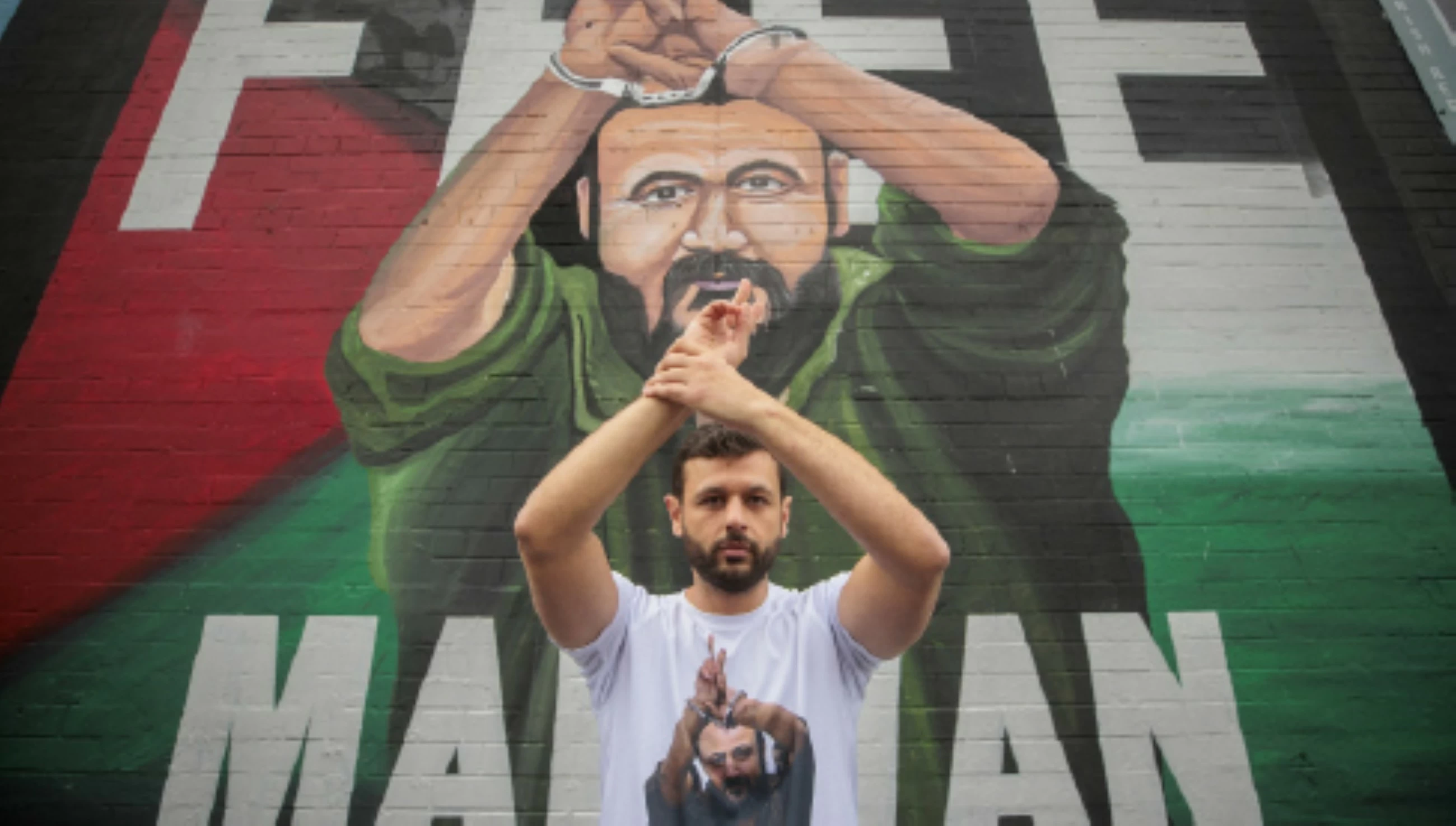
Global media has picked up reports that Palestinian political prisoner Marwan Barghouti has suffered three recent beatings by Israeli prison guards during the last month. Although such reports are generally ignored, his treatment headlined for a day or two before being overtaken by more dramatic events. But he should neither be forgotten nor his situation ignored since he is a prominent representative of the hundreds of Palestinians – men, women, and children – languishing in Israeli prisons and jails.
Barghouti is regarded as Palestine’s Nelson Mandela, who was jailed for 27 years in South Africa for campaigning against apartheid, racial segregation. Barghouti’s son Arab was informed of mistreatment by Israeli lawyers. While the Israeli Prison Service contended “the allegations made are false and baseless” the most recent images of formerly robust Barghouti show him thin and weak and his head shaved. In a 13-second video made last August, Israeli National Security Minister Itamar Ben Gvir taunted and threatened Barghouti: “Whoever harms the people of Israel, whoever kills children, whoever kills women, we will wipe them out.” When Barghouti tried to reply, Ben Gvir interrupted: “No, no, you must know this, throughout all of history….” He did not finish his sentence. Commenting on Ben Gvir’s motivation, Mustafa Barghouti, Palestinian independent spokesman, said the minister “didn’t humiliate Marwan – he humiliated himself.”
Marwan Barghouti was arrested 24 years ago during the Second Intifada, the 2000-2005 Palestinian uprising, for establishing the Tanzim, the armed wing of the mainstream Fatah movement. He was convicted of planning deadly attacks that killed five Israeli civilians and sentenced to serve five life terms plus 40 years.
Conditions for Palestinian prisoners have sharply deteriorated while Ben-Gvir has been in charge of their lives and 89-98 have died since the October 2023 Hamas attack on southern Israel where 1,200 were killed. Restrictions on Palestinian prisoners have multiplied. They have suffered torture, long periods of lone lockdown, widespread abuse and noticeable weight loss from inadequate and poor-quality food, medical neglect, and psychological trauma. At least 9,300 Palestinians are currently detained in Israeli prisons, including about 350 children, according to recent figures. More than a million Palestinians have been imprisoned since Israel conquered East Jerusalem, the West Bank and Gaza in 1967. Under international law, resistance is legal to hostile occupation as long as actions are confined to military/occupation personnel and objects.
Ben Gvir was elevated in 2022 to this highly sensitive post by Prime Minister Binyamin Netanyahu despite a long history of anti-Palestinian racism and repeated convictions for incite-ment, including against Israeli peacemakers. He scorned Yitzhak Rabin, who had assumed the task of peacemaking and was assassinated in 1995 by right-wing Israeli extremist Yigal Amir, who was imprisoned for life.
Between 3,500 to 4,600 Palestinians are held by Israel under administrative detention without charge or trial. This amounts to an increase of 168 per cent since October 2023. These detainees, often held on secret evidence, are among a total of 9,500-10,000 Palestinians in Israeli prisons. The detainees include Palestinian human rights defenders and activists who have neither planned violence nor carried out gun and bomb attacks.
Among the detainees is Palestinian paediatrician Dr. Hussam Abu Safiya who served as director of Kamal Adwan Hospital in the Gaza Strip from February 2024 until its evacuation by the Israeli military in December 2024. During the Israeli offensive he expanded the hospital’s capacity from 120 to 200 beds and provided accommodation for displaced civilians. Despite being wounded in the leg by shrapnel, he continued to treat patients. He was interrogated and briefly detained during the conflict. As far as Israel was concerned, his “crime” was describing events in Gaza during phone calls to international correspondents.
In 1990, teenager Iyad Burnat was sentenced to two years in prison for throwing stones at Israeli soldiers and since then has been arrested and imprisoned for non-violently protesting the Israeli occupation of the West Bank village of Bil’in and confiscation of its land. His brother Emad Burnat shot the film “5 Broken Cameras” about Bil’in’s struggle to survive won a Sundance Film Festival documentary award and he was the first Palestinian nominated for the Academy Award for Best Documentary Feature.
Saeb Erekat was 12 years old when the Israelis captured the West Bank and at 13 was imprisoned for two years for writing anti-occupation graffiti, posting anti-occupation fliers and throwing stones. Between 1972 and 1983 he studied in the US and Britain. He rose to be Secretary General of the Executive Committee of the Palestine Liberation Organisation, served in the Palestinian parliament, minister of information as well as negotiator. He died in 2020.
Professor of philosophy, former president of Jerusalem’s Al-Quds University and Palestinian National Authority representative in the city, Sari Nusseibeh’s family can trace 1,300 years’ existence there. On Jan. 29, 1991, he was arrested and accused of being an Iraqi agent because of his opposition to the US war on Iraq. Amnesty International adopted him as a prisoner of conscience. Israeli moderates accused the government of trying to discredit Nusseibeh as an effective Palestinian spokesman. Palestinians saw his detention as a warning that Israel did not intend to negotiate with any Palestinians. He was released at the war’s end after 90 days.
Palestinian Centre for Human Rights (PCHR) Director Raji Sourani is a human rights lawyer who served three years in prison for belonging to the Popular Front for the Liberation of Palestine. He was an Amnesty International prisoner of conscience in 1985 and 1988. He served as a member of the International Commission of Jurists and vice president of the International Federation of Human Rights. He received the Robert F. Kennedy Human Rights Award in 1991 and in 1995, he founded the PCHR. He has lived in exile in Cairo since 2024 where he continues the PCHR’s work.
Photo: TNS