admin
admin 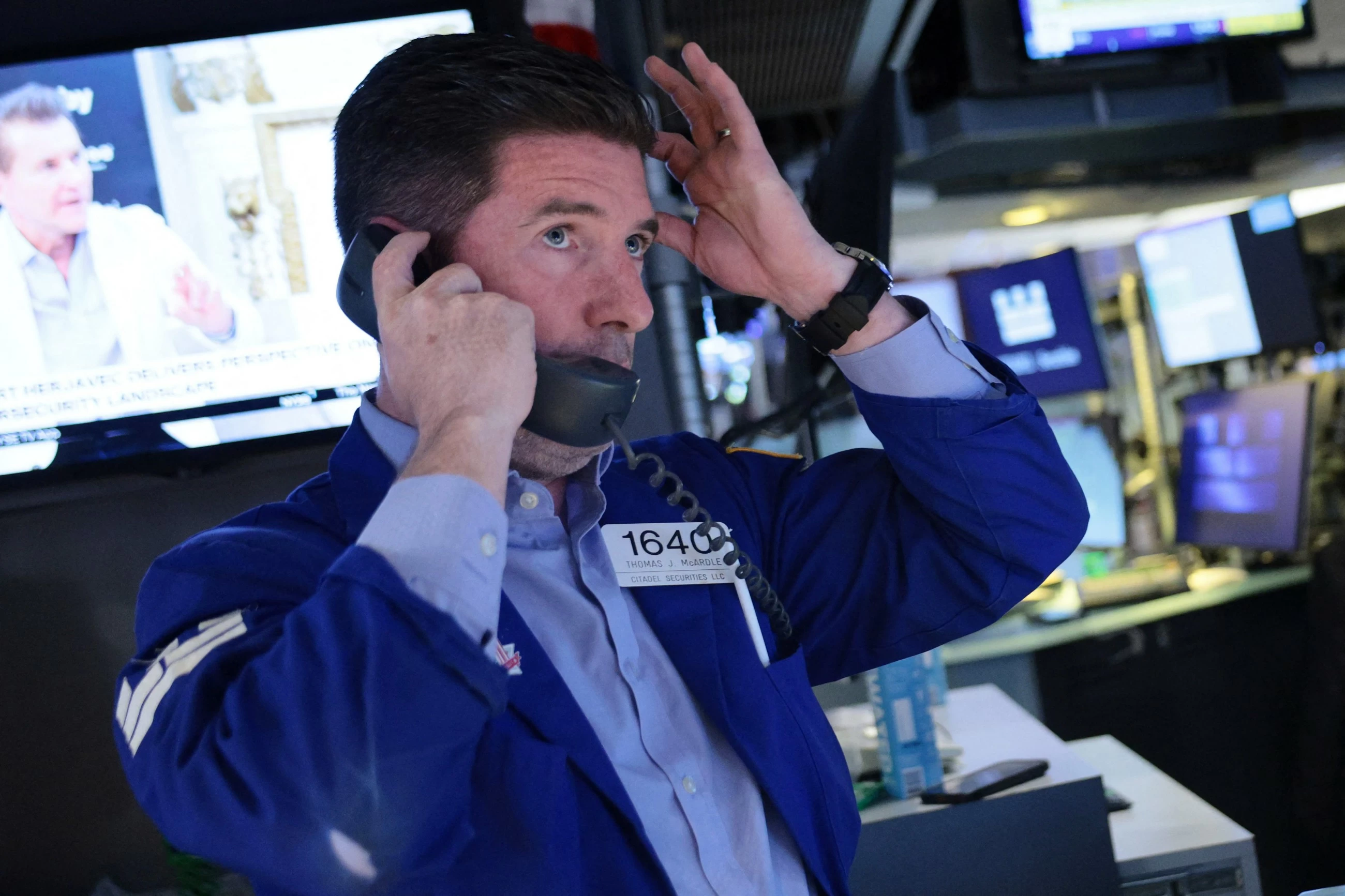
Oil prices surged back above $100 a barrel and stocks fell on Monday as investors awaited a looming US deadline on a blockade of the Strait of Hormuz, ratcheting up fears for Middle East energy supplies.
The resurgent geopolitical tensions come after ceasefire talks between Washington and Iran broke down over the weekend, dousing hopes for a lasting end to a war that has threatened economies worldwide.
Traders say the prospect of widespread inflation from spiking oil prices and supply disruptions has also put a focus on corporate earnings, with a range of blue chips this week starting to report first-quarter results.
On Friday, the US reported that its consumer price index climbed to 3.3 per cent in March, the highest level since May last year.
“The stagflation word is being widely aired once again as geopolitical turmoil threatens to stymie international growth and stoke inflationary pressures,” said Russ Mould, investment director at AJ Bell.
Such concerns have increased with the United States set at 1400 GMT on Monday to begin a partial blockade of the Strait of Hormuz, through which one-fifth of the world’s oil and gas passes.
“The blockade will be enforced impartially against vessels of all nations entering or departing Iranian ports and coastal areas, including all Iranian ports on the Arabian Gulf and Gulf of Oman,” US Central Command posted on X.
The threat comes as Tehran has already effectively closed the Strait of Hormuz to oil and other traffic since the start of US-Israel strikes on Iran in late February.
World oil prices jumped around seven per cent Monday, while stocks on Wall Street opened lower, in line with losses across Asia and Europe.
“Reopening the Strait of Hormuz remains the key requirement for reigniting a sustainable rally across risk assets,” said David Morrison, an analyst at Trade Nation.
“Yet there’s also a conviction, rightly or wrongly, that the war will end relatively soon,” he said, noting that oil futures contracts for deliveries later this year are currently priced well below current market prices.
“As far as oil traders are concerned, this war may be in its seventh week, but it should be resolved by summer,” Morrison said.
But Chancellor Friedrich Merz warned Monday that Germany, Europe’s biggest economy, would feel the effects of the energy shock from the war “for a long time to come, even after it is over”, as his government announced relief measures including a fuel-tax cut.
In Hungary, stocks rallied after conservative Peter Magyar won a thumping majority in parliamentary elections Sunday, ousting Prime Minister Viktor Orban after 16 years in power and opening the way to improved relations with the European Union. The BUX index in Budapest was up more than three per cent.
Economists at ING said that alongside economic reforms, Hungary’s new pro-Europe government could set a target date for adopting the euro.
“If timed perfectly, this could boost market confidence and give the Tisza party more time to work on the Hungarian economy with some tailwinds,” they wrote in a research note.
China and Hong Kong stocks closed flat on Monday as the collapse of U.S.-Iran peace talks dampened risk appetite across the region.
The Shanghai Composite Index gained less than 0.1% to 3,988.56 at market close, and the blue-chip CSI300 Index added 0.2%, both clawing back from steep losses at the opening hour.
Hong Kong’s benchmark Hang Seng lost 0.9% to 25,660.85. The Hang Seng Tech Index was down 0.8%.
Around the region, MSCI’s Asia ex-Japan stock index was 0.8% lower.
The US military said it would begin a blockade of all maritime traffic entering and exiting Iranian ports and coastal areas on Monday after weekend talks failed to reach a deal to end the war in Iran, jeopardizing a fragile two-week ceasefire.
“Ongoing geopolitical tensions are making it hard for the market to break out of its current slump,” analysts at Soochow Futures wrote in a note. “High volatility and choppy, range-bound trading are likely to persist for the near term.” ** Still, China’s domestic economic recovery remained intact with factory-gate prices rising for the first time in more than three years in March, they added.
Investors are also awaiting key China macro data releases this week, including trade data on Tuesday, March credit figures and Q1 real GDP.
“China looks relatively attractive given the domestically orientated nature of its economy and equity markets, as well as valuations and risks to current earnings expectations,” analysts at BNP Paribas said in a note.
“If the situation remains uncertain and energy prices stay elevated, then we would expect this outperformance to continue.” ** Among winning sectors, the CSI New Energy Index added 1.9% and the CSI New Energy Vehicle Index climbed 1.7%. The CSI 300 Energy Index gained 0.5%.
Weighing on the markets, the CSI Oil and Gas Industry Sub Index lost 0.9%, while liquor makers were down 0.5%.
Agencies